Unitree G1 Robot Climbs 6,000-Meter Peak
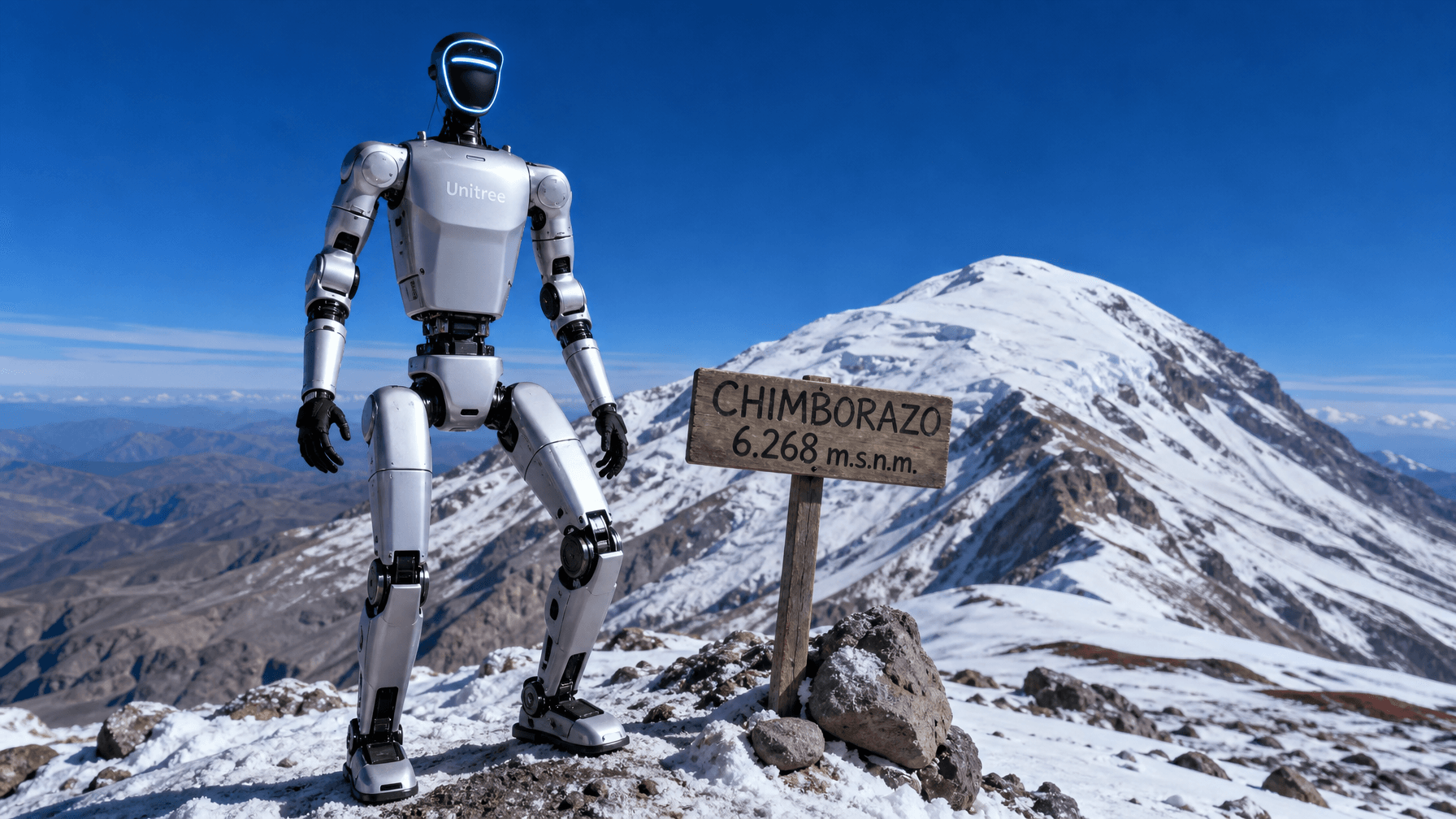
💡See how embodied AI and legged robotics are conquering extreme environments, signaling a leap in hardware durability.
⚡ 30-Second TL;DR
What Changed
Unitree G1 humanoid robot reached 6,310 meters altitude
Why It Matters
This achievement proves that humanoid robots are moving from controlled lab environments to real-world, rugged terrains. It opens new possibilities for autonomous exploration in hazardous areas.
What To Do Next
Analyze the locomotion control strategies used in the Unitree G1 to improve your own robot's stability in unstructured environments.
Key Points
- •Unitree G1 humanoid robot reached 6,310 meters altitude
- •Demonstrates advanced legged locomotion in extreme terrain
- •Potential applications include environmental monitoring and high-altitude exploration
🧠 Deep Insight
AI-generated analysis for this event — not the original article.
🔑 Enhanced Key Takeaways
- •The robot, named Pemba, was specifically equipped with specialized crampons and reinforced joints to handle the icy, uneven terrain of the Chimborazo volcano.
- •The mission was part of a collaborative research initiative between Unitree and high-altitude mountaineering experts to test the limits of autonomous navigation in low-oxygen, sub-zero environments.
- •Data collected during the ascent included real-time atmospheric pressure, temperature fluctuations, and terrain stability analysis, which were transmitted back to base camp via satellite link.
- •The G1 model utilized for this expedition featured an upgraded thermal management system to prevent battery degradation and actuator freezing at altitudes exceeding 6,000 meters.
- •This achievement marks the first time a mass-produced humanoid robot has successfully navigated a high-altitude peak without human intervention for the majority of the climb.
📊 Competitor Analysis▸ Show
| Feature | Unitree G1 (Pemba) | Boston Dynamics Atlas (Electric) | Tesla Optimus Gen 2 |
|---|---|---|---|
| Target Market | Research/Industrial | Industrial/R&D | Consumer/Manufacturing |
| Weight | ~35kg | ~80kg (est) | ~57kg |
| High-Altitude Capability | Validated (6,310m) | Not publicly tested | Not publicly tested |
| Pricing | ~$16,000 (Base) | N/A (R&D) | ~$20,000 (Target) |
🛠️ Technical Deep Dive
- Actuation: Uses high-torque density joint motors with integrated planetary gearboxes designed for high-frequency response.
- Navigation: Employs a multi-modal sensor suite including 3D LiDAR, depth cameras, and IMU-based odometry for terrain mapping.
- Power: High-energy-density lithium-ion battery pack with active thermal insulation layers.
- Software: Runs on a real-time operating system (RTOS) with proprietary reinforcement learning algorithms for adaptive gait control on loose scree and ice.
- Structural: Chassis constructed from aerospace-grade aluminum and carbon fiber composites to minimize weight while maintaining structural integrity.
🔮 Future ImplicationsAI analysis grounded in cited sources
⏳ Timeline
Weekly AI Recap
Read this week's curated digest of top AI events →
👉Related Updates



AI-curated news aggregator. All content rights belong to original publishers.
Original source: Pandaily ↗
This is a summary, not the original. Read the source, or get the weekly briefing.
Weekly AI briefing
One email a week. Unsubscribe anytime.