Unitree and the Embodied AI Funding Reality Check
💡Embodied AI funding is cooling—learn what investors may now demand from robotics startups.
⚡ 30-Second TL;DR
What Changed
Unitree is positioned as a potential flagship company in embodied AI.
Why It Matters
A more disciplined funding environment could favor robotics companies with demonstrable products, deployment data, and sustainable unit economics. For AI founders, the story signals that hardware capability alone may no longer be enough to attract capital.
What To Do Next
Review Unitree's publicly available SDK and run a small simulation-to-real deployment test before considering the platform for an embodied-AI prototype.
Key Points
- •Unitree is positioned as a potential flagship company in embodied AI.
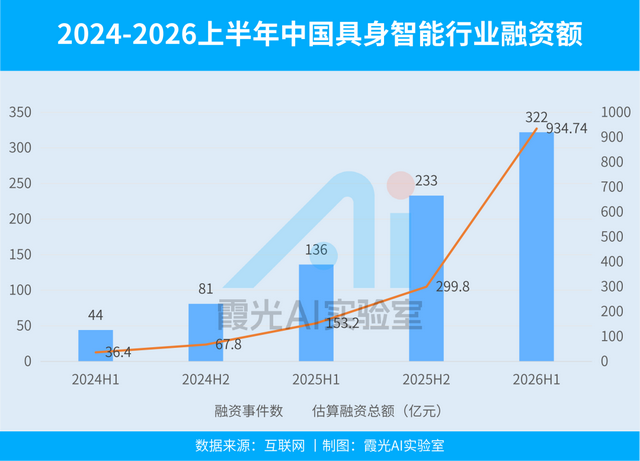
- •The sector has attracted approximately 93.5 billion yuan in funding.
- •Embodied-AI financing is shifting from speculative enthusiasm toward rational evaluation.
🧠 Deep Insight
Web-grounded analysis with 24 cited sources.
🔑 Enhanced Key Takeaways
- •The embodied AI market funding accelerated sharply in 2026, with year-to-date funding reaching approximately $5.60 billion by early July, marking a 6.7x increase over the comparable period in 2025.
- •Funding in the embodied AI sector is consolidating around fewer, larger investment rounds, with 12 out of 14 deals in the first half of 2026 exceeding $100 million, and the top 5 deals accounting for 74.4% of the total capital.
- •The embodied AI market is transitioning from a formation stage to a scale-up market, with late-stage capital (Series B and later) comprising about $4.12 billion, or 73.5% of total funding, in year-to-date 2026.
- •Unitree Robotics successfully completed its Initial Public Offering (IPO) on the Shanghai Stock Exchange's STAR Market on August 19, 2026, becoming the "first A-share humanoid robot stock" and seeing its shares surge nearly 500% on the first day of trading.
- •Unitree reported substantial financial growth in 2025, with revenue soaring to approximately 1.7 billion yuan and a net profit of nearly 600 million yuan, while its bipedal humanoid robot shipments exceeded 5500 units, making it the world's largest humanoid robot maker by sales in 2025.
🛠️ Technical Deep Dive
- Unitree H1 Humanoid Robot:
- Dimensions & Weight: Approximately 180 cm tall and 47 kg (H1), or 178 cm tall and 70 kg (H1-2).
- Degrees of Freedom (DOF): 19 for H1, expandable to 27 for H1-2.
- Sensors: Integrated 3D LiDAR (LIVOX-MID360) and Intel RealSense D435i depth camera for 360° perception.
- Actuators: Self-developed high-torque permanent magnet synchronous motors (PMSMs); max knee torque ~360 N·m, hip joint torque ~220 N·m, arm joint torque ~75 N·m (H1) or 120 N·m (H1-2). Peak torque density of 189 N·m/kg.
- Mobility: Achieves a moving speed of 3.3 m/s (world record for humanoids), with potential for over 5 m/s.
- Battery: Quick-release 864 Wh lithium-ion battery.
- Onboard Computing: Intel i5/i7 for H1, NVIDIA Jetson Orin (100 TOPS) for H1-2.
- Software: Supports ROS 2, Python, and C++ SDK.
- Design: Features hollow electrical routing for internal cabling.
- Unitree G1 Humanoid Robot:
- Dimensions & Weight: Approximately 1.20-1.32 m tall and 35 kg.
- Degrees of Freedom (DOF): Ranges from 23 (base model) to 43 (EDU Ultimate version), including 6 per leg, 5 per arm, and waist, with options for multi-jointed hands.
- Actuators: High-torque permanent magnet synchronous motors (PMSMs); knee actuators can deliver up to 120 N·m of torque (EDU Ultimate).
- Onboard Computing: 8-core high-performance CPU; EDU versions include Jetson Orin NX 16GB (100 TOPS).
- Sensors: Equipped with a depth camera (Intel RealSense D435) and 3D LiDAR (LIVOX-MID360).
- Mobility: Can walk at speeds up to 2 m/s (7.2 km/h).
- Battery: Rechargeable 13-cell lithium-ion battery (9000 mAh), providing roughly 2 hours of operation.
- Control: Utilizes imitation and reinforcement learning, with force-position hybrid control for dexterous hands.
- Connectivity: Features Wi-Fi 6 and Bluetooth 5.2.
- Design: Foldable structure for easier transport.
- Unitree Go1 Quadruped Robot:
- Dimensions & Weight: 588 × 220 × 290 mm (standing), weighs approximately 12 kg.
- Top Speed: 4.7 m/s.
- Payload Capacity: Approximately 3–5 kg.
- Battery: 6,000 mAh Li-ion, offering 1–2.5 hours of endurance.
- Operating System: Linux (Ubuntu) with ROS support.
- Interfaces: Wi-Fi, Ethernet, USB, GPIO, CAN.
- Sensors: Multiple depth cameras, ultrasonic sensors, foot force sensors, and IMU.
- AI: Onboard edge AI with a 16-core CPU and a 384-core GPU (1.5 TFLOPS).
- Features: Includes an Intelligent Side-Follow System (ISS).
- Degrees of Freedom: 12.
- Unitree B1 Industrial Quadruped Robot:
- Dimensions & Weight: 1102 × 461 × 700 mm, weighs approximately 40-50 kg with battery.
- Payload Capacity: Up to 20 kg walking (continuous), up to 80-104 kg standing.
- Max Speed: 1.5-2 m/s.
- Endurance: 3-5 hours (up to 2-2.5 hours walking, 5 hours standing).
- IP Rating: IP67 standard, with optional IP68 for higher water resistance.
- Actuators: 12 joints (3 per leg) with industrial-grade servo motors; max knee joint torque of 210 N·m.
- Onboard Computing: Equipped with three NVIDIA Jetson Xavier NX modules.
- Sensors: Five Intel RealSense D430 depth cameras, two terrain sensors, foot force sensors, and optional LiDAR.
- Connectivity: Built-in 4G module (including GNSS), Ethernet, USB, RS-485, and CAN interfaces.
- Software: Open-source system with full high-level and low-level control, ROS-compatible architecture.
🔮 Future ImplicationsAI analysis grounded in cited sources
⏳ Timeline
📎 Sources (24)
Factual claims are grounded in the sources below. Forward-looking analysis is AI-generated interpretation.
- newmarketpitch.com
- 36kr.com
- straitstimes.com
- ynetnews.com
- bidyutinnovation.com
- stemfinity.com
- botinfo.ai
- unitree.com
- robozaps.com
- robostore.com
- fandom.com
- generationrobots.com
- unitree.com
- humanoid.guide
- maverickdrone.com
- wevolver.com
- unitree.com
- trossenrobotics.com
- unitree.com
- rbtx.co.uk
- robotsasia.com
- trossenrobotics.com
- top3dshop.com
- maverickdrone.com
Weekly AI Recap
Read this week's curated digest of top AI events →
👉Related Updates

AI-curated news aggregator. All content rights belong to original publishers.
Original source: 钛媒体 ↗
Weekly AI briefing
One email a week. Unsubscribe anytime.