Baidu搭子追赶WorkBuddy:不只拼执行
💡As generation gets cheaper, trustworthy verification may become the real moat for AI assistants.
⚡ 30-Second TL;DR
What Changed
Baidu 搭子 is positioned as a competitor to WorkBuddy.
Why It Matters
This signals a shift in AI assistant competition from simply doing more work to producing trustworthy outcomes. Builders may need to invest more in evaluation, citations, human review, and quality-control workflows.
What To Do Next
Add citation checks, structured validators, and human-review sampling to your Baidu 搭子 or WorkBuddy prototype before expanding task coverage.
Key Points
- •Baidu 搭子 is positioned as a competitor to WorkBuddy.
- •Lower generation costs are shifting differentiation toward output verification.
- •AI assistants need to prove result quality, reliability, and usefulness beyond task completion.
🧠 Deep Insight
Web-grounded analysis with 25 cited sources.
🔑 Enhanced Key Takeaways
- •Baidu Dazi recently integrated its internal office AI agent, Dodo, to unify internal and external AI office offerings, enhancing capabilities in meeting management, knowledge base access, and R&D collaboration.
- •WorkBuddy, developed by Tencent, is an agentic AI workspace designed for end-to-end complex office tasks, capable of multi-agent orchestration and local file access.
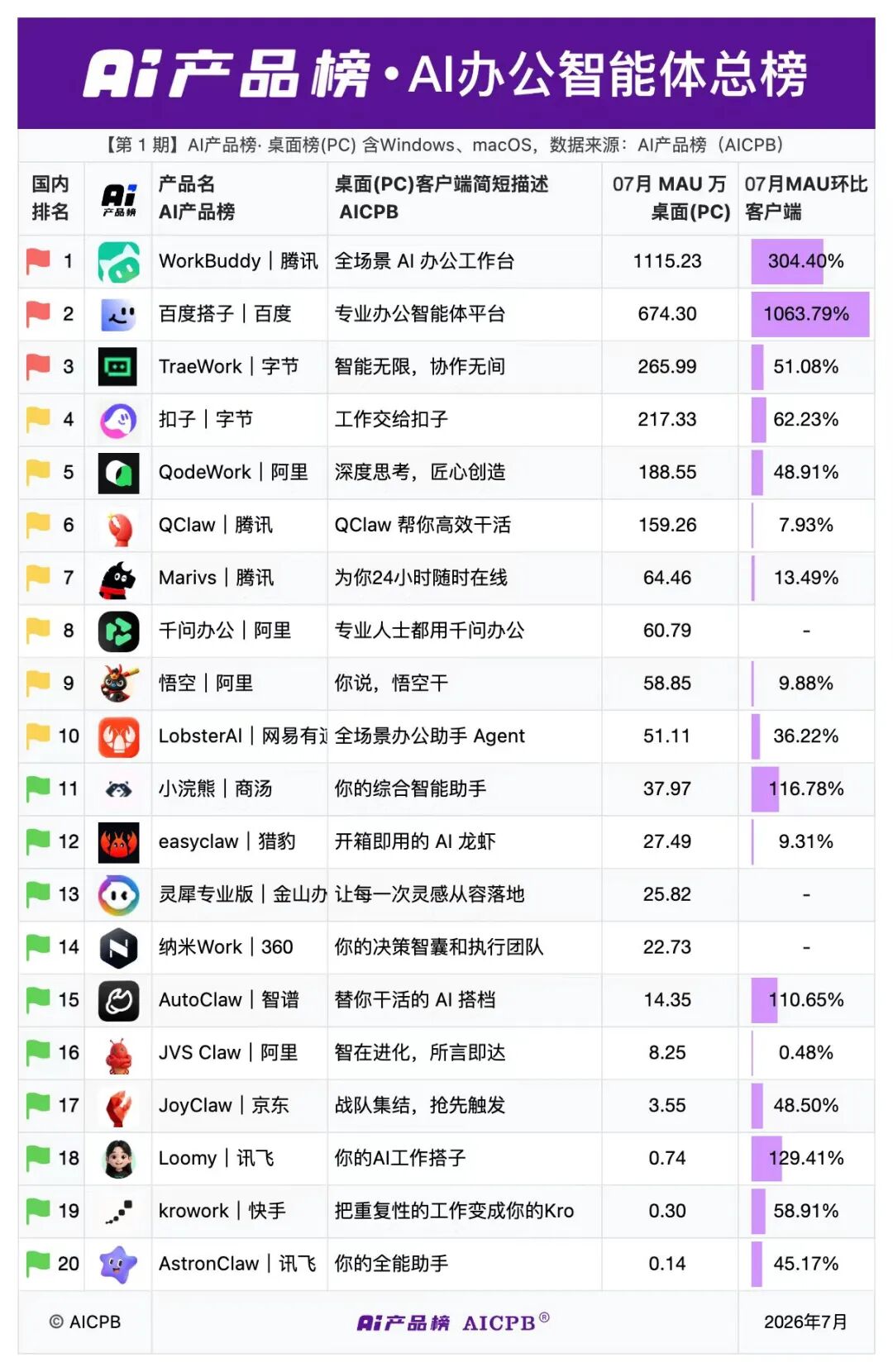
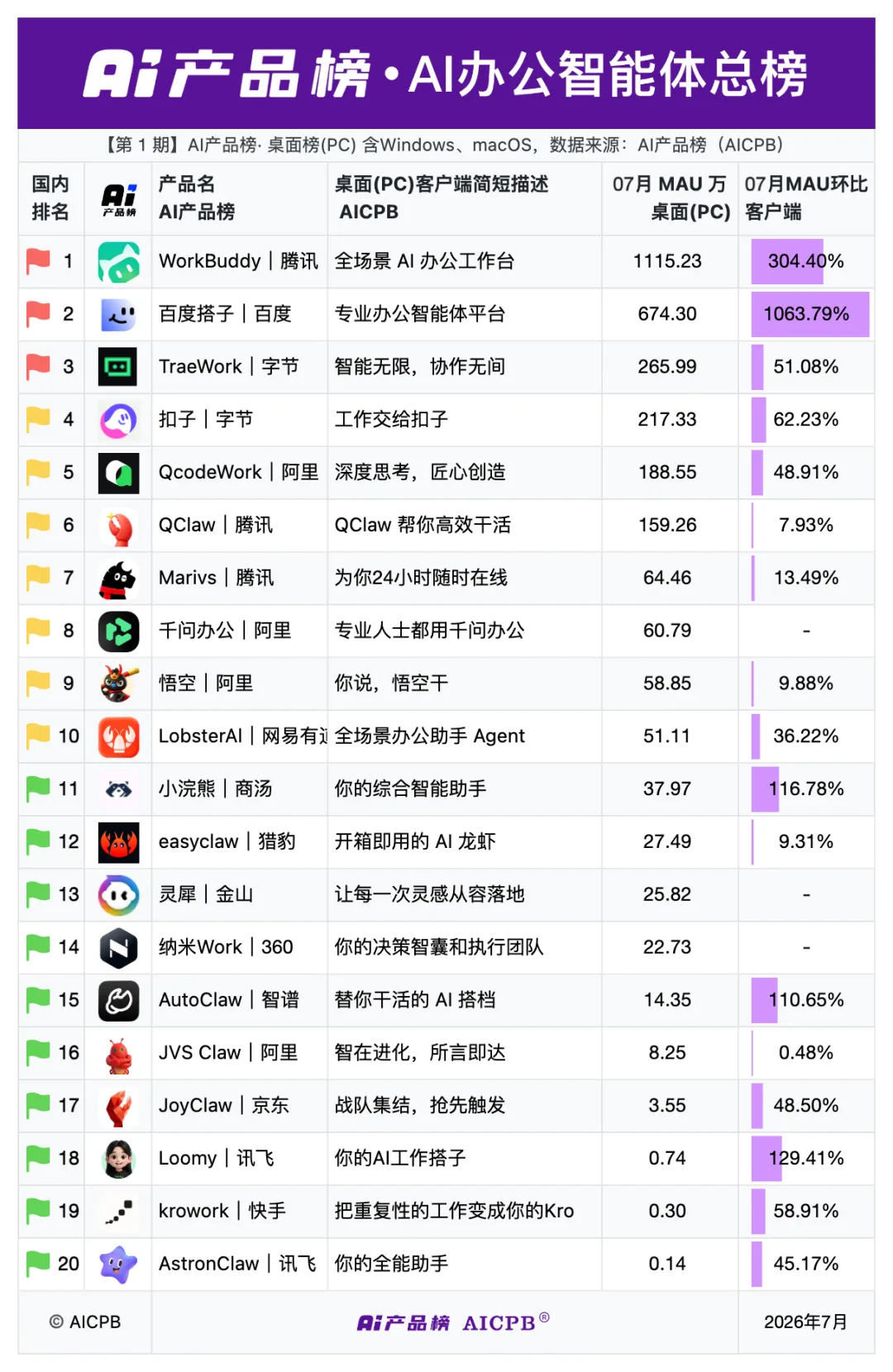
- •In July 2026, WorkBuddy led the China AI office desktop market with 11.15 million monthly active users (MAU), while Baidu Dazi showed the highest growth rate at 1,063.79% month-over-month, reaching 6.74 million MAU.
- •The broader shift in AI product differentiation is increasingly driven by the need for reliability, with surveys indicating that reliability issues are the biggest barrier to enterprise adoption of AI agents.
- •Baidu Dazi incorporates smart routing to automatically select between cloud sandbox, local sandbox, or chat mode based on task requirements, which has reportedly reduced average task completion time by 20% and improved token utilization by 25%.
📊 Competitor Analysis▸ Show
| Feature/Category | Baidu 搭子 (Dazi) |
|---|---|
| Core Functionality | Intelligent agent platform for personal and enterprise office scenarios, capable of task decomposition, information search, document processing, web operations, and result delivery. Supports continuous task execution across files and applications. |
| Underlying Models | Built on Baidu's ERNIE series of large language models (e.g., ERNIE 4.5, X1). |
| Key Features | Browser-controlled tasks, cross-device memory, smart routing (cloud sandbox, local sandbox, chat mode), self-media suite, enterprise features like shared workspaces, organizational roles, permission management, reusable team assets, usage controls, and auditable records. Offers automated data cleaning, multi-table correlation analysis, and intelligent report generation. |
| Integrations | Integrates with Baidu Search, Baidu Netdisk, Baidu Maps, Baidu Ability Reach, and Woodcutting Solutions. |
| Pricing (Enterprise) | ¥189/seat/month, includes 25,000 resource points/seat/month. Enterprise increment package: ¥1500 for 250,000 resource points. |
| Market Performance (July 2026) | 6.74 million MAU, 1,063.79% month-over-month growth (highest in market). |
| Competitor: WorkBuddy (Tencent) | |
| Core Functionality | Agentic AI workspace for end-to-end complex office work, interpreting goals, building multi-step plans, calling tools, and returning ready-to-use outputs. |
| Underlying Models | Supports multi-model flexibility, allowing users to connect various large language models via API keys. |
| Key Features | Multi-agent orchestration, local file access, broad ecosystem integrations (GitHub, Jira, Notion, Google Drive, Slack, Telegram, Discord, WeChat, Enterprise WeChat, QQ, DingTalk, Feishu). Includes Work Mode (document generation, data analysis, presentations, reports, research, email drafting) and Coding Mode (code generation, review, bug fixing). Deeply integrates Tencent Docs for knowledge management. |
| Integrations | Slack, Telegram, Discord, WeChat Assistant Bot, Enterprise WeChat (WeCom), QQ, Yuanbao Pai, DingTalk, Feishu, GitHub, Jira, Notion, Google Drive, Tencent Docs. |
| Pricing (Individual/Team) | Free tier for evaluation. Pro plan: $9.95/month (billed annually) or ~$19.90/month (monthly), includes 1,000 Credits/month. Team plan: $40/seat/month, includes 1,000 Credits/seat/month (pooled), Admin Console, unified billing, IDE/CLI/plugin support. Enterprise plan: Custom quote. |
| Market Performance (July 2026) | 11.15 million MAU (market leader), 304.4% month-over-month growth. |
🛠️ Technical Deep Dive
- Baidu Dazi:
- Powered by Baidu's ERNIE series of large language models, such as ERNIE 4.5 and X1, which offer multimodal capabilities (text, images, audio, video) and advanced reasoning.
- Employs a hybrid approach combining deep learning with structural knowledge mapping, leveraging Baidu's proprietary knowledge graphs to reduce hallucinations and ground responses in verified data.
- Utilizes continual multi-paradigm learning, trained on document reading, dialogue interactions, and search engine query logs to understand user intent.
- Features smart routing to dynamically select between cloud sandbox, local sandbox, or chat mode based on task requirements, optimizing for compute, latency, or data security.
- Includes built-in security sandboxes to isolate data and operations within the user's local device, ensuring data privacy and security.
- WorkBuddy (Tencent):
- Designed with a multi-agent orchestration architecture, allowing parallel sub-agents to collaborate on complex tasks (e.g., researching, coding, writing) and deliver integrated outputs.
- Supports multi-model flexibility, enabling users to connect various large language models via API keys to optimize for cost, performance, or specific use cases.
- Operates with a desktop access layer (global shortcut, screenshot capture, file upload) and a context-aware layer that can read content from active editors, terminals, notes, or connected data sources.
- Incorporates features like multi-turn conversation, streaming, deep thinking, multimodal understanding, context caching, context management, and tool calling to facilitate complex task execution.
- Offers local desktop execution capabilities, allowing on-device processing of spreadsheets and documents without mandatory cloud uploads.
🔮 Future ImplicationsAI analysis grounded in cited sources
⏳ Timeline
📎 Sources (25)
Factual claims are grounded in the sources below. Forward-looking analysis is AI-generated interpretation.
Weekly AI Recap
Read this week's curated digest of top AI events →
👉Related Updates



AI-curated news aggregator. All content rights belong to original publishers.
Original source: 钛媒体 ↗