Unconventional AI Launches Model with Oscillator Architecture
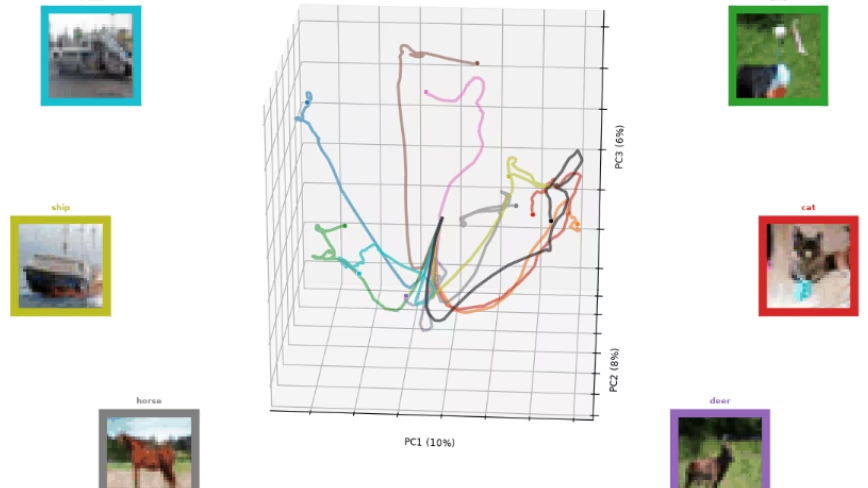
A potential 1,000x reduction in AI power consumption could redefine hardware requirements for future AI models.
30-Second TL;DR
What Changed
Un-0 model achieves performance comparable to state-of-the-art diffusion models.
Why It Matters
If validated, this architecture could fundamentally change the economics of AI inference by drastically lowering energy costs for large-scale deployments.
What To Do Next
Monitor the research paper for benchmarks on energy efficiency versus standard GPU-based inference.
Key Points
- •Un-0 model achieves performance comparable to state-of-the-art diffusion models.
- •Utilizes a proprietary oscillator computing architecture.
- •Potential to reduce AI power consumption by 1,000x.
Deep Insight
AI-generated analysis for this event — not the original article.
Enhanced Key Takeaways
- •Unconventional AI's oscillator architecture draws inspiration from biological neural systems, specifically mimicking the rhythmic firing patterns of neurons rather than relying on static matrix multiplication.
- •The Un-0 model utilizes a specialized hardware-software co-design approach, requiring custom silicon or FPGA emulation to achieve the claimed power efficiency gains.
- •The company was founded by former researchers from leading AI labs who pivoted from traditional Transformer architectures to focus on neuromorphic-inspired computing.
- •Early benchmarks suggest that while Un-0 excels in energy efficiency, it currently faces challenges in maintaining high-fidelity generation speeds for extremely high-resolution images compared to GPU-accelerated diffusion models.
- •The proprietary oscillator framework operates on a continuous-time signal processing paradigm, allowing the model to process data streams with lower latency than discrete-time digital neural networks.
Competitor Analysis
- Unconventional AI (Un-0)
- Oscillator-based
- Traditional Diffusion Models (e.g., Stable Diffusion)
- Transformer/U-Net
- Neuromorphic AI (e.g., Intel Loihi 2)
- Spiking Neural Network
- Unconventional AI (Un-0)
- Extremely High (1000x claim)
- Traditional Diffusion Models (e.g., Stable Diffusion)
- Baseline
- Neuromorphic AI (e.g., Intel Loihi 2)
- High
- Unconventional AI (Un-0)
- Proprietary/Custom
- Traditional Diffusion Models (e.g., Stable Diffusion)
- Standard GPU (NVIDIA)
- Neuromorphic AI (e.g., Intel Loihi 2)
- Specialized Neuromorphic Chips
- Unconventional AI (Un-0)
- Emerging/Experimental
- Traditional Diffusion Models (e.g., Stable Diffusion)
- Industry Standard
- Neuromorphic AI (e.g., Intel Loihi 2)
- Research/Early Commercial
| Feature | Unconventional AI (Un-0) | Traditional Diffusion Models (e.g., Stable Diffusion) | Neuromorphic AI (e.g., Intel Loihi 2) |
|---|---|---|---|
| Architecture | Oscillator-based | Transformer/U-Net | Spiking Neural Network |
| Power Efficiency | Extremely High (1000x claim) | Baseline | High |
| Hardware Dependency | Proprietary/Custom | Standard GPU (NVIDIA) | Specialized Neuromorphic Chips |
| Maturity | Emerging/Experimental | Industry Standard | Research/Early Commercial |
Technical Deep Dive
- Architecture relies on coupled oscillators where information is encoded in the phase and frequency of signals rather than binary activations.
- Employs a non-von Neumann computing paradigm to minimize data movement between memory and processing units.
- The oscillator nodes utilize analog-like dynamics to perform complex mathematical operations through natural physical resonance.
- Training involves a modified backpropagation algorithm adapted for continuous-time dynamical systems to stabilize convergence.
- The system architecture significantly reduces the need for high-precision floating-point arithmetic, favoring low-precision phase-based computation.
Future ImplicationsAI analysis grounded in cited sources
Timeline
- 2024-03Unconventional AI founded to explore non-traditional neural architectures.
- 2025-09Successful demonstration of prototype oscillator-based logic gates.
- 2026-06Official release of the Un-0 image generation model.
Weekly AI Recap
Read this week's curated digest of top AI events →
Related Updates

AI-curated news aggregator. All content rights belong to original publishers.
Original source: The Next Web (TNW) ↗
This is a summary, not the original. Read the source, or get the weekly briefing.
The weekly digest
One email a week. Unsubscribe anytime.