Japan Plans $140B AI Data Centre Expansion
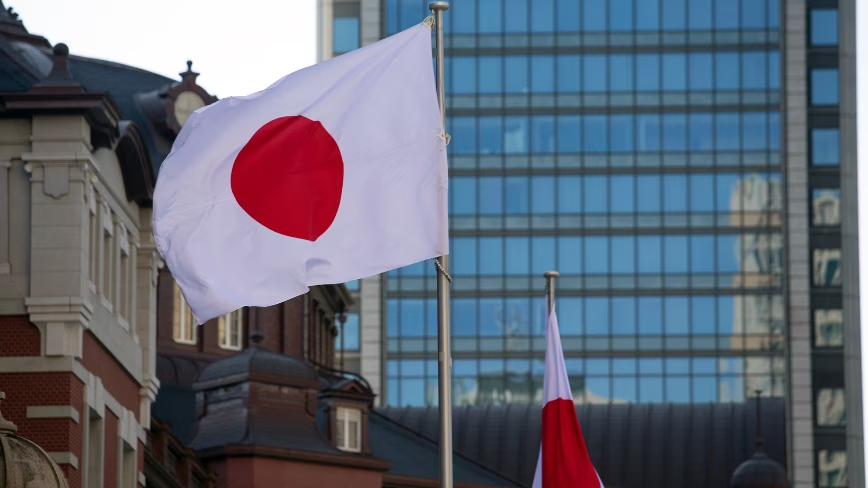
A potential $140B build-out could reshape Japan’s AI compute, power and infrastructure market.
30-Second TL;DR
What Changed
JERA, Dell and RHAELM signed a non-binding development agreement.
Why It Matters
A build-out at this scale could materially increase Japan’s AI compute capacity and demand for power, networking and cooling. Because the agreement is non-binding, financing and execution risks remain significant.
What To Do Next
Evaluate Japan-based power, connectivity and GPU-hosting options before committing to regional AI workloads.
Key Points
- •JERA, Dell and RHAELM signed a non-binding development agreement.
- •The proposed nationwide build-out could require up to $140 billion.
- •Apollo will help finance the project through RHAELM’s funding structure.
Deep Insight
Background and context from public sources — not the original article. 2 sources cited.
Enhanced Key Takeaways
- •The maiden project is a 400 MW AI data centre located in Chiba Prefecture, carrying an estimated cost of over $15 billion (¥2.3 trillion) across all development phases.
- •The Chiba site utilizes a 'behind-the-meter' architecture directly linked to an adjacent JERA gas-fired power station to circumvent multi-year public electrical grid interconnection backlogs.
- •The technical roles allocate on-site power, land, and cooling provision to JERA, pre-configured AI server racks and compute hardware to Dell Technologies, and facility construction and system architecture to RHAELM.
- •The consortium's broader roadmap targets between 3 GW and 4 GW of dedicated AI computing and accompanying gas-fired power capacity deployed across Japan by the 2030s.
- •The strategic expansion comes in response to warnings from Japan's Digital Ministry regarding compute sovereignty, aiming to prevent the nation from becoming an 'AI colony' dependent on foreign infrastructure.
Competitor Analysis
- Targeted Investment
- Up to $140B over 5 years
- Power / Capacity Strategy
- 3-4 GW target; 400 MW maiden site; Direct behind-the-meter gas-fired power
- Technical & Infrastructure Partners
- Dell (AI servers/hardware), JERA (power/cooling), RHAELM (site build/architecture), Apollo (financing)
- Targeted Investment
- $30B committed
- Power / Capacity Strategy
- Multi-site digital infrastructure buildout across Japan
- Technical & Infrastructure Partners
- Internal portfolio data centre platforms
- Targeted Investment
- Multi-billion multi-gigawatt pipeline
- Power / Capacity Strategy
- Sovereign data centre networks utilizing public utility and domestic grid links
- Technical & Infrastructure Partners
- Domestic telecoms, public grid interconnects, global GPU vendors
| Consortium / Investor | Targeted Investment | Power / Capacity Strategy | Technical & Infrastructure Partners |
|---|---|---|---|
| JERA / Dell / RHAELM | Up to $140B over 5 years | 3-4 GW target; 400 MW maiden site; Direct behind-the-meter gas-fired power | Dell (AI servers/hardware), JERA (power/cooling), RHAELM (site build/architecture), Apollo (financing) |
| Blackstone | $30B committed | Multi-site digital infrastructure buildout across Japan | Internal portfolio data centre platforms |
| SoftBank / NTT Data | Multi-billion multi-gigawatt pipeline | Sovereign data centre networks utilizing public utility and domestic grid links | Domestic telecoms, public grid interconnects, global GPU vendors |
Technical Deep Dive
- Maiden Facility Scale: 400-megawatt (MW) total capacity across phased development in Chiba Prefecture, east of Tokyo.
- Power Delivery Architecture: Direct 'behind-the-meter' electrical connection to JERA's co-located gas-fired generation plant, bypassing public grid transmission lines and connection delays.
- Compute and Hardware Layer: Dell Technologies supplies pre-configured, turnkey AI server racks and accelerated compute clusters.
- Facility & Site Engineering: RHAELM oversees site design, specialized cooling integration, and construction management alongside JERA's land and cooling asset footprint.
- Target Total Capacity: Long-term objective of 3 to 4 gigawatts (GW) of coupled gas-fired generation and dedicated AI computing.
Future ImplicationsAI analysis grounded in cited sources
Timeline
- 2026-10JERA, Dell, and RHAELM sign $140B non-binding agreement backed by Apollo
Sources (2)
Factual claims are grounded in the sources below. Forward-looking analysis is AI-generated interpretation.
Weekly AI Recap
Read this week's curated digest of top AI events →
Related Updates

AI-curated news aggregator. All content rights belong to original publishers.
Original source: The Next Web (TNW) ↗
This is a summary, not the original. Read the source, or get the weekly briefing.
The weekly digest
One email a week. Unsubscribe anytime.