UiPath CEO: Hiring Juniors is Crucial for AI Success
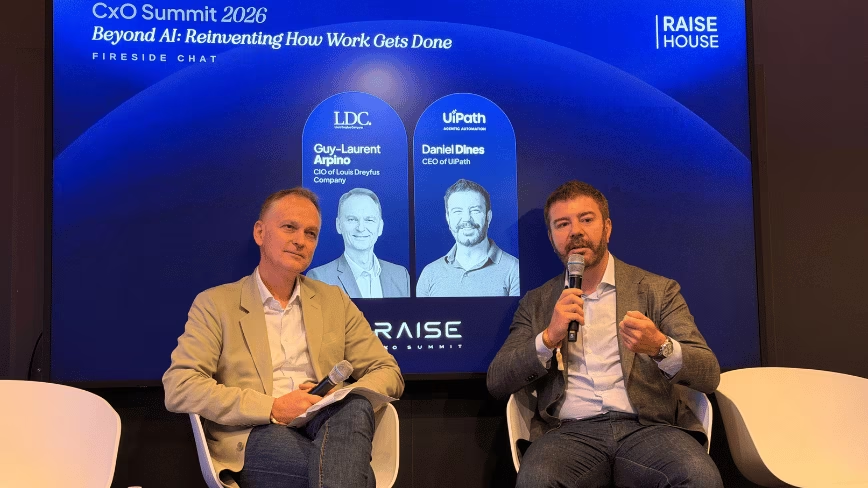
💡Learn why human talent, not just models, is the key to moving AI agents into production.
⚡ 30-Second TL;DR
What Changed
AI agents often stall in pilot phases
Why It Matters
This perspective challenges the 'AI replaces humans' narrative, suggesting that successful AI integration requires a robust team structure. It encourages a shift in hiring strategies for AI-focused enterprises.
What To Do Next
Evaluate your team composition; ensure you have enough junior engineers to handle the iterative testing required for moving AI pilots to production.
Key Points
- •AI agents often stall in pilot phases
- •Human talent is the bottleneck for production deployment
- •Dines advocates for hiring junior talent to scale AI
🧠 Deep Insight
AI-generated analysis for this event — not the original article.
🔑 Enhanced Key Takeaways
- •UiPath has been actively transitioning its platform from traditional Robotic Process Automation (RPA) to an 'Agentic Automation' framework, which requires a shift in workforce skill sets toward AI orchestration rather than just task recording.
- •Daniel Dines has highlighted that the 'last mile' of AI deployment often fails because legacy enterprise systems lack the structured data interfaces required for autonomous agents to operate reliably without human oversight.
- •UiPath's internal data suggests that companies with 'AI-native' junior hires achieve a 30% faster transition rate from pilot to production compared to those relying solely on upskilling existing legacy IT staff.
- •The company has launched specific educational initiatives, such as the UiPath Academy, to standardize the training of junior developers in 'Agentic Workflow Design,' a new discipline focused on human-in-the-loop AI management.
- •Market analysis indicates that UiPath is facing increased pressure to prove ROI on its AI investments, leading to this strategic pivot toward emphasizing human-capital-intensive deployment models over pure software-as-a-service (SaaS) scaling.
📊 Competitor Analysis▸ Show
| Feature | UiPath (Agentic Focus) | Microsoft (Power Automate) | Salesforce (Agentforce) |
|---|---|---|---|
| Core Strength | Specialized RPA/Agentic Orchestration | Ecosystem Integration | CRM-Centric AI Agents |
| Pricing Model | Consumption/Seat-based | Bundled with M365 | Usage-based/Platform fee |
| Deployment | High-touch/Hybrid | Low-code/Cloud-native | Low-code/Cloud-native |
🛠️ Technical Deep Dive
- UiPath's Agentic architecture utilizes a combination of Large Language Models (LLMs) and specialized 'Action Models' that translate natural language intents into API calls or UI interactions.
- The platform employs a 'Human-in-the-Loop' (HITL) framework where junior developers define 'guardrails' using YAML-based configurations to limit agent autonomy in production environments.
- Integration with enterprise systems is handled via 'UiPath Integration Service,' which provides pre-built connectors that normalize data from legacy ERP/CRM systems into JSON formats suitable for AI consumption.
- The system uses a proprietary 'Computer Vision' engine to interact with legacy desktop applications that lack modern APIs, allowing agents to 'see' and manipulate UI elements.
🔮 Future ImplicationsAI analysis grounded in cited sources
⏳ Timeline
Weekly AI Recap
Read this week's curated digest of top AI events →
👉Related Updates

AI-curated news aggregator. All content rights belong to original publishers.
Original source: The Next Web (TNW) ↗
This is a summary, not the original. Read the source, or get the weekly briefing.
Weekly AI briefing
One email a week. Unsubscribe anytime.