UBS: Chinese Tech Firms to Boost Overseas Revenue by 2030
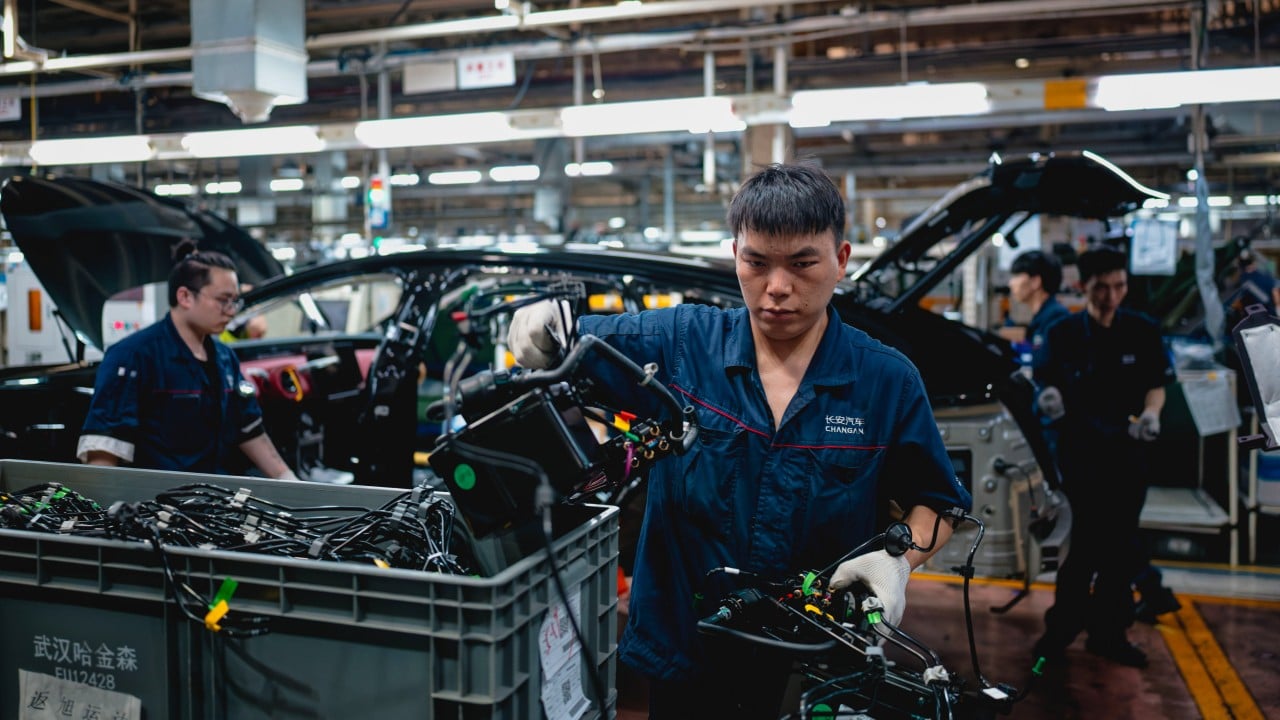
Understand how Chinese tech competitiveness is reshaping global market share in power and automotive sectors by 2030.
30-Second TL;DR
What Changed
Overseas revenue share for Chinese firms to hit 25% by 2030.
Why It Matters
The shift suggests a significant increase in global market penetration for Chinese tech-heavy industries, potentially altering competitive landscapes in international markets.
What To Do Next
Monitor the expansion strategies of Chinese EV and power-tech firms to identify potential partnership or competitive threats in your target market.
Key Points
- •Overseas revenue share for Chinese firms to hit 25% by 2030.
- •Growth is primarily fueled by advancements in power and carmaking technologies.
- •Current offshore revenue contribution stands at 18.7% as of last year.
- •Technological competitiveness is the primary catalyst for global expansion.
Deep Insight
Background and context from public sources — not the original article. 17 sources cited.
Enhanced Key Takeaways
- •The current wave of Chinese firms' global expansion is increasingly driven by 'bottom-up' profit motivations due to intense domestic market competition, shifting from previous 'top-down' policy pushes.
- •China's investment in research and development (R&D) reached 2.8% of its GDP last year (2025), surpassing the OECD average for the first time, with enterprises contributing 77.7% of the total R&D expenditure in 2024.
- •Chinese companies are evolving their overseas expansion into a 'Globalization Strategy 2.0 phase,' which emphasizes localizing operations and supply chains in international markets, including adopting a 'China plus One' model to diversify manufacturing beyond the home market.
- •Overseas markets are proving to be more profitable for Chinese firms, offering higher margins compared to the increasingly saturated domestic market.
- •China's clean technology exports, particularly electric vehicles (EVs) and batteries, reached a record high of $20 billion in August 2025, with significant growth observed in emerging markets across ASEAN, Africa, Latin America, and the Middle East.
Technical Deep Dive
- Chinese leadership in EV battery technology includes advancements in LFP (lithium iron phosphate) and sodium-ion battery roadmaps.
- Chinese BEVs achieved price parity with fossil fuel vehicles in 2024, accelerating their market penetration.
- China leads globally in ultra-high voltage (UHV) technology for power transmission, though this is primarily dominated by state-owned enterprises with limited overseas revenue.
- The Chinese power quality equipment market is projected to reach $7,246.6 million by 2030, with Uninterruptible Power Supply (UPS) being the largest and fastest-growing segment.
- Huawei is developing a proprietary 'LogicFolding' technology for 1.4-nanometer chips, with production planned by 2031, aiming to reduce the technology gap with global leaders.
- Exports of high-powered diesel generator sets from China, particularly those used for data centers, surged over 130% in the first two months of 2026, driven by global AI infrastructure demand.
Future ImplicationsAI analysis grounded in cited sources
Timeline
- 2001China joins the World Trade Organization (WTO), significantly accelerating its integration into global trade.
- 2003Overseas revenue contribution for mainland-listed non-financial firms was at a low point, from which the projected 25% by 2030 would be the highest level.
- 2017The Chinese government releases the 'New Generation Artificial Intelligence (AI) Development Plan,' encouraging its technology companies to pursue a 'going out' strategy.
- 2019China's per capita GDP surpasses $10,000, a threshold historically associated with a surge in businesses expanding overseas in developed countries.
- 2024Chinese battery electric vehicles (BEVs) achieve price parity with fossil fuel vehicles for the first time.
- 2025China's R&D to GDP ratio reaches 2.8%, exceeding the average of the Organisation for Economic Cooperation and Development (OECD) for the first time.
- 2025The share of overseas revenue for Chinese mainland-listed firms reaches a record high of nearly 17%.
Sources (17)
Factual claims are grounded in the sources below. Forward-looking analysis is AI-generated interpretation.
Weekly AI Recap
Read this week's curated digest of top AI events →
Related Updates



AI-curated news aggregator. All content rights belong to original publishers.
Original source: SCMP Technology ↗
This is a summary, not the original. Read the source, or get the weekly briefing.
The weekly digest
One email a week. Unsubscribe anytime.