Uber opens waitlist for Wayve robotaxis in London
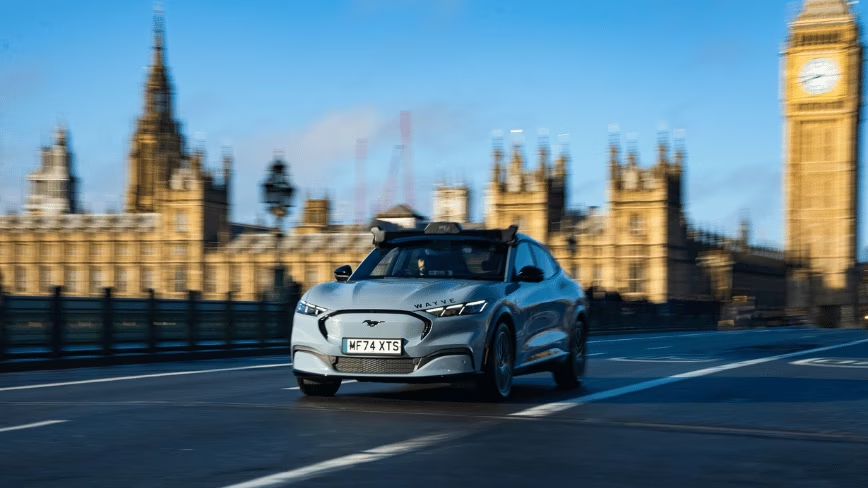
💡See how Uber is integrating Wayve's end-to-end AI driving tech into its global ride-hailing platform.
⚡ 30-Second TL;DR
What Changed
Uber and Wayve partnership brings robotaxis to London streets
Why It Matters
This move accelerates the adoption of autonomous transport in dense urban environments. It positions Uber as a primary aggregator for diverse autonomous driving technologies.
What To Do Next
Research Wayve’s 'AV2.0' approach to autonomous driving to understand how end-to-end learning is outperforming traditional modular stacks.
Key Points
- •Uber and Wayve partnership brings robotaxis to London streets
- •Waitlist is now open for users interested in autonomous rides
- •Wayve's technology is at the forefront of the UK's driverless vehicle development
🧠 Deep Insight
Background and context from public sources — not the original article. 21 sources cited.
🔑 Enhanced Key Takeaways
- •Wayve's core technology is an end-to-end deep learning and vision-based AI system that learns from camera data, distinguishing itself by not relying on detailed 3D maps or hand-coded rules, a strategy akin to Tesla's but designed to be vehicle-agnostic and mapless.
- •Uber's involvement extends beyond a partnership, as it invested an additional $300 million to specifically support Wayve's global robotaxi rollout, supplementing its participation in Wayve's $1.2 billion Series D funding round in February 2026.
- •The initial robotaxi services in London will utilize electric Ford Mustang Mach-E SUVs and will operate with a human safety operator present, with plans to transition to fully driverless operations at a later stage.
- •The UK's Automated Vehicles Act, enacted in 2024, provides the essential legal framework for these trials, aiming to facilitate the first pilots of automated passenger services on British roads as early as 2026.
- •Wayve has demonstrated the scalability of its AI by successfully driving in over 500 cities across Asia, Europe, and North America without requiring prior high-definition mapping for each location.
📊 Competitor Analysis▸ Show
| Feature/Company | Wayve | Waymo (Google) | Tesla (FSD) |
|---|---|---|---|
| Technology Approach | End-to-end deep learning, vision-based AI, Embodied AI | Classic robotics, 3D mapping, sensors, LiDAR | End-to-end neural stack (FSD v12), vision-only |
| Mapping Dependency | Mapless, learns from data | Relies on detailed 3D maps | Mapless, learns from data |
| Hardware Agnostic | Yes, vehicle and sensor agnostic | No, integrated hardware/software stack | No, proprietary to Tesla vehicles |
| Business Model | Licenses AI Driver software to OEMs and fleet operators | Operates its own robotaxi service, partners with ride-hailing platforms | Integrated into Tesla vehicles, subscription for FSD |
| Primary Focus | Global deployment of AI Driver for L2+ to L4 autonomy | Robotaxi operations in specific geofenced areas | Consumer vehicles (L2+), aiming for robotaxi |
| Key Markets (Current/Planned) | UK (London), Europe, US, Japan | US (e.g., Phoenix, San Francisco, Austin) | Global (Tesla vehicles), US (FSD beta) |
| Uber Partnership | Strategic investor and robotaxi deployment partner | Robotaxi partner in some US cities (e.g., Austin, Atlanta) | No direct partnership |
| Data Advantage | Data-driven, leverages real and simulated data, fleet learning | Extensive real-world driving data, simulation | Massive fleet data from millions of consumer vehicles |
🛠️ Technical Deep Dive
- End-to-End Deep Learning: Wayve's system is built on an end-to-end deep learning architecture, meaning a single neural network processes raw sensor inputs (primarily camera data) directly into driving outputs, such as steering and acceleration.
- Vision-Based AI: The primary input for Wayve's AI Driver comes from a suite of monocular cameras, supplemented by basic automotive sensors and ordinary GPS navigation information.
- Embodied AI / AI Driver: Wayve refers to its self-learning system as an "Embodied AI" or "AI Driver," which learns from extensive real and simulated driving experience to adapt to complex and novel situations, rather than relying on pre-programmed rules.
- Mapless Operation: A key differentiator is its mapless approach, eliminating the need for high-definition (HD) maps, which allows for easier scalability to new roads and cities.
- Foundation Models & World Model: Wayve specializes in developing AI foundation models for autonomous driving, centered around a "world model" that acts as the core understanding engine for the system, enabling it to predict and adapt to real-world environments.
- Hardware Agnostic: The AI software is designed to be compatible with any type of vehicle and various sensor and hardware configurations, running on onboard compute units powered by GPUs.
- Safety 2.0: Wayve employs a "Safety 2.0" approach, which focuses on deep world understanding and uses "introspectable models" that can be systematically examined and reviewed to ensure safe and natural driving performance.
🔮 Future ImplicationsAI analysis grounded in cited sources
⏳ Timeline
📎 Sources (21)
Factual claims are grounded in the sources below. Forward-looking analysis is AI-generated interpretation.
Weekly AI Recap
Read this week's curated digest of top AI events →
👉Related Updates


AI-curated news aggregator. All content rights belong to original publishers.
Original source: The Next Web (TNW) ↗
This is a summary, not the original. Read the source, or get the weekly briefing.
The weekly digest
One email a week. Unsubscribe anytime.