Uber Bets Big on an Autonomous Vehicle Platform
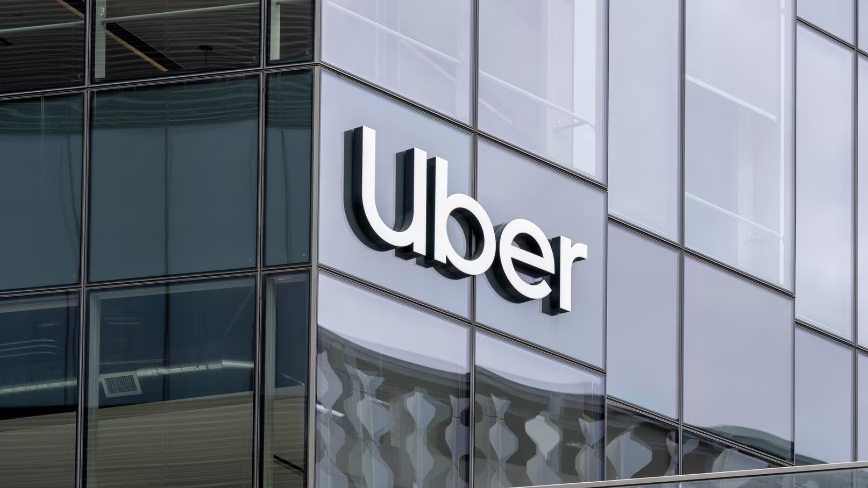
Uber’s robotaxi strategy shows where the real integration bottlenecks may emerge beyond the driving model.
30-Second TL;DR
What Changed
Uber plans to participate in the robotaxi market as an operating platform rather than a vehicle manufacturer.
Why It Matters
Uber’s approach could make autonomous mobility more accessible to developers and fleet partners by centralizing operations and deployment infrastructure. However, the model requires significant capital, regulatory coordination, and reliable integration across heterogeneous autonomous-driving systems.
What To Do Next
Map your autonomous-mobility product against Uber’s dispatch, fleet-operations, charging, and insurance integration requirements before committing to a deployment architecture.
Key Points
- •Uber plans to participate in the robotaxi market as an operating platform rather than a vehicle manufacturer.
- •The company identifies dispatch, fleet operations, charging, insurance, and regulation as critical parts of autonomous-vehicle commercialization.
- •CEO Dara Khosrowshahi said the company is spending billions on the strategy, despite the negative stock-market reaction.
Deep Insight
AI-generated analysis for this event — not the original article.
Enhanced Key Takeaways
- •Uber has established strategic partnerships with multiple autonomous vehicle developers, including Waymo, Aurora, and Cruise, to integrate their fleets into the Uber app.
- •The company is leveraging its 'Uber AI' infrastructure to optimize route efficiency and demand prediction specifically for autonomous fleets, which operate under different constraints than human-driven vehicles.
- •Uber's strategy includes the development of a proprietary 'AV Orchestration Layer' designed to manage handoffs between autonomous systems and human intervention centers.
- •Financial analysts note that Uber's shift to an asset-light model is a direct response to the high capital expenditure and R&D risks associated with its previous internal AV development unit, Advanced Technologies Group (ATG), which was sold to Aurora in 2020.
- •Regulatory coordination efforts are focused on establishing standardized data-sharing protocols with municipal governments to manage curb space and traffic flow in high-density urban environments.
Competitor Analysis
- Uber (Platform Model)
- Aggregator/Orchestrator
- Waymo (Vertically Integrated)
- Full-stack Operator
- Tesla (Network/Fleet)
- Hardware/Software Provider
- Uber (Platform Model)
- Third-party fleets
- Waymo (Vertically Integrated)
- Owned/Operated
- Tesla (Network/Fleet)
- Customer-owned/Tesla Network
- Uber (Platform Model)
- Commission/Service Fee
- Waymo (Vertically Integrated)
- Per-ride/Subscription
- Tesla (Network/Fleet)
- Software licensing/Fleet cut
- Uber (Platform Model)
- Multi-vendor interoperability
- Waymo (Vertically Integrated)
- High-density urban robotaxi
- Tesla (Network/Fleet)
- Consumer-to-robotaxi transition
| Feature | Uber (Platform Model) | Waymo (Vertically Integrated) | Tesla (Network/Fleet) |
|---|---|---|---|
| Primary Strategy | Aggregator/Orchestrator | Full-stack Operator | Hardware/Software Provider |
| Vehicle Ownership | Third-party fleets | Owned/Operated | Customer-owned/Tesla Network |
| Revenue Model | Commission/Service Fee | Per-ride/Subscription | Software licensing/Fleet cut |
| Market Focus | Multi-vendor interoperability | High-density urban robotaxi | Consumer-to-robotaxi transition |
Technical Deep Dive
- Uber's AV platform utilizes a multi-tenant API architecture that allows disparate autonomous driving systems to communicate with the Uber dispatch engine using standardized telemetry formats.
- The platform incorporates a predictive maintenance module that analyzes real-time sensor health data from partner vehicles to schedule charging and servicing before failures occur.
- Implementation relies on a cloud-native microservices framework that handles high-concurrency requests for vehicle re-routing and dynamic pricing adjustments in autonomous-only zones.
- The system integrates with third-party 'Teleoperation' interfaces, allowing remote human operators to provide high-level path planning guidance when an AV encounters an edge case.
Future ImplicationsAI analysis grounded in cited sources
Timeline
- 2016-09Uber launches its first public autonomous pilot in Pittsburgh using modified Ford Fusions.
- 2018-03Uber suspends autonomous testing following a fatal collision involving an Uber test vehicle in Tempe, Arizona.
- 2020-12Uber sells its Advanced Technologies Group (ATG) to Aurora Innovation, pivoting away from internal hardware development.
- 2023-10Uber announces a multi-year partnership to bring Waymo's autonomous vehicles to the Uber app in Phoenix.
- 2025-05Uber expands its autonomous platform strategy to include partnerships with Cruise and other emerging AV developers.
Weekly AI Recap
Read this week's curated digest of top AI events →
Related Updates



AI-curated news aggregator. All content rights belong to original publishers.
Original source: The Next Web (TNW) ↗
This is a summary, not the original. Read the source, or get the weekly briefing.
The weekly digest
One email a week. Unsubscribe anytime.