Train Yourself Like an AI Model
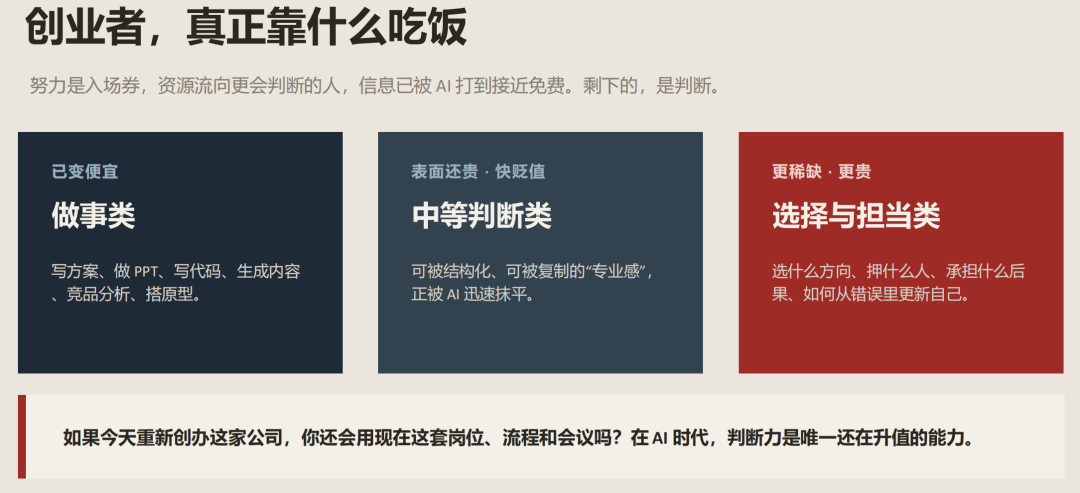
💡Learn how to build a 'dual-intelligence system' by training your human judgment to outperform AI-driven automation.
⚡ 30-Second TL;DR
What Changed
AI shifts value from execution to 'Choice and Responsibility'.
Why It Matters
This perspective helps practitioners pivot from being mere tool users to strategic leaders who leverage AI to amplify their unique judgment and decision-making quality.
What To Do Next
Define your 'Objective Function' for the next 6 months and audit your daily tasks to see if they align with your long-term 'Taste' goals.
Key Points
- •AI shifts value from execution to 'Choice and Responsibility'.
- •Taste is defined as a selection capability (choosing direction and talent) rather than aesthetic taste.
- •The 'Taste' framework consists of five components: compression, calibration, trade-offs, betting, and iteration.
- •Human intelligence is distinguished from AI by the ability to set self-driven goals and derive meaning.
🧠 Deep Insight
AI-generated analysis for this event — not the original article.
🔑 Enhanced Key Takeaways
- •The concept of 'Taste' in AI-driven productivity is increasingly linked to the 'Human-in-the-loop' (HITL) paradigm, where human curation acts as the primary reinforcement signal for RLHF (Reinforcement Learning from Human Feedback) systems.
- •Cognitive scientists argue that 'Taste' functions as a heuristic for high-dimensional decision-making, effectively reducing the search space for complex problems that AI models struggle to optimize without human-defined constraints.
- •The 'Compression' component mentioned in the framework aligns with Information Theory principles, where human experts act as lossy compressors of vast datasets, retaining only the most salient features for downstream decision-making.
- •Recent studies in organizational behavior suggest that 'Calibration'—the ability to align internal confidence with external reality—is the primary differentiator between high-performing AI-augmented workers and those prone to automation bias.
- •The shift toward 'Self-driven goals' reflects a broader trend in AGI research toward 'Intrinsic Motivation' architectures, where agents are designed to seek novelty and competence rather than just extrinsic reward maximization.
🔮 Future ImplicationsAI analysis grounded in cited sources
Weekly AI Recap
Read this week's curated digest of top AI events →
👉Related Updates



AI-curated news aggregator. All content rights belong to original publishers.
Original source: 虎嗅 ↗
This is a summary, not the original. Read the source, or get the weekly briefing.
Weekly AI briefing
One email a week. Unsubscribe anytime.