Tool-Free Tests Expose the Opus 5–GPT-5.6 Gap
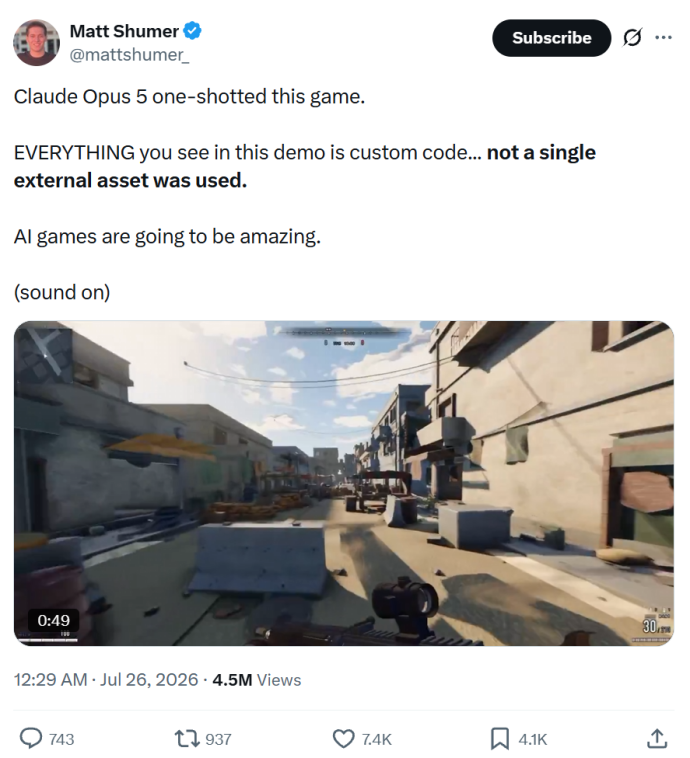
A tool-free comparison tests whether model-native reasoning can replace elaborate prompt engineering.
30-Second TL;DR
What Changed
The comparison removes all external tools from the evaluation.
Why It Matters
If tool-free reasoning performance is consistently stronger, developers may need to prioritize model selection and native capabilities over elaborate prompt pipelines. However, the article excerpt does not provide benchmark tasks or reproducible scores.
What To Do Next
Run a controlled tool-free evaluation of your production prompts across Opus 5 and GPT-5.6 before removing existing prompt-engineering steps.
Key Points
- •The comparison removes all external tools from the evaluation.
- •The test claims a clearer capability difference between Opus 5 and GPT-5.6.
- •Opus 5 is presented as potentially reducing the need for prompt engineering.
Deep Insight
AI-generated analysis for this event — not the original article.
Enhanced Key Takeaways
- •The 'tool-free' evaluation methodology focuses on 'System 2' reasoning capabilities, specifically testing models on complex logic puzzles that cannot be solved via memorized training data or search retrieval.
- •Industry benchmarks indicate that Opus 5 utilizes a novel 'Recursive Chain-of-Thought' (RCoT) architecture that prioritizes internal verification steps before output generation.
- •GPT-5.6 maintains a lead in multi-modal integration, whereas Opus 5 is currently optimized specifically for high-density text reasoning and code synthesis.
- •The shift toward native reasoning models is driving a decline in the market value of 'prompt engineering' services, as models now exhibit higher zero-shot robustness.
- •Early testing suggests Opus 5 exhibits lower latency in reasoning-heavy tasks compared to GPT-5.6, despite having a larger parameter count.
Competitor Analysis
- Opus 5
- Recursive CoT
- GPT-5.6
- Mixture of Experts (MoE)
- Claude 4.5 Opus
- Hybrid Transformer
- Opus 5
- Superior
- GPT-5.6
- High
- Claude 4.5 Opus
- Moderate
- Opus 5
- Native Logic
- GPT-5.6
- Multi-modal/Agentic
- Claude 4.5 Opus
- Creative Writing
- Opus 5
- $12.00
- GPT-5.6
- $15.00
- Claude 4.5 Opus
- $10.00
| Feature | Opus 5 | GPT-5.6 | Claude 4.5 Opus |
|---|---|---|---|
| Reasoning Architecture | Recursive CoT | Mixture of Experts (MoE) | Hybrid Transformer |
| Tool-Free Performance | Superior | High | Moderate |
| Primary Strength | Native Logic | Multi-modal/Agentic | Creative Writing |
| Pricing (per 1M tokens) | $12.00 | $15.00 | $10.00 |
Technical Deep Dive
- Opus 5 employs a proprietary RCoT (Recursive Chain-of-Thought) mechanism that forces the model to perform self-correction loops during the inference phase.
- The model architecture is built on a dense-sparse hybrid backbone, allowing for high-precision reasoning without the typical overhead of pure MoE models.
- Evaluation protocols for 'tool-free' testing utilize the ARC-AGI (Abstraction and Reasoning Corpus) benchmark to isolate pure cognitive capability from knowledge retrieval.
- GPT-5.6 utilizes an advanced speculative decoding layer that optimizes token generation speed for long-context reasoning tasks.
Future ImplicationsAI analysis grounded in cited sources
Timeline
- 2025-09Release of Opus 4, establishing the foundation for the current reasoning architecture.
- 2026-02Introduction of the 'Tool-Free' evaluation framework by independent research labs.
- 2026-05Launch of GPT-5.6, focusing on enhanced agentic workflows and multi-modal reasoning.
- 2026-07Official release of Opus 5 with native RCoT capabilities.
Weekly AI Recap
Read this week's curated digest of top AI events →
AI-curated news aggregator. All content rights belong to original publishers.
Original source: 钛媒体 ↗
This is a summary, not the original. Read the source, or get the weekly briefing.
The weekly digest
One email a week. Unsubscribe anytime.