Tokyo U Open-Sources Quadruped Robot MEVIUS2
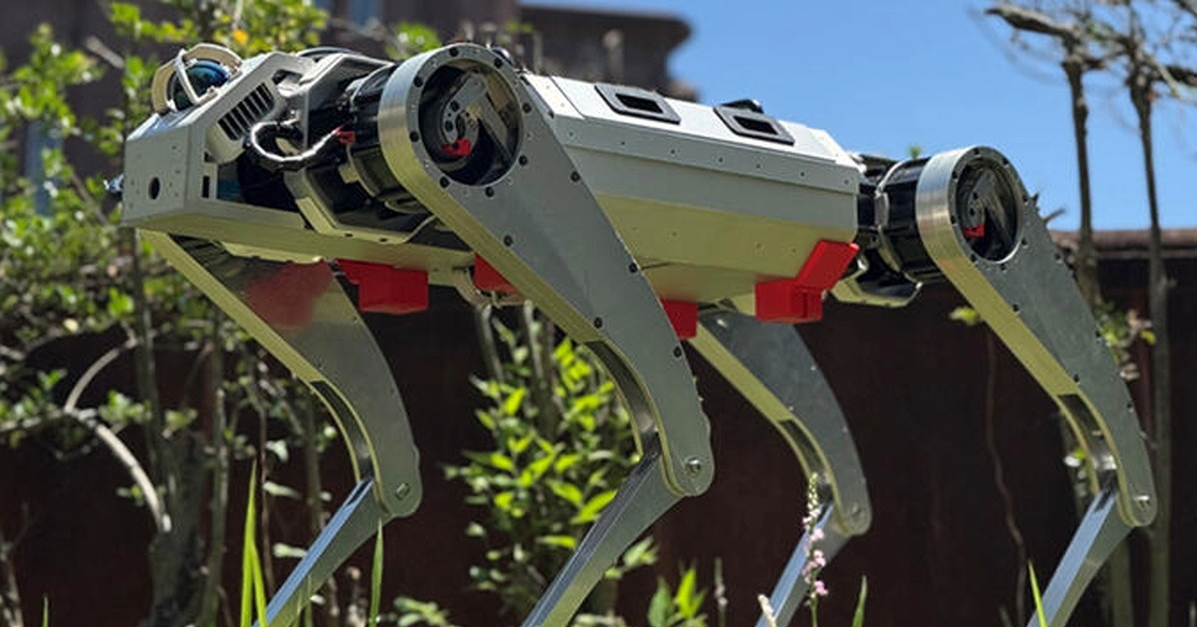
💡Tokyo U's open-source stair-climbing quadruped: build embodied AI robots affordably!
⚡ 30-Second TL;DR
What Changed
University of Tokyo developed fully open-source quadruped robot MEVIUS2
Why It Matters
This release lowers barriers for robotics research, allowing global developers to replicate and iterate on advanced quadruped designs. It accelerates embodied AI progress in academia and industry.
What To Do Next
Download MEVIUS2 schematics from Tokyo U's repository and order parts to prototype your own quadruped.
Key Points
- •University of Tokyo developed fully open-source quadruped robot MEVIUS2
- •Robot parts available for easy online ordering
- •Demonstrated advanced mobility like stair climbing
- •Aimed at enabling widespread robotics experimentation
🧠 Deep Insight
AI-generated analysis for this event — not the original article.
🔑 Enhanced Key Takeaways
- •MEVIUS2 is built upon the research legacy of the JSK Lab at the University of Tokyo, specifically evolving from the original MEVIUS platform which focused on high-torque, low-cost actuator design.
- •The project utilizes a modular software stack compatible with ROS 2 (Robot Operating System), facilitating integration with existing simulation environments like Gazebo and Isaac Sim.
- •The open-source hardware design includes 3D-printable structural components and standardized off-the-shelf electronic modules to lower the barrier for academic and hobbyist entry.
📊 Competitor Analysis▸ Show
| Feature | MEVIUS2 | Unitree Go2 | Boston Dynamics Spot |
|---|---|---|---|
| Primary Model | Open-Source/DIY | Commercial/Closed | Industrial/Closed |
| Target Audience | Researchers/Students | Consumers/Developers | Enterprise/Industrial |
| Cost Profile | Low (Parts-based) | Mid-Range | High (Lease/Purchase) |
| Customizability | High (Full access) | Limited (API-based) | Restricted (SDK-based) |
🛠️ Technical Deep Dive
- Actuation: Employs custom quasi-direct drive (QDD) actuators designed for high back-drivability and impact resistance.
- Control Architecture: Features a hierarchical control system with a whole-body impulse control (WBIC) framework for stable locomotion.
- Sensing: Integrated IMU-based state estimation combined with depth-camera-based SLAM for autonomous navigation.
- Power: Utilizes a high-discharge lithium-polymer battery system with a modular power distribution board for easy maintenance.
🔮 Future ImplicationsAI analysis grounded in cited sources
⏳ Timeline
Weekly AI Recap
Read this week's curated digest of top AI events →
👉Related Updates
AI-curated news aggregator. All content rights belong to original publishers.
Original source: ITmedia AI+ (日本) ↗
This is a summary, not the original. Read the source, or get the weekly briefing.
Weekly AI briefing
One email a week. Unsubscribe anytime.