Google押注AI电网,而非最强模型
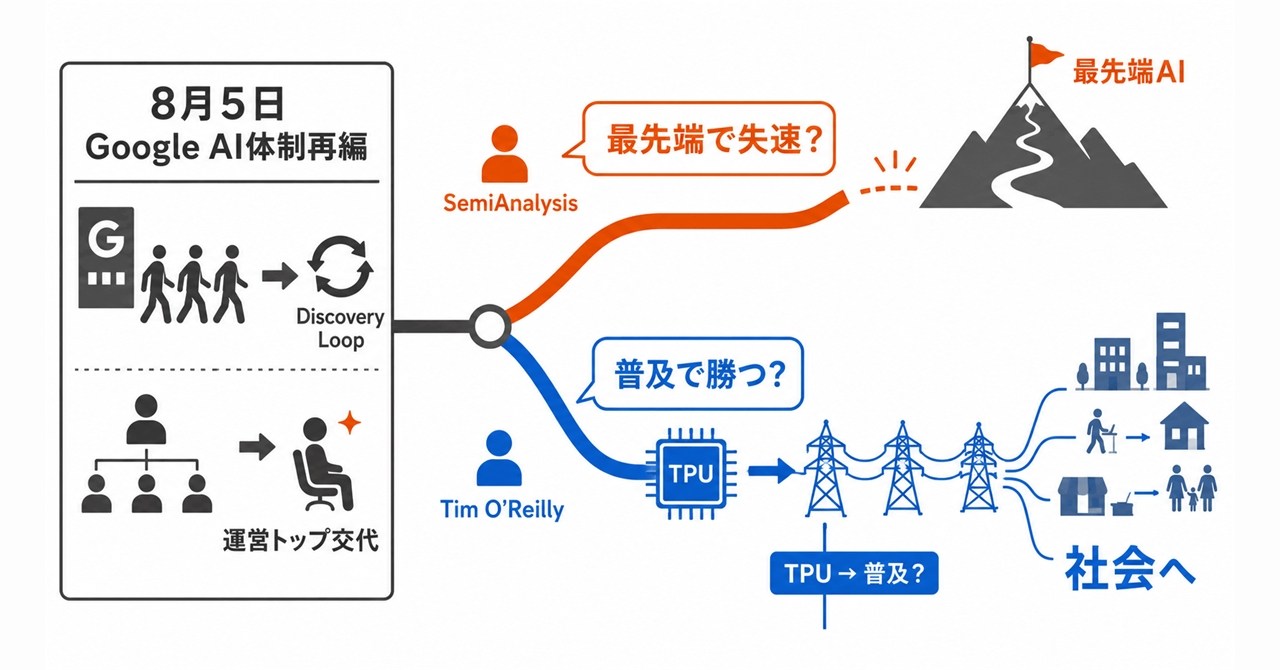
💡Google可能不靠單一最強模型取勝,而是靠完整AI基礎設施建立長期優勢。
⚡ 30-Second TL;DR
What Changed
GoogleのAI研究を率いた中心人物が相次いで退社している
Why It Matters
この戦略が成功すれば、モデル性能だけでなく、クラウド、開発者ツール、配布網、企業導入まで含む総合的なAI基盤競争が加速する。AI企業は、最強モデルの開発と同時に、利用・運用インフラを確保する必要がある。
What To Do Next
Benchmark Gemini through Vertex AI against your current model on cost, latency, reliability, and deployment integration before choosing a long-term platform.
Key Points
- •GoogleのAI研究を率いた中心人物が相次いで退社している
- •Geminiの最先端モデル競争でGoogleが劣勢との見方が広がっている
- •GoogleはAIを社会全体へ届ける「電力網」のような基盤構築を重視している
- •記事はAIの歴史を電気産業の発展になぞらえ、モデル以外の競争軸を提示している
🧠 Deep Insight
Background and context from public sources — not the original article. 30 sources cited.
🔑 Enhanced Key Takeaways
- •Several high-profile AI researchers have recently departed Google, including Demis Hassabis (DeepMind CEO to Alphabet Chief Scientist), Jeff Dean (Chief Scientist of Google DeepMind and Google Research to a new startup Discovery Loop), Noam Shazeer (Gemini co-lead to OpenAI), and John Jumper (AlphaFold lead to Anthropic).
- •Alphabet plans its largest-ever capital expenditure for 2026, allocating between $195 billion and $205 billion primarily to build out AI infrastructure, including new data centers, powerful computer chips, and servers to support AI models like Gemini.
- •Google is actively implementing its 'AI grid' vision through partnerships, such as with PJM Interconnection (North America's largest grid operator) and its moonshot project Tapestry, to develop AI tools for modernizing the U.S. electric grid, aiming to integrate new power sources faster and predict demand/supply more precisely.
- •Google.org has launched significant initiatives like the $75 million AI Opportunity Fund for free AI training and the $30 million AI for Government Innovation global challenge, demonstrating a commitment to leveraging AI for broad societal good in areas such as healthcare, environmental protection, and public services.
- •There has been a strategic reallocation of Google's compute capacity, with a notable shift away from its research arm, Google DeepMind, towards serving paying customers; DeepMind's share of Google AI compute capacity has reportedly decreased from the mid-forties to approximately 15% since 2026.
📊 Competitor Analysis▸ Show
| Competitor | Primary AI Strategic Focus | Key Offerings/Initiatives |
|---|---|---|
| Google/Alphabet | Building foundational 'AI grid' infrastructure for widespread AI adoption; developing Gemini models; AI for social good. | Google Cloud AI, Vertex AI, Gemini models, AI Opportunity Fund, Tapestry (grid modernization), significant data center investments. |
| OpenAI (backed by Microsoft) | Advancing frontier large language models and developer ecosystem. | GPT series models, DALL-E, API access for developers, strategic partnership with Microsoft Azure. |
| Anthropic | Developing safe and responsible AI, focusing on constitutional AI. | Claude series models, attracting top AI research talent. |
| Microsoft (Azure AI) | Enterprise AI solutions, cloud AI platform, strategic partnership with OpenAI, AI-driven grid modernization. | Azure AI services, Copilot Studio, investments in data centers and AI infrastructure, initiatives for grid flexibility and resilience. |
| Amazon (AWS AI, Bedrock) | Cloud AI services, offering foundation models and tools for custom AI development. | AWS AI services, Amazon Bedrock (managed service for FMs), investments in data centers and AI infrastructure. |
🛠️ Technical Deep Dive
- AI Hypercomputer: Google emphasizes its AI Hypercomputer architecture, integrating TPUs, networking, and data infrastructure to provide scalable and efficient compute for AI workloads.
- Tensor Processing Units (TPUs): Google's custom-designed ASICs are a core component of its AI infrastructure, optimized for machine learning workloads.
- Vertex AI Platform: Google Cloud's managed machine learning platform is utilized for orchestrating and deploying various AI models and solutions, including those for grid management like GridVista.
- Gemini Energy Consumption: A median text prompt to Gemini Apps consumes approximately 0.24 watt-hours (Wh) of electricity. The energy breakdown includes 58% for AI chips, 25% for supporting hardware (CPUs, memory), 10% for idle backup equipment, and 8% for cooling systems and power conversion.
- GridVista System: Developed by CTC Global using Google Cloud's Vertex AI, this system integrates environmental forecasting (e.g., Google Earth, DeepMind's WeatherNext models) and real-time data to provide dynamic line rating and predictive maintenance for electricity transmission lines, enhancing grid awareness and reliability.
- Tapestry: An Alphabet-incubated moonshot, powered by Google Cloud and Google DeepMind, focused on building AI tools and models to intelligently manage and optimize the interconnection of power generation to electric grids, aiming for faster integration of energy sources.
🔮 Future ImplicationsAI analysis grounded in cited sources
⏳ Timeline
📎 Sources (30)
Factual claims are grounded in the sources below. Forward-looking analysis is AI-generated interpretation.
- pureai.com
- searchenginejournal.com
- latimes.com
- em360tech.com
- euronext.com
- inc.com
- theguardian.com
- time.com
- axios.com
- hindustantimes.com
- newindianexpress.com
- hugoinvesting.com
- fool.com
- datacenterfrontier.com
- blog.google
- energyconnects.com
- constructconnect.com
- seesaa.net
- blog.google
- research.google
- google.org
- ai.google
- exponentialview.co
- reddit.com
- google.com
- energysage.com
- techuk.org
- quora.com
- medium.com
- substack.com
Weekly AI Recap
Read this week's curated digest of top AI events →
👉Related Updates

AI-curated news aggregator. All content rights belong to original publishers.
Original source: ITmedia AI+ (日本) ↗
This is a summary, not the original. Read the source, or get the weekly briefing.
Weekly AI briefing
One email a week. Unsubscribe anytime.