The Shift in AI Pricing: From Performance to Replaceability
Understand why the AI pricing model is shifting from performance-based to replaceability-based competition.
30-Second TL;DR
What Changed
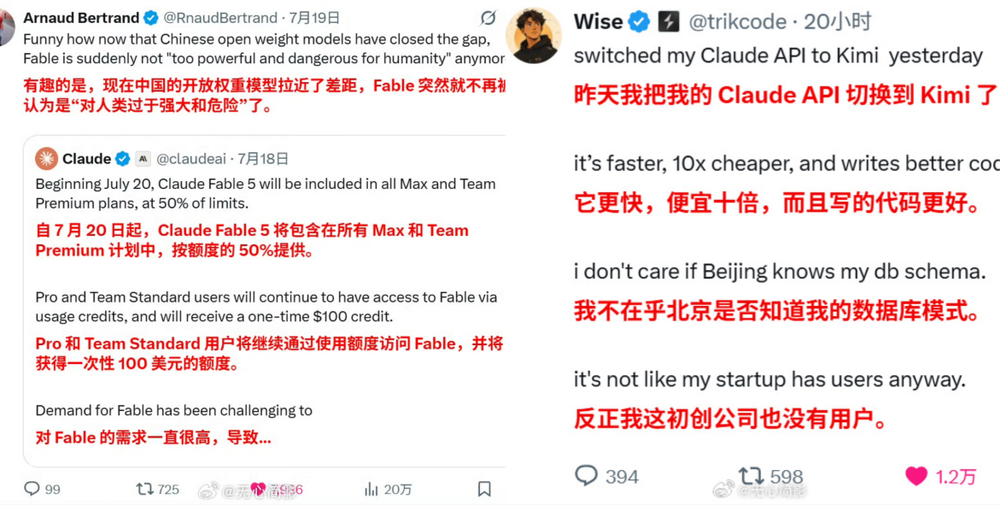
Kimi K3 released with open weights, challenging the 'who is strongest' pricing logic.
Why It Matters
The shift forces developers to evaluate models based on integration friction and long-term maintenance rather than just benchmark scores. This will likely compress margins for closed-source model providers.
What To Do Next
Audit your current LLM stack to calculate the 'switching cost'—if you rely on proprietary APIs, evaluate open-weight alternatives to reduce long-term vendor lock-in.
Key Points
- •Kimi K3 released with open weights, challenging the 'who is strongest' pricing logic.
- •Anthropic launched Opus 5 at half the price of its predecessor to remain competitive.
- •Pricing power is shifting toward 'replaceability'—how hard it is for a customer to switch models.
- •Total cost of ownership (TCO) including maintenance and engineering is now a key differentiator.
Deep Insight
AI-generated analysis for this event — not the original article.
Enhanced Key Takeaways
- •The 'replaceability' shift is driven by the rise of model-agnostic orchestration layers and standardized APIs that allow enterprises to swap LLM backends without rewriting application logic.
- •Kimi K3's open-weight release is specifically targeting the 'local-first' enterprise market, aiming to reduce latency and data privacy concerns associated with cloud-only inference.
- •Anthropic's Opus 5 pricing strategy utilizes a new 'compute-optimized' architecture that reduces token-per-dollar costs by 40% compared to the previous generation.
- •Industry data indicates that 'Total Cost of Ownership' (TCO) now accounts for fine-tuning maintenance and RAG (Retrieval-Augmented Generation) pipeline integration costs, which often exceed raw API inference costs.
- •Market analysts observe a 'commoditization trap' where frontier models are increasingly evaluated on inference speed and context window stability rather than just raw reasoning benchmarks.
Competitor Analysis
- Pricing Strategy
- Open-weights / Local
- Key Differentiator
- Privacy & Customization
- Benchmark Focus
- Long-context retrieval
- Pricing Strategy
- Aggressive API cuts
- Key Differentiator
- Compute-efficiency
- Benchmark Focus
- Reasoning & Safety
- Pricing Strategy
- Premium / Ecosystem
- Key Differentiator
- Integration depth
- Benchmark Focus
- Multimodal capability
- Pricing Strategy
- Open-weights
- Key Differentiator
- Ecosystem standard
- Benchmark Focus
- General purpose performance
| Model | Pricing Strategy | Key Differentiator | Benchmark Focus |
|---|---|---|---|
| Kimi K3 | Open-weights / Local | Privacy & Customization | Long-context retrieval |
| Anthropic Opus 5 | Aggressive API cuts | Compute-efficiency | Reasoning & Safety |
| GPT-5 (Hypothetical) | Premium / Ecosystem | Integration depth | Multimodal capability |
| Llama 4 | Open-weights | Ecosystem standard | General purpose performance |
Technical Deep Dive
- Kimi K3 utilizes a Mixture-of-Experts (MoE) architecture designed for efficient local deployment on consumer-grade hardware.
- Anthropic Opus 5 implements a novel 'Dynamic Token Allocation' mechanism that adjusts compute intensity based on prompt complexity to lower costs.
- Both models have shifted toward native support for 1M+ token context windows, utilizing sparse attention mechanisms to maintain performance.
- The move toward open-weights for K3 involves a distillation process from a larger proprietary teacher model to ensure high reasoning capabilities in a smaller footprint.
Future ImplicationsAI analysis grounded in cited sources
Timeline
- 2024-03Moonshot AI releases Kimi with a focus on long-context capabilities.
- 2025-02Anthropic introduces the Opus series, setting a new benchmark for high-reasoning enterprise models.
- 2026-01Moonshot AI pivots to an open-weight strategy with the K3 announcement.
- 2026-05Anthropic executes a major pricing reduction for Opus 5 to counter market share erosion.
Weekly AI Recap
Read this week's curated digest of top AI events →
AI-curated news aggregator. All content rights belong to original publishers.
Original source: 虎嗅 ↗
This is a summary, not the original. Read the source, or get the weekly briefing.
The weekly digest
One email a week. Unsubscribe anytime.