來源虎嗅•較早收集於 16m
AI 定價邏輯轉變:從性能競爭轉向替代成本競爭
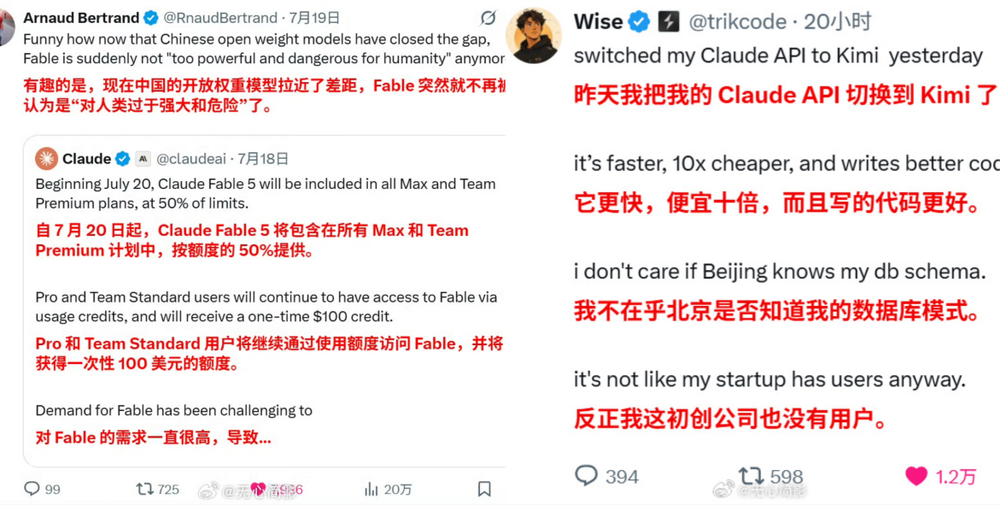
了解為何 AI 定價模式正從性能競爭轉向基於替代成本的競爭。
30 秒速覽
有什麼變化
Kimi K3 發布完整權重,挑戰了「誰最強誰貴」的定價邏輯。
為什麼重要
這種轉變迫使開發者在評估模型時,需考量整合摩擦與長期維護成本,而不僅僅是基準測試分數。這可能會壓縮閉源模型供應商的利潤空間。
下一步行動
審計您目前的 LLM 技術棧並計算「切換成本」;若您依賴專有 API,請評估開源權重替代方案,以降低長期供應商鎖定風險。
誰應關注:Founders & Product Leaders
關鍵要點
- •Kimi K3 發布完整權重,挑戰了「誰最強誰貴」的定價邏輯。
- •Anthropic 發布 Opus 5,定價僅為前代產品的一半,以維持競爭力。
- •定價權正轉向「替代成本」,即客戶更換模型的難易程度。
- •總體擁有成本(TCO),包括維護與工程成本,已成為關鍵差異化因素。
深度解析
本篇為 AI 生成分析,非原文內容。
增強重點摘要
- •The 'replaceability' shift is driven by the rise of model-agnostic orchestration layers and standardized APIs that allow enterprises to swap LLM backends without rewriting application logic.
- •Kimi K3's open-weight release is specifically targeting the 'local-first' enterprise market, aiming to reduce latency and data privacy concerns associated with cloud-only inference.
- •Anthropic's Opus 5 pricing strategy utilizes a new 'compute-optimized' architecture that reduces token-per-dollar costs by 40% compared to the previous generation.
- •Industry data indicates that 'Total Cost of Ownership' (TCO) now accounts for fine-tuning maintenance and RAG (Retrieval-Augmented Generation) pipeline integration costs, which often exceed raw API inference costs.
- •Market analysts observe a 'commoditization trap' where frontier models are increasingly evaluated on inference speed and context window stability rather than just raw reasoning benchmarks.
競品分析
Kimi K3
- Pricing Strategy
- Open-weights / Local
- Key Differentiator
- Privacy & Customization
- Benchmark Focus
- Long-context retrieval
Anthropic Opus 5
- Pricing Strategy
- Aggressive API cuts
- Key Differentiator
- Compute-efficiency
- Benchmark Focus
- Reasoning & Safety
GPT-5 (Hypothetical)
- Pricing Strategy
- Premium / Ecosystem
- Key Differentiator
- Integration depth
- Benchmark Focus
- Multimodal capability
Llama 4
- Pricing Strategy
- Open-weights
- Key Differentiator
- Ecosystem standard
- Benchmark Focus
- General purpose performance
| Model | Pricing Strategy | Key Differentiator | Benchmark Focus |
|---|---|---|---|
| Kimi K3 | Open-weights / Local | Privacy & Customization | Long-context retrieval |
| Anthropic Opus 5 | Aggressive API cuts | Compute-efficiency | Reasoning & Safety |
| GPT-5 (Hypothetical) | Premium / Ecosystem | Integration depth | Multimodal capability |
| Llama 4 | Open-weights | Ecosystem standard | General purpose performance |
技術深入
- Kimi K3 utilizes a Mixture-of-Experts (MoE) architecture designed for efficient local deployment on consumer-grade hardware.
- Anthropic Opus 5 implements a novel 'Dynamic Token Allocation' mechanism that adjusts compute intensity based on prompt complexity to lower costs.
- Both models have shifted toward native support for 1M+ token context windows, utilizing sparse attention mechanisms to maintain performance.
- The move toward open-weights for K3 involves a distillation process from a larger proprietary teacher model to ensure high reasoning capabilities in a smaller footprint.
前景展望基於引用來源的 AI 分析
API-only model providers will lose 30% of enterprise market share by 2027.
The increasing demand for data sovereignty and local inference will drive enterprises toward open-weight models that can be hosted on private infrastructure.
Inference pricing will stabilize at a 'floor' cost determined by hardware energy consumption.
As model architectures reach a point of diminishing returns in efficiency, the cost of electricity and GPU utilization will become the primary constraint on pricing.
時間線
2024-03
Moonshot AI releases Kimi with a focus on long-context capabilities.
2025-02
Anthropic introduces the Opus series, setting a new benchmark for high-reasoning enterprise models.
2026-01
Moonshot AI pivots to an open-weight strategy with the K3 announcement.
2026-05
Anthropic executes a major pricing reduction for Opus 5 to counter market share erosion.
- 2024-03Moonshot AI releases Kimi with a focus on long-context capabilities.
- 2025-02Anthropic introduces the Opus series, setting a new benchmark for high-reasoning enterprise models.
- 2026-01Moonshot AI pivots to an open-weight strategy with the K3 announcement.
- 2026-05Anthropic executes a major pricing reduction for Opus 5 to counter market share erosion.
AI 週報
閱讀本週精選 AI 大事摘要 →
AI 策展新聞聚合。所有內容版權歸原始發布者所有。
原始來源: 虎嗅 ↗
每週電子報
每週一封,可隨時退訂。