The Missing Layer in AI Productivity
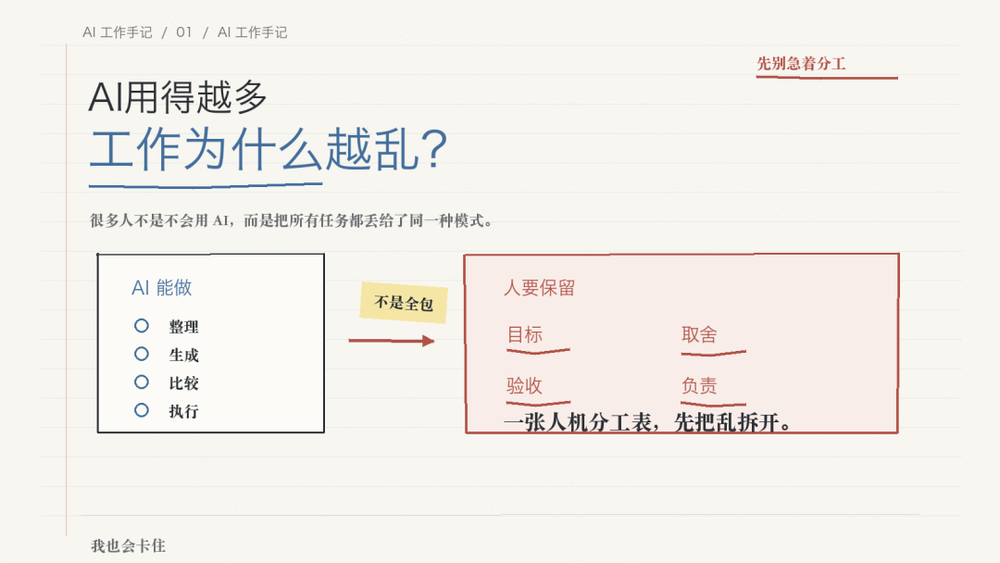
💡AI may be making your team slower—not because it is weak, but because the workflow lacks clear ownership.
⚡ 30-Second TL;DR
What Changed
An NBER study of 5,179 customer-service agents found a 14% average productivity increase with generative AI, rising to 34% for newer or lower-skilled agents.
Why It Matters
The framework shifts AI adoption from prompt optimization to workflow design and accountability. For teams, the main productivity gain may come from assigning AI to reversible, verifiable subtasks while reserving consequential decisions for humans.
What To Do Next
Pilot the five-column matrix for one week on a recurring workflow, assigning a named human owner to approve every AI-generated deliverable.
Key Points
- •An NBER study of 5,179 customer-service agents found a 14% average productivity increase with generative AI, rising to 34% for newer or lower-skilled agents.
- •A Harvard Business School and BCG study found AI improved performance inside its capability frontier but reduced performance by 19 percentage points outside it.
- •AI should be assigned different roles—delegation, collaboration, questioning, or exploration—depending on task ambiguity and risk.
- •The proposed workflow keeps humans responsible for goals, judgment, fact-checking, boundaries, risk review, and final acceptance.
Weekly AI Recap
Read this week's curated digest of top AI events →
👉Related Updates



AI-curated news aggregator. All content rights belong to original publishers.
Original source: 虎嗅 ↗
This is a summary, not the original. Read the source, or get the weekly briefing.
Weekly AI briefing
One email a week. Unsubscribe anytime.