Tesla Whistleblower Flags FSD Safety Staffing Gap
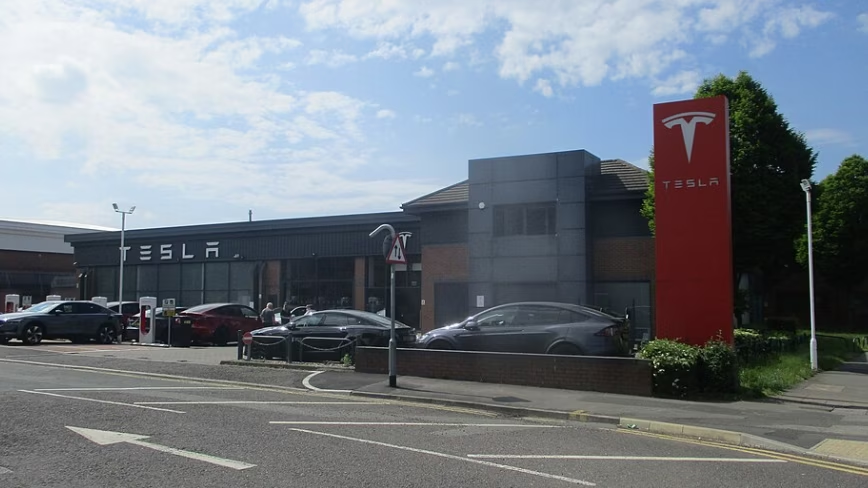
A Tesla lawsuit exposes how staffing ratios can become a critical risk in real-world autonomous-driving tests.
30-Second TL;DR
What Changed
Javier Medrano filed a federal lawsuit against Tesla.
Why It Matters
If the allegations are substantiated, understaffing could undermine the safety and credibility of real-world autonomous-driving tests. The case may also increase regulatory and operational scrutiny of human oversight ratios in advanced driver-assistance deployments.
What To Do Next
For any real-world AI vehicle pilot, document the operator-to-supervisor ratio and require a safety review before expanding shifts or fleet size.
Key Points
- •Javier Medrano filed a federal lawsuit against Tesla.
- •The lawsuit alleges that one manager oversaw 38 vehicle operators across three shifts.
- •The Houston Full Self-Driving fleet allegedly operated around the clock with inadequate safety oversight.
Deep Insight
AI-generated analysis for this event — not the original article.
Enhanced Key Takeaways
- •Medrano's lawsuit alleges that Tesla's 'Full Self-Driving' (FSD) testing protocols in Houston violated internal safety policies by prioritizing rapid data collection over human operator fatigue management.
- •The complaint claims that the high operator-to-manager ratio led to 'normalization of deviance,' where safety checks were bypassed to meet aggressive vehicle uptime targets set by corporate leadership.
- •Court filings indicate that Medrano was terminated shortly after raising internal concerns regarding the lack of real-time monitoring for the 38-person operator team.
- •The lawsuit seeks damages for wrongful termination and whistleblower retaliation under the Sarbanes-Oxley Act and relevant state labor laws.
- •Tesla's defense strategy has reportedly focused on characterizing the Houston fleet as a 'data-gathering' operation rather than a public-facing autonomous service, attempting to lower the threshold for required safety oversight.
Competitor Analysis
- Tesla (FSD/Data Collection)
- Human-in-the-loop (Remote)
- Waymo (Autonomous Taxi)
- Fully Autonomous (Remote Assist)
- Zoox (Purpose-Built AV)
- Fully Autonomous (Remote Assist)
- Tesla (FSD/Data Collection)
- Data-gathering/Beta testing
- Waymo (Autonomous Taxi)
- Commercial Robotaxi
- Zoox (Purpose-Built AV)
- Commercial Robotaxi
- Tesla (FSD/Data Collection)
- Allegedly high (1:38)
- Waymo (Autonomous Taxi)
- Low (Centralized Ops Center)
- Zoox (Purpose-Built AV)
- Low (Centralized Ops Center)
- Tesla (FSD/Data Collection)
- Vision-only (Cameras)
- Waymo (Autonomous Taxi)
- LiDAR + Radar + Cameras
- Zoox (Purpose-Built AV)
- LiDAR + Radar + Cameras
| Feature | Tesla (FSD/Data Collection) | Waymo (Autonomous Taxi) | Zoox (Purpose-Built AV) |
|---|---|---|---|
| Safety Oversight | Human-in-the-loop (Remote) | Fully Autonomous (Remote Assist) | Fully Autonomous (Remote Assist) |
| Operational Model | Data-gathering/Beta testing | Commercial Robotaxi | Commercial Robotaxi |
| Staffing Ratio | Allegedly high (1:38) | Low (Centralized Ops Center) | Low (Centralized Ops Center) |
| Hardware | Vision-only (Cameras) | LiDAR + Radar + Cameras | LiDAR + Radar + Cameras |
Technical Deep Dive
- Tesla's FSD data collection fleet utilizes the 'Tesla Vision' stack, relying exclusively on camera-based neural networks for object detection and path planning.
- The Houston testing environment specifically focused on training the 'End-to-End' neural network architecture, which maps raw video input directly to vehicle control commands (steering, braking, acceleration).
- Operators were tasked with 'shadow mode' monitoring, where they were required to intervene if the neural network's predicted trajectory deviated from safe driving parameters.
- Data logs from the fleet are uploaded via Wi-Fi/LTE to Tesla's Dojo supercomputing cluster for automated labeling and model retraining.
Future ImplicationsAI analysis grounded in cited sources
Timeline
- 2023-05Tesla expands FSD data collection operations to the Houston metropolitan area.
- 2024-02Javier Medrano is hired as a fleet operations manager for the Houston FSD testing program.
- 2025-01Medrano allegedly submits formal internal complaints regarding staffing shortages and safety risks.
- 2025-06Medrano is terminated from his position at Tesla.
- 2026-03Medrano files a federal lawsuit against Tesla alleging whistleblower retaliation and unsafe work practices.
Weekly AI Recap
Read this week's curated digest of top AI events →
Related Updates
AI-curated news aggregator. All content rights belong to original publishers.
Original source: The Next Web (TNW) ↗
This is a summary, not the original. Read the source, or get the weekly briefing.
The weekly digest
One email a week. Unsubscribe anytime.