Tesla vs. Waymo: The Texas Robotaxi Fleet Gap
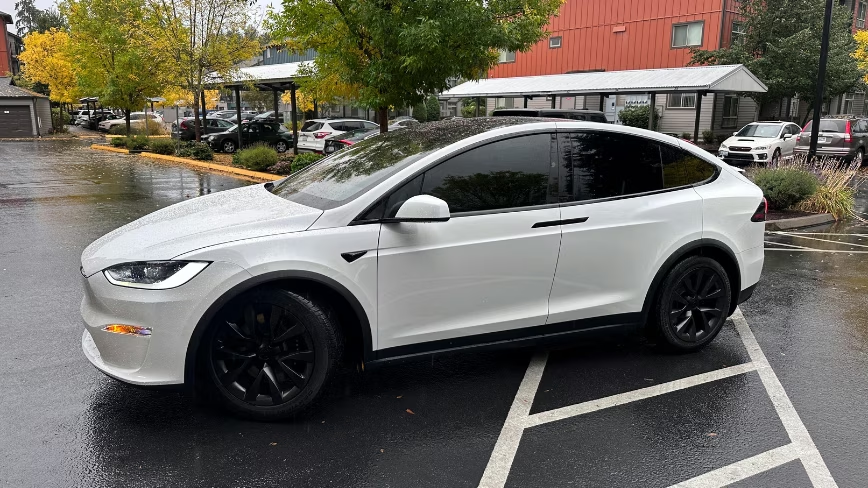
💡See the hard data on the robotaxi race between Tesla and Waymo in a key US market.
⚡ 30-Second TL;DR
What Changed
Texas law now requires public disclosure of commercial driverless vehicle operators.
Why It Matters
The transparency of these figures forces Tesla to accelerate its FSD (Full Self-Driving) deployment to remain competitive in the commercial robotaxi market.
What To Do Next
Review the latest Texas Department of Motor Vehicles autonomous vehicle reports to benchmark your own fleet deployment metrics against industry leaders.
Key Points
- •Texas law now requires public disclosure of commercial driverless vehicle operators.
- •Waymo currently operates 577 autonomous vehicles in Texas, significantly outpacing Tesla's 42.
- •The data provides a transparent look at the competitive landscape of autonomous ridehailing.
🧠 Deep Insight
Background and context from public sources — not the original article. 36 sources cited.
🔑 Enhanced Key Takeaways
- •The new Texas law mandating public disclosure of commercial driverless vehicle operators became enforceable on May 28, 2026, providing the first objective, government-verified comparison of fleet sizes in the state.
- •Tesla's self-certification of its 42 vehicles as SAE Level 4 autonomy in Texas raises questions, as the company has historically characterized most of its cars as Level 2 driver-assistance systems, which require constant driver supervision.
- •Beyond Waymo and Tesla, the Texas market includes other significant autonomous vehicle operators such as Avride with 317 vehicles, Nuro with 47, and Amazon's Zoox with 35, indicating a broader competitive landscape.
- •Tesla's current Texas robotaxi fleet of 42 vehicles falls substantially short of CEO Elon Musk's previous targets, which included having 1,000 cars within months of launch or 500 robotaxis in Austin by the end of 2025.
- •Waymo's national paid robotaxi network encompasses nearly 4,000 vehicles across multiple U.S. cities, and the company has set an ambitious goal to achieve one million paid rides per week by the end of 2026.
📊 Competitor Analysis▸ Show
| Feature/Category | Waymo (Alphabet) |
|---|---|
| Operational Model | Operates its own ride-hailing service (Waymo One), also partners with Uber in some cities (e.g., Austin). |
| Texas Fleet Size (May 2026) | 577 vehicles. |
| Texas Service Areas | Austin, Dallas, Houston, San Antonio. |
| National Fleet Size | Nearly 4,000 vehicles across 10+ metropolitan regions. |
| Autonomy Level | SAE Level 4. |
| Core Technology | Integrated system of Lidar, Cameras, Radar, and AI software (Waymo Driver, 5th/6th generation). |
| Pricing Model | Based on trip distance and time, with a minimum fare. Studies in June 2025 showed average price in San Francisco was $20.43, often higher than Uber/Lyft. |
| Estimated Vehicle Cost | Estimated $130,000-$150,000 per vehicle (2021 estimate). |
| Key Competitors in Texas | Tesla, Avride (317 vehicles), Nuro (47 vehicles), Zoox (35 vehicles), Aurora (trucking). |
| Strategic Goals | Aims for one million paid rides per week by end of 2026. |
| Recent Incidents (Texas) | Temporarily suspended rides in some Texas cities due to concerns about flooded roads. |
| Tesla | |
| Operational Model | Robotaxi service using modified Tesla Model Y vehicles, with plans for a purpose-built "Cybercab." |
| Texas Fleet Size (May 2026) | 42 vehicles. |
| Texas Service Areas | Austin, Dallas, Houston. |
| National Fleet Size | Not explicitly stated, but significantly smaller commercial deployment. |
| Autonomy Level | Self-certified as Level 4 in Texas, but previously characterized most cars as Level 2 driver-assistance. |
| Core Technology | Vision-only system (cameras) with custom FSD chips (HW3, HW4) and advanced AI for vision and planning. |
| Pricing Model | Dynamic pricing; as of March 2026, Austin base fare was $3.25 plus $1.00 per mile. |
| Estimated Vehicle Cost | Cybercab aims to be under $30,000 (production planned 2026). |
| Key Competitors in Texas | Waymo, Avride (317 vehicles), Nuro (47 vehicles), Zoox (35 vehicles), Aurora (trucking). |
| Strategic Goals | Elon Musk previously targeted 500 robotaxis in Austin by end of 2025, later scaled back. |
| Recent Incidents (Texas) | 17 incidents in Austin robotaxis (July 2025-April 2026), two with minor injuries, one requiring hospitalization; all occurred with human supervisors. |
🛠️ Technical Deep Dive
-
Waymo Driver (5th/6th Generation):
- Employs an integrated sensor suite including Lidar, Cameras, and Radar.
- Lidar: Provides a 3D picture of surroundings with 360-degree field of view and a range exceeding 300 meters, effective in all lighting conditions.
- Cameras: Offers a 360-degree vision system with high dynamic range and thermal stability, capable of identifying objects like pedestrians and stop signs from over 500 meters away. The Jaguar I-PACE fleet uses 29 cameras.
- Radar: Utilizes millimeter wave frequencies to measure object distance and speed, maintaining effectiveness in adverse weather conditions such as rain, fog, and snow.
- Onboard Computer: Acts as the 'brain,' combining server-grade CPUs and GPUs to process sensor data in real-time, identify objects, and plan safe routes using AI.
- Sensor Fusion: Software integrates diverse data inputs from all sensors (video, lidar point clouds, radar imagery) to build a comprehensive and coherent understanding of the environment.
- Simulation: The Waymo Driver has accumulated over 20 billion miles in simulation, alongside 200+ million miles of real-world driving experience, to train its AI and anticipate road user behavior.
-
Tesla Full Self-Driving (FSD):
- Vision-Based System: Primarily relies on an array of cameras for perception, a strategy known as "Tesla Vision," having previously removed radar and ultrasonic sensors from new vehicles.
- FSD Computer (Hardware 3 & 4): Utilizes custom-designed AI inference chips for processing.
- Hardware 3 (HW3): Manufactured by Samsung using a 14nm FinFET CMOS process, features over 6 billion transistors, and LPDDR4 RAM with 68 GB/s bandwidth. It includes two FSD Chips for redundancy, each with two systolic arrays capable of 36 trillion operations per second (TOPS), processing images at 2,300 frames per second.
- Hardware 4 (HW4): Introduced in January 2023, it is three to eight times more powerful than HW3, built on 10nm technology, and includes an upgraded camera suite and a new radar unit. FSD v13.2.1 (as of December 2024) is the first software version to leverage the native resolution of all HW4 cameras.
- Neural Networks: Employs 48 deep neural networks, requiring 70,000 GPU hours for a full build, to perform tasks like semantic segmentation, object detection, monocular depth estimation from raw camera images, and generating road layout and 3D objects from a bird's-eye view.
- Software Architecture: Features a centralized, model-based software architecture that enables rapid over-the-air updates and seamless integration of new hardware components.
🔮 Future ImplicationsAI analysis grounded in cited sources
⏳ Timeline
📎 Sources (36)
Factual claims are grounded in the sources below. Forward-looking analysis is AI-generated interpretation.
- thenextweb.com
- techdogs.com
- txdmv.gov
- tipranks.com
- qz.com
- gurufocus.com
- businessinsider.com
- seekingalpha.com
- stocktwits.com
- gizmodo.com
- latimes.com
- electrive.com
- businessinsider.com
- wikipedia.org
- ien.com
- cnet.com
- waymo.com
- google.com
- waymo.com
- waymo.com
- wardsauto.com
- reddit.com
- cmu.edu
- virginia.edu
- techdogs.com
- wikipedia.org
- smartcitiesdive.com
- gurufocus.com
- vaisakhvenugopal.com
- tesla.com
- autopilotreview.com
- wikipedia.org
- basenor.com
- teslahubs.com
- caranddriver.com
- medium.com
Weekly AI Recap
Read this week's curated digest of top AI events →
👉Related Updates
AI-curated news aggregator. All content rights belong to original publishers.
Original source: The Next Web (TNW) ↗
This is a summary, not the original. Read the source, or get the weekly briefing.
The weekly digest
One email a week. Unsubscribe anytime.