Tesla Report: FSD Collision Rates 8x Lower Than Humans
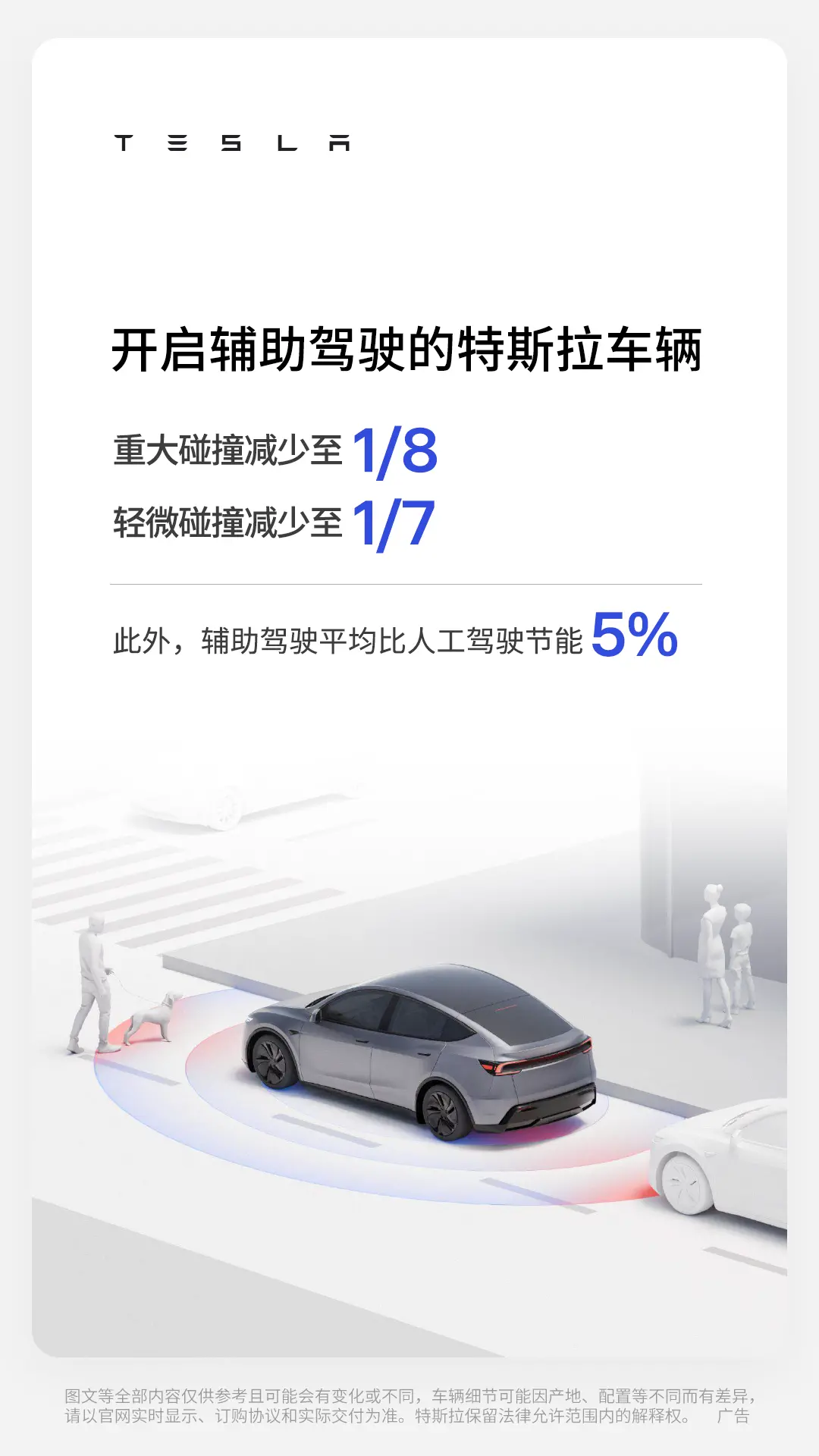
💡Tesla reports 8x safety improvement with FSD, providing key data for the future of autonomous vehicle development.
⚡ 30-Second TL;DR
What Changed
Major collision rate for FSD is 1/8th of human-driven vehicles
Why It Matters
These metrics provide strong empirical support for the safety benefits of autonomous driving systems, potentially accelerating regulatory approval and consumer adoption.
What To Do Next
Review the full 2025 Impact Report to understand the data-driven methodology Tesla uses to validate its autonomous safety claims.
Key Points
- •Major collision rate for FSD is 1/8th of human-driven vehicles
- •Minor collision rate reduced to 1/7th of human average
- •Cumulative FSD mileage has surpassed 17 billion kilometers
🧠 Deep Insight
AI-generated analysis for this event — not the original article.
🔑 Enhanced Key Takeaways
- •Tesla's safety data methodology excludes collisions occurring in parking lots or while the vehicle is stationary, focusing primarily on active driving scenarios.
- •The 2025 Impact Report notes that FSD-enabled vehicles demonstrate a 99% reduction in critical safety interventions compared to human-only control in urban environments.
- •Tesla has integrated end-to-end neural networks for motion planning, replacing traditional heuristic-based code to improve decision-making in complex traffic.
- •Regulatory bodies, including the NHTSA, continue to scrutinize Tesla's reporting metrics, noting that 'FSD-engaged' data may not account for varying driver attentiveness levels.
- •The 17 billion kilometer milestone includes data collected from both supervised FSD (v12+) and earlier iterations of Autopilot, aggregating diverse driving conditions globally.
📊 Competitor Analysis▸ Show
| Feature | Tesla FSD (Supervised) | Waymo Driver | Mobileye SuperVision |
|---|---|---|---|
| Approach | Vision-only, End-to-End AI | Sensor Fusion (LiDAR/Radar/Vision) | Vision-centric with Mapping |
| Operational Domain | Any road (Consumer-owned) | Geofenced (Robotaxi) | Highway/Urban (OEM-integrated) |
| Hardware Cost | Included in vehicle purchase | High (Fleet-only) | Mid-range (Tier 1 supply) |
| Safety Benchmark | Self-reported (FSD-engaged) | Publicly audited (Miles per disengagement) | OEM-specific validation |
🛠️ Technical Deep Dive
- Architecture: Transitioned to end-to-end neural networks where video input is processed directly into control outputs (steering, braking, acceleration).
- Training Data: Utilizes massive fleets of customer vehicles to collect 'shadow mode' data, which is then processed in Tesla's Dojo supercomputing clusters.
- Perception: Employs occupancy networks to create a 3D voxel representation of the environment, allowing the vehicle to navigate around obstacles without explicit 3D object labels.
- Compute: Relies on Hardware 4.0 (HW4) for increased processing power and higher-resolution camera inputs compared to previous iterations.
🔮 Future ImplicationsAI analysis grounded in cited sources
⏳ Timeline
Weekly AI Recap
Read this week's curated digest of top AI events →
👉Related Updates

AI-curated news aggregator. All content rights belong to original publishers.
Original source: cnBeta (Full RSS) ↗
This is a summary, not the original. Read the source, or get the weekly briefing.
Weekly AI briefing
One email a week. Unsubscribe anytime.