Tesla FSD Enters China, Challenging Local Competitors
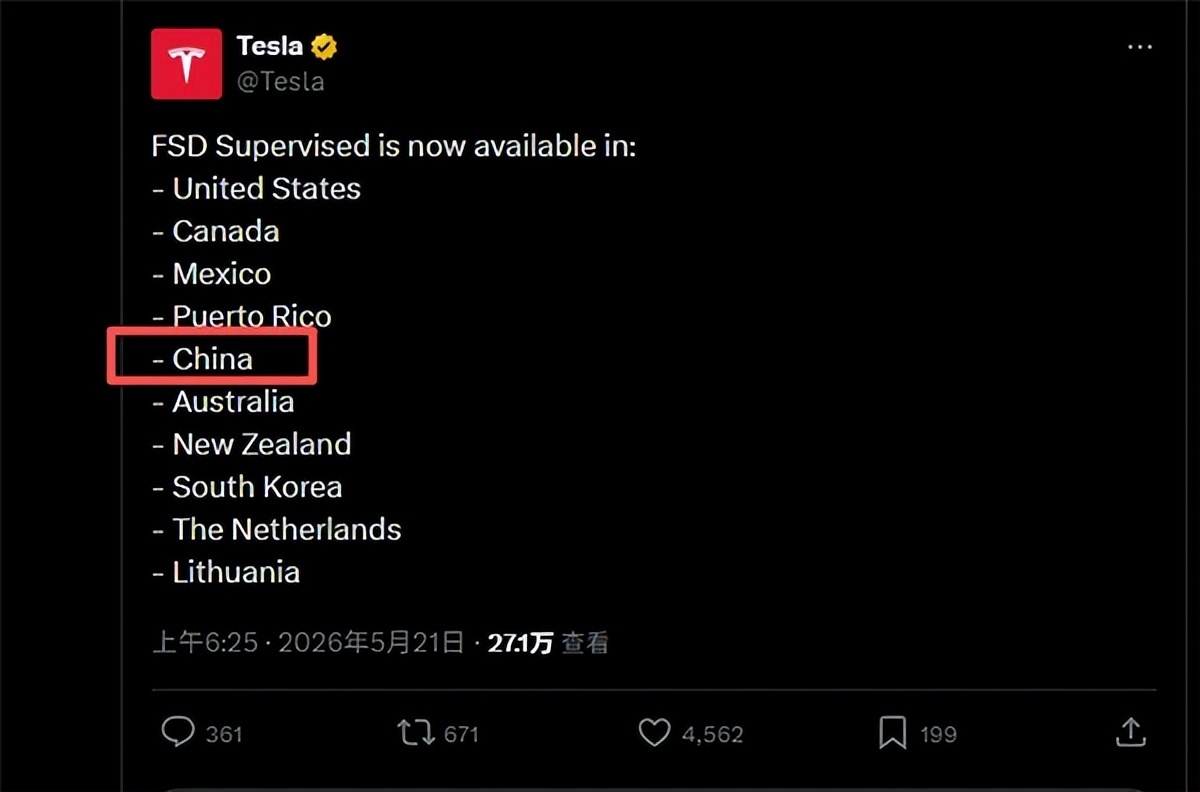
See how Tesla's FSD entry is disrupting the competitive landscape for autonomous driving in China.
30-Second TL;DR
What Changed
Tesla FSD is officially entering the Chinese market
Why It Matters
The entry of Tesla FSD will likely accelerate the adoption of end-to-end autonomous driving technology in China, forcing local players to innovate faster.
What To Do Next
Benchmark your autonomous driving stack against Tesla's FSD V12 end-to-end approach to identify potential performance gaps.
Key Points
- •Tesla FSD is officially entering the Chinese market
- •Local autonomous driving firms face a shrinking window of opportunity
- •Competition is intensifying between global leaders and local startups
Deep Insight
Background and context from public sources — not the original article. 24 sources cited.
Enhanced Key Takeaways
- •Tesla has established a dedicated data center in Shanghai and partnered with Baidu for mapping services to comply with China's stringent data localization and regulatory requirements for autonomous driving technology.
- •While Tesla's FSD Supervised is now officially available in China, full regulatory approval for a nationwide rollout to all eligible vehicles is still pending, with the company targeting Q3 2026 for broader clearance.
- •Unlike other global markets where Tesla transitioned to a subscription-only model for FSD in February 2026, China currently maintains a one-time purchase option for 64,000 yuan (approximately $9,400 USD), with a monthly subscription service yet to be introduced.
- •Chinese domestic competitors like Changan Auto and BAIC Motor have already received Level 3 autonomous driving certifications as of December 2025, a capability that Tesla's FSD (Supervised) (a Level 2 system) does not yet offer.
- •Local players like DeepRoute.ai have achieved significant deployment scale, with over 300,000 cars using its assisted-driving system on Chinese roads by April 2026 and a target of 1 million by year-end 2026, while Momenta has secured partnerships with major OEMs including SAIC, BYD, Mercedes-Benz, and BMW.
Competitor Analysis
- Tesla FSD (Supervised)
- Level 2 ADAS (requires constant driver attention)
- Momenta
- ADAS, Robotaxi (L3 testing with GM in Shanghai)
- DeepRoute.ai
- ADAS, Robotaxi, Robotrucks (L4 solution available)
- Tesla FSD (Supervised)
- Vision-only (cameras)
- Momenta
- Deep learning software, partnerships with OEMs for various sensor suites
- DeepRoute.ai
- Full-stack, supports both LiDAR-based and vision-only configurations
- Tesla FSD (Supervised)
- End-to-end AI, Occupancy Networks, World Model, Video-based neural networks
- Momenta
- Deep learning software, intelligent driving technologies
- DeepRoute.ai
- Vision-Language-Action (VLA) model, chain-of-thought reasoning, large language model integration
- Tesla FSD (Supervised)
- 64,000 yuan (one-time purchase); no monthly subscription yet
- Momenta
- B2B model (software licensing to OEMs); no direct consumer pricing found
- DeepRoute.ai
- Targets vehicles priced 150,000-300,000 yuan for assisted-driving system
- Tesla FSD (Supervised)
- Limited, supervised deployment; full rollout pending Q3 2026 approval
- Momenta
- Partnerships with SAIC, BYD, Mercedes-Benz, Toyota, GM, BMW for ADAS and robotaxi operations
- DeepRoute.ai
- Over 300,000 cars with assisted-driving system by April 2026; targeting 1 million by end of 2026
- Tesla FSD (Supervised)
- Local data center in Shanghai, local AI training center for closed-loop data processing within China
- Momenta
- Not explicitly detailed, but operates in China with local partnerships
- DeepRoute.ai
- Not explicitly detailed, but operates in China with local partnerships
| Feature/Category | Tesla FSD (Supervised) | Momenta | DeepRoute.ai |
|---|---|---|---|
| Autonomy Level | Level 2 ADAS (requires constant driver attention) | ADAS, Robotaxi (L3 testing with GM in Shanghai) | ADAS, Robotaxi, Robotrucks (L4 solution available) |
| Perception System | Vision-only (cameras) | Deep learning software, partnerships with OEMs for various sensor suites | Full-stack, supports both LiDAR-based and vision-only configurations |
| Key Technologies | End-to-end AI, Occupancy Networks, World Model, Video-based neural networks | Deep learning software, intelligent driving technologies | Vision-Language-Action (VLA) model, chain-of-thought reasoning, large language model integration |
| Pricing (China) | 64,000 yuan (one-time purchase); no monthly subscription yet | B2B model (software licensing to OEMs); no direct consumer pricing found | Targets vehicles priced 150,000-300,000 yuan for assisted-driving system |
| Deployment Scale (China) | Limited, supervised deployment; full rollout pending Q3 2026 approval | Partnerships with SAIC, BYD, Mercedes-Benz, Toyota, GM, BMW for ADAS and robotaxi operations | Over 300,000 cars with assisted-driving system by April 2026; targeting 1 million by end of 2026 |
| Data Handling | Local data center in Shanghai, local AI training center for closed-loop data processing within China | Not explicitly detailed, but operates in China with local partnerships | Not explicitly detailed, but operates in China with local partnerships |
Technical Deep Dive
- Tesla FSD:
- Vision-Only Philosophy: Relies exclusively on a suite of cameras for perception, eschewing LiDAR and radar, based on the premise that humans drive using vision.
- Neural Network Stack: Utilizes a pipeline of interconnected neural networks, transitioning towards video-based neural networks to analyze temporal continuity and understand motion across frames.
- Occupancy Networks: A key breakthrough that predicts which 3D space is occupied versus free, even with partial occlusions, improving depth estimation and prediction of hidden obstacles.
- World Model: Converts perception data into a vector space representation, where elements like lanes become splines and vehicles are dynamic objects with predicted trajectories.
- End-to-End AI: FSD V12.0, released in August 2023, marked a significant shift by replacing approximately 300,000 lines of C++ code with neural network decision-making, directly processing raw input data to output control commands.
- Training Infrastructure: Historically used NVIDIA GPUs, but now leverages its custom-built Dojo supercomputer, optimized for video training workloads and neural network scaling.
- Hardware Requirements: Requires Hardware 3 (HW3) or newer, with newer vehicles shipping with Hardware 4 (HW4). Older HW3 vehicles may require a hardware retrofit for full FSD capability.
- DeepRoute.ai:
- VLA Model (Vision-Language-Action): A core component of its DeepRoute IO 2.0 platform, integrating visual perception, semantic understanding, and action decision-making into a unified framework. It employs chain-of-thought reasoning and large language model integration for enhanced interpretability and generalization across diverse driving cultures.
- DeepRoute IO 2.0 Platform: Features a flexible "multi-modal, multi-chip, multi-vehicle" architecture, supporting both LiDAR-based and vision-only sensor configurations, adaptable to various vehicle types.
- DeepRoute-Driver 2.0: An L4-level autonomous driving solution that includes five solid-state LiDAR sensors, eight cameras, a proprietary computing system, and optional millimeter-wave radar, designed for a production cost under US$10,000.
Future ImplicationsAI analysis grounded in cited sources
Timeline
- 2019Tesla's Shanghai Gigafactory opens, enabling localized production of Model 3/Y with Autopilot hardware.
- 2020-2023Tesla establishes a data center in Shanghai and partners with Baidu for mapping services to comply with Chinese data laws.
- 2023-08Elon Musk live-streams the release of Tesla's FSD V12.0, its first end-to-end AI autonomous driving system.
- 2024-04China Association of Automobile Manufacturers (CAAM) confirms Tesla satisfied four mandatory data security requirements.
- 2025-02Tesla pushes 'City Autopilot' to some Chinese owners, but suspends rollout due to approval issues.
- 2026-02Tesla's Shanghai Lingang AI training center officially begins operations, ensuring local data processing and model training.
- 2026-05-21Tesla officially confirms FSD (Supervised) support for the Chinese market.
Sources (24)
Factual claims are grounded in the sources below. Forward-looking analysis is AI-generated interpretation.
Weekly AI Recap
Read this week's curated digest of top AI events →
AI-curated news aggregator. All content rights belong to original publishers.
Original source: 钛媒体 ↗
This is a summary, not the original. Read the source, or get the weekly briefing.
The weekly digest
One email a week. Unsubscribe anytime.