Tencent tests Xiaowei AI assistant for Q3 WeChat rollout
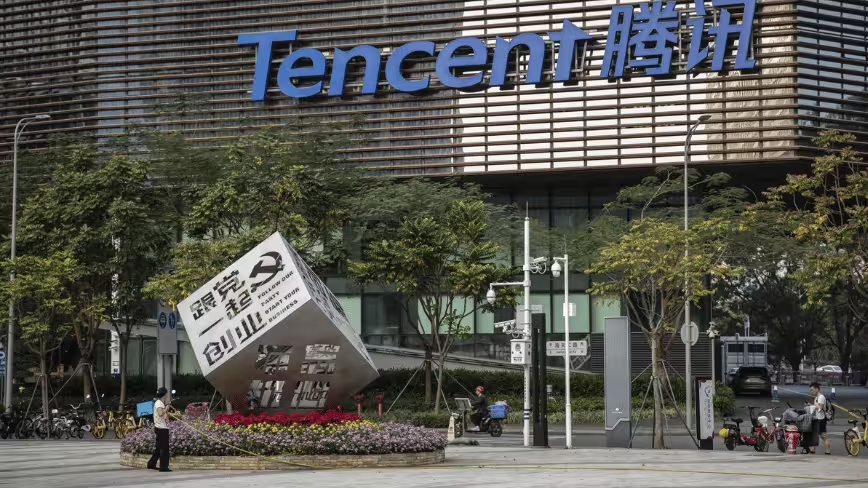
Tencent is betting on super-app AI integration over standalone chatbots. See how it changes the agent landscape.
30-Second TL;DR
What Changed
Xiaowei AI assistant is being tested for integration within WeChat.
Why It Matters
This integration could set a precedent for super-apps to monopolize AI agent interaction, potentially shifting user behavior away from standalone AI chatbots.
What To Do Next
Monitor Tencent's developer documentation for potential API access to the Xiaowei agent framework for third-party mini-program integration.
Key Points
- •Xiaowei AI assistant is being tested for integration within WeChat.
- •Tencent targets a Q3 rollout for the new AI features.
- •Strategy focuses on embedding AI into an existing super-app rather than a standalone chatbot.
Deep Insight
AI-generated analysis for this event — not the original article.
Enhanced Key Takeaways
- •Tencent's Xiaowei was originally launched as a cloud-based intelligent assistant platform in 2017, primarily targeting smart hardware and IoT devices before this pivot to WeChat integration.
- •The integration leverages Tencent's proprietary Hunyuan large language model (LLM) to power the conversational capabilities within the WeChat interface.
- •This rollout is part of a broader 'AI-in-All' strategy by Tencent to defend WeChat's market share against ByteDance's Doubao and other aggressive AI-native competitors in China.
- •The Xiaowei integration will include deep-linking capabilities, allowing the AI to trigger specific WeChat Mini Programs and internal services like WeChat Pay and Video Accounts directly.
- •Regulatory compliance remains a critical focus, with Tencent implementing mandatory content filtering and safety guardrails to align with China's strict generative AI service management regulations.
Competitor Analysis
- Tencent Xiaowei (WeChat)
- Super-app (WeChat)
- ByteDance Doubao
- Standalone App / Web
- Alibaba Tongyi Qianwen
- Cloud / DingTalk
- Tencent Xiaowei (WeChat)
- High (Payments/Social)
- ByteDance Doubao
- Medium (Content/Video)
- Alibaba Tongyi Qianwen
- High (Enterprise/Office)
- Tencent Xiaowei (WeChat)
- Hunyuan
- ByteDance Doubao
- Doubao (Cloud)
- Alibaba Tongyi Qianwen
- Qwen
- Tencent Xiaowei (WeChat)
- Freemium (Integrated)
- ByteDance Doubao
- Freemium (Token-based)
- Alibaba Tongyi Qianwen
- Freemium (API/Cloud)
| Feature | Tencent Xiaowei (WeChat) | ByteDance Doubao | Alibaba Tongyi Qianwen |
|---|---|---|---|
| Primary Platform | Super-app (WeChat) | Standalone App / Web | Cloud / DingTalk |
| Ecosystem Depth | High (Payments/Social) | Medium (Content/Video) | High (Enterprise/Office) |
| Core Model | Hunyuan | Doubao (Cloud) | Qwen |
| Pricing | Freemium (Integrated) | Freemium (Token-based) | Freemium (API/Cloud) |
Technical Deep Dive
- Architecture: Utilizes a Mixture-of-Experts (MoE) framework within the Hunyuan model to optimize latency for mobile-first interactions.
- Integration Layer: Implements a lightweight agentic framework that translates natural language queries into API calls for WeChat Mini Programs.
- Context Window: Optimized for short-to-medium context retention to maintain performance within the constrained memory environment of the WeChat mobile client.
- Edge Processing: Employs hybrid cloud-edge computing to handle basic intent recognition locally, reducing round-trip latency for common commands.
Future ImplicationsAI analysis grounded in cited sources
Timeline
- 2017-06Tencent officially launches the Xiaowei intelligent assistant platform.
- 2023-09Tencent unveils the Hunyuan large language model at the Global Digital Ecosystem Summit.
- 2024-05Tencent begins internal testing of AI-powered features for the WeChat ecosystem.
- 2026-03Tencent announces the strategic alignment of Xiaowei with the Hunyuan model for mobile integration.
Event Coverage
Weekly AI Recap
Read this week's curated digest of top AI events →
Related Updates


AI-curated news aggregator. All content rights belong to original publishers.
Original source: The Next Web (TNW) ↗
This is a summary, not the original. Read the source, or get the weekly briefing.
The weekly digest
One email a week. Unsubscribe anytime.