Tencent Music pivots to a second battlefield
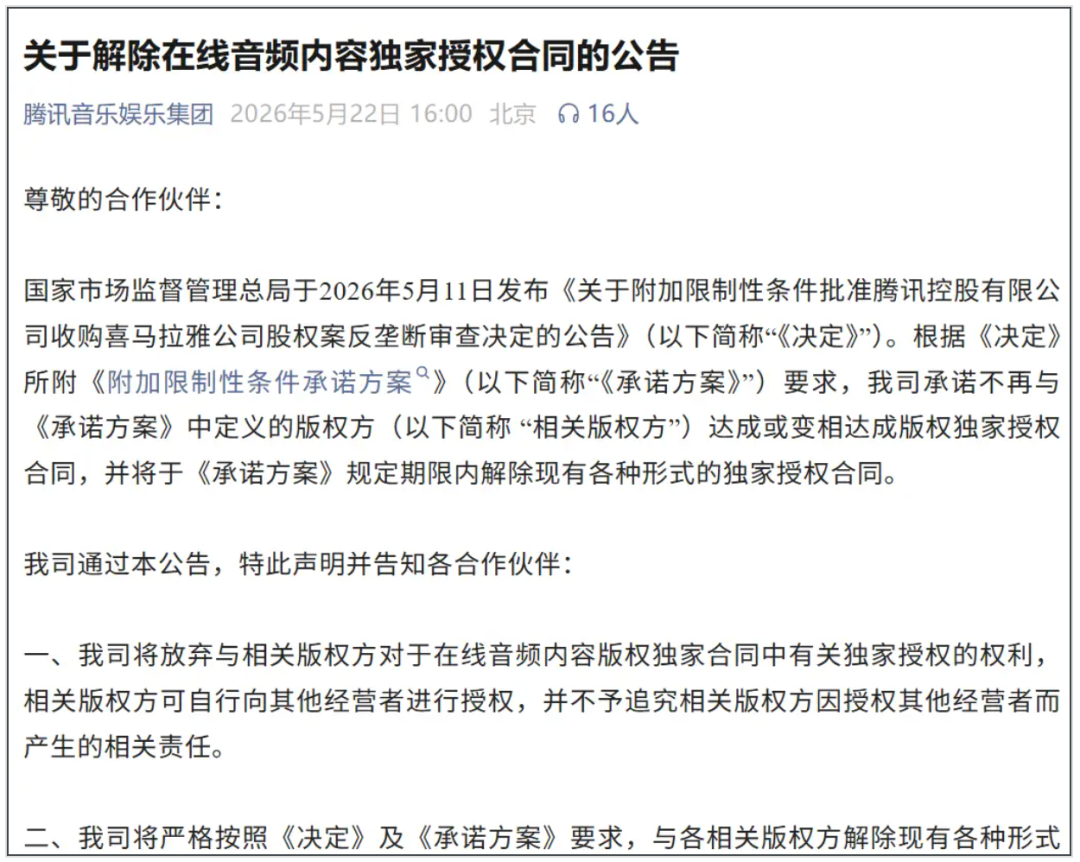
Understand how major Chinese entertainment platforms are pivoting their business models in the AI era.
30-Second TL;DR
What Changed
Tencent Music is diversifying its business model beyond traditional streaming
Why It Matters
This shift signals a broader trend among Chinese tech giants to pivot away from saturated consumer entertainment markets toward more sustainable, high-margin AI or service-oriented models.
What To Do Next
Monitor Tencent's financial reports for specific investments in AI-driven content generation or personalized recommendation infrastructure.
Key Points
- •Tencent Music is diversifying its business model beyond traditional streaming
- •The company faces significant pressure to find new revenue streams
- •Strategic transition involves balancing core assets with emerging market opportunities
Deep Insight
Background and context from public sources — not the original article. 11 sources cited.
Enhanced Key Takeaways
- •Tencent Music has significantly expanded its long-form audio offerings, including podcasts and audiobooks, notably through the acquisition of Ximalaya in 2025, aiming to capture a larger share of total audio consumption time.
- •The company is aggressively pivoting into physical live concert promotion and ticketing, launching an in-house ticketing service called E Piao Piao in February 2026 and reporting triple-digit year-over-year growth in this segment.
- •TME is leveraging artificial intelligence for various functions, including AI-generated content (AIGC) tools like "Venus" for artists, LLM-based personalized recommendation systems, and advanced AI-driven content governance for copyright compliance and identifying AI-generated material.
- •A strategic shift has occurred from a reliance on social entertainment (primarily virtual gifting) to a subscription-first model, with online music services becoming the dominant revenue contributor by early 2025.
- •TME is pursuing international market penetration, particularly in high-growth regions like Southeast Asia and Latin America, by leveraging its WeSing karaoke app and the JOOX streaming service.
Technical Deep Dive
- AI-driven Content Creation (AIGC): TME Studio provides AIGC tools for melody, lyrics, and vocal enhancement, with the "Venus" AI tool enabling artists to generate companion tracks.
- Personalized Recommendations: In 2025, TME deployed an LLM-based recommender that reportedly improved average daily listening time per user by 10%. The proprietary Lingyin AI engine powered over 80% of personalized music recommendations in 2024.
- Advanced Audio Technologies: TME has invested in spatial audio patents to create a competitive advantage for its premium tiers and launched 24-bit Hi-Res FLAC audio streams for Super VIP subscribers in late 2024.
- Content Governance and Identification: The company utilizes AI-based detection systems, including audio fingerprinting, voiceprint recognition, melody comparison, and text similarity analysis, to monitor its catalog for copyright compliance and practices like "song theft."
- Blockchain for Rights Management: TME's innovation roadmap includes the use of blockchain for rights ledgers to potentially reduce disputes and expedite royalty payouts.
Future ImplicationsAI analysis grounded in cited sources
Timeline
- 2016-07Tencent Music Entertainment Group (TME) formally established through merger of Tencent's QQ Music with China Music Corporation (Kugou and Kuwo).
- 2018-12TME lists on the New York Stock Exchange (NYSE), raising approximately $1.1 billion.
- 2019-09TME announces its Content, Technology and Service (CTS) strategy, emphasizing diversification into long-form audio and IoT partnerships.
- 2021-04TME unveils its future strategy for long-form audio, integrating content sections on its music apps and launching standalone platforms.
- 2023TME Live pivots towards physical concerts, entering a strategic partnership with Galaxy Arena in Macau.
- 2025TME acquires Ximalaya, a leading long-form audio platform, significantly expanding its non-music audio offerings.
Sources (11)
Factual claims are grounded in the sources below. Forward-looking analysis is AI-generated interpretation.
Weekly AI Recap
Read this week's curated digest of top AI events →
AI-curated news aggregator. All content rights belong to original publishers.
Original source: 钛媒体 ↗
This is a summary, not the original. Read the source, or get the weekly briefing.
The weekly digest
One email a week. Unsubscribe anytime.