Systematic Engineering for AI-Driven Development
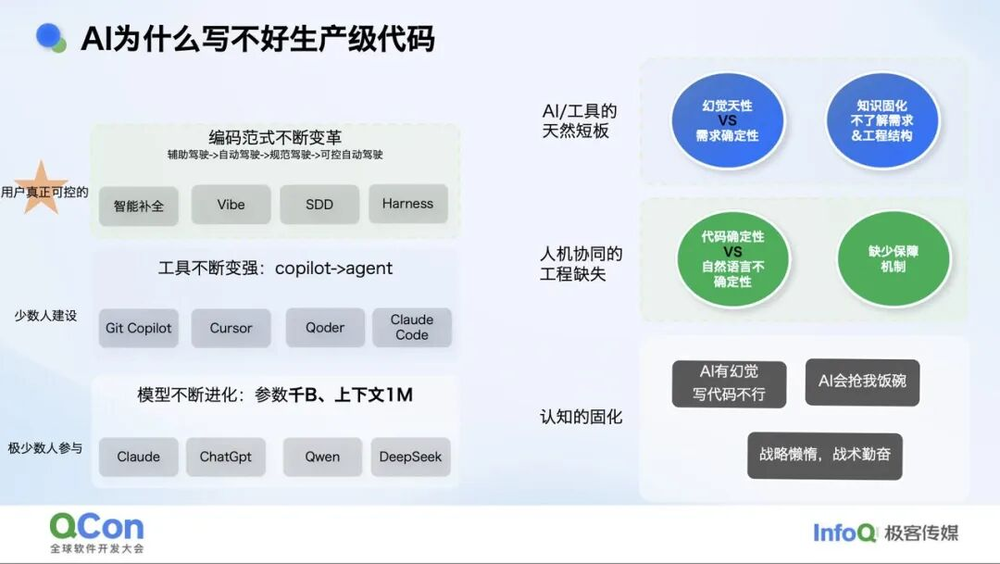
💡Learn how to move AI coding from experimental to production-ready using architectural constraints.
⚡ 30-Second TL;DR
What Changed
AI coding requires explicit architectural constraints to prevent hallucinated or misaligned code.
Why It Matters
Moving from 'vibe coding' to 'specification-driven development' is essential for enterprise-grade AI adoption.
What To Do Next
Create a 'claude.md' or project-specific rules file to define your architecture and coding standards for your AI agent.
Key Points
- •AI coding requires explicit architectural constraints to prevent hallucinated or misaligned code.
- •Differentiate between 'new feature' and 'modification' requirements to tailor AI analysis templates.
- •Establish a 'code quality closed-loop' by enforcing strict rules across requirement analysis and code review.
🧠 Deep Insight
AI-generated analysis for this event — not the original article.
🔑 Enhanced Key Takeaways
- •The methodology aligns with the emerging 'AI Software Engineering' (AISE) paradigm, which shifts focus from prompt engineering to deterministic workflow orchestration.
- •Industry adoption of 'Constitutional AI' in coding environments is increasingly utilizing RAG-based architectural guardrails to inject domain-specific coding standards into LLM context windows.
- •Modern AI-driven development frameworks are moving toward 'Agentic Workflows' where the AI acts as a multi-role team (Architect, Coder, Reviewer) rather than a single code-generation tool.
- •The 'closed-loop' quality control mentioned is being implemented via automated static analysis integration (e.g., SonarQube, ESLint) that triggers iterative AI self-correction cycles.
- •Standardization of 'Requirement Analysis Templates' is becoming a critical differentiator for enterprise-grade AI coding tools to reduce context-switching overhead for human developers.
🛠️ Technical Deep Dive
- Implementation of Chain-of-Thought (CoT) prompting specifically for architectural constraint enforcement.
- Utilization of Vector Databases to store organizational 'Code Constitutions' for retrieval during the requirement analysis phase.
- Integration of feedback loops where compiler error logs are fed back into the LLM context to facilitate automated debugging.
- Use of structured output formats (JSON/YAML) for requirement specifications to ensure deterministic parsing by downstream agentic processes.
🔮 Future ImplicationsAI analysis grounded in cited sources
Weekly AI Recap
Read this week's curated digest of top AI events →
👉Related Updates


AI-curated news aggregator. All content rights belong to original publishers.
Original source: 虎嗅 ↗
This is a summary, not the original. Read the source, or get the weekly briefing.
Weekly AI briefing
One email a week. Unsubscribe anytime.