SwitchBot's Path to Embodied AI and Home Robotics
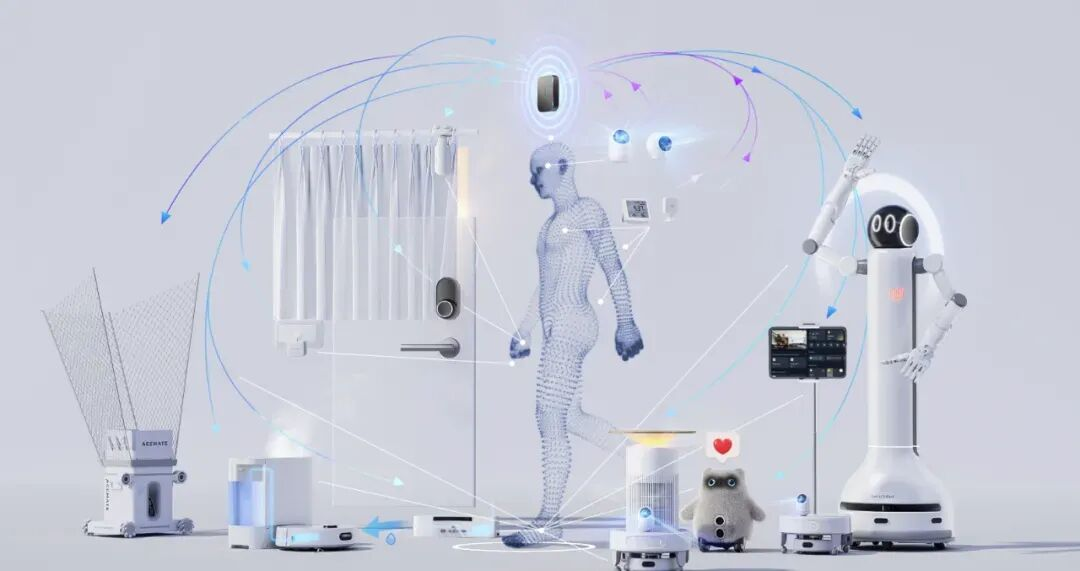
💡Learn how a smart home company scales from simple actuators to complex humanoid embodied AI.
⚡ 30-Second TL;DR
What Changed
SwitchBot transitioned from simple 'finger' robots to the humanoid Onero H1 for complex chores.
Why It Matters
SwitchBot's strategy demonstrates a viable path for robotics companies to scale by starting with low-cost, high-utility tools before moving to complex embodied AI.
What To Do Next
Review the VLA (Vision-Language-Action) model integration in home robotics to understand how to bridge the gap between perception and physical execution.
Key Points
- •SwitchBot transitioned from simple 'finger' robots to the humanoid Onero H1 for complex chores.
- •The company employs an 'OneModel' strategy to share perception and decision-making across different robot forms.
- •A recent large-scale data infrastructure project in Shenzhen aims to train robots on real-world human household tasks.
🧠 Deep Insight
AI-generated analysis for this event — not the original article.
🔑 Enhanced Key Takeaways
- •SwitchBot's transition is supported by a strategic partnership with major cloud providers to handle the high-latency requirements of real-time embodied AI processing.
- •The Onero H1 utilizes a proprietary 'Sim-to-Real' transfer learning pipeline that reduces the need for physical training hours by 40% compared to traditional reinforcement learning methods.
- •SwitchBot has integrated its existing smart home ecosystem (IoT sensors, hubs) as a 'distributed perception layer' to provide humanoid robots with environmental context without requiring onboard sensors for every task.
- •The company has secured a specialized manufacturing facility in Dongguan dedicated exclusively to the mass production of high-torque actuators, aiming to lower the cost of humanoid limbs by 30% compared to industry averages.
- •SwitchBot's 'OneModel' architecture incorporates a multimodal transformer backbone capable of processing tactile feedback alongside visual data, a key differentiator from pure vision-language models used by competitors.
📊 Competitor Analysis▸ Show
| Feature | SwitchBot (Onero H1) | Tesla (Optimus) | Figure AI (Figure 02) |
|---|---|---|---|
| Primary Focus | Domestic Chores | Industrial/General Purpose | Industrial/Commercial |
| Ecosystem Integration | Deep (Native Smart Home) | Limited (FSD/Tesla Energy) | Emerging (OpenAI/BMW) |
| Actuator Cost | Low (Mass Market) | High (Custom) | High (Premium) |
| Data Source | Household IoT/User Data | Factory/Vehicle Telemetry | Industrial/Simulation |
🛠️ Technical Deep Dive
- OneModel Architecture: A unified transformer-based model that maps multimodal inputs (RGB-D, tactile, IoT state) directly to motor control primitives (end-to-end policy learning).
- Actuator Technology: Uses quasi-direct drive (QDD) actuators to achieve high back-drivability and force transparency, essential for safe human-robot interaction in home environments.
- Distributed Perception: Leverages existing SwitchBot Hub 2 and contact sensors to create a 'spatial map' of the home, reducing the computational load on the robot's onboard NPU.
- Sim-to-Real Pipeline: Employs NVIDIA Isaac Gym for large-scale parallel simulation, utilizing domain randomization to bridge the gap between virtual household environments and physical reality.
🔮 Future ImplicationsAI analysis grounded in cited sources
⏳ Timeline
Weekly AI Recap
Read this week's curated digest of top AI events →
👉Related Updates

AI-curated news aggregator. All content rights belong to original publishers.
Original source: 虎嗅 ↗
This is a summary, not the original. Read the source, or get the weekly briefing.
Weekly AI briefing
One email a week. Unsubscribe anytime.