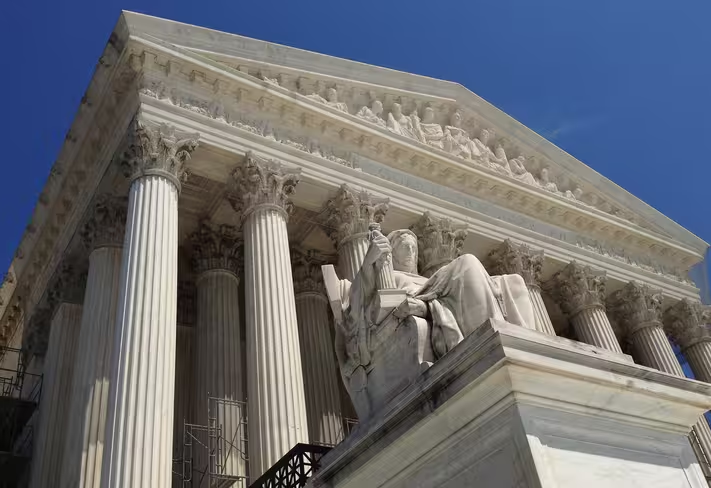
Supreme Court allows Texas age verification for app stores
💡New regulatory hurdles for app distribution that could impact user onboarding and global compliance strategies.
⚡ 30-Second TL;DR
What Changed
Texas law mandates age verification for app store downloads
Why It Matters
Developers may face new friction in user acquisition and must prepare for stricter compliance requirements across app stores.
What To Do Next
Review your app's target demographic and prepare for potential integration of age-verification SDKs to maintain store compliance.
Key Points
- •Texas law mandates age verification for app store downloads
- •Apple and Google are now responsible for enforcing age-gating
- •Supreme Court refusal to block the law signals potential nationwide compliance shifts
🧠 Deep Insight
AI-generated analysis for this event — not the original article.
🔑 Enhanced Key Takeaways
- •The law, known as HB 20, specifically targets platforms that host content deemed harmful to minors, requiring them to implement 'commercially reasonable' age verification methods.
- •Privacy advocates and tech industry groups have challenged the law on First Amendment grounds, arguing that age verification mandates infringe upon anonymous speech and user privacy.
- •Texas officials have argued that the law is a necessary measure to protect children from exposure to sexually explicit content and online predators, framing it as a consumer protection issue.
- •The Supreme Court's decision to decline the stay is an interlocutory ruling, meaning the underlying constitutional challenges to the law will continue to proceed through the lower courts.
- •This legal development follows a broader trend of state-level legislation, such as Utah's Social Media Regulation Act, which has similarly sought to impose stricter age-gating requirements on digital platforms.
🛠️ Technical Deep Dive
- The law requires platforms to implement age verification systems that can reliably determine if a user is under 18 without necessarily requiring government-issued ID for every transaction.
- Potential implementation methods include third-party identity verification services, facial age estimation algorithms, or credit card-based age verification.
- Platforms must balance these verification requirements with data minimization principles to comply with existing privacy regulations like GDPR or CCPA.
- Technical challenges include preventing 'false negatives' where adults are blocked, and 'false positives' where minors bypass the system using VPNs or spoofing tools.
🔮 Future ImplicationsAI analysis grounded in cited sources
⏳ Timeline
Weekly AI Recap
Read this week's curated digest of top AI events →
👉Related Updates


AI-curated news aggregator. All content rights belong to original publishers.
Original source: The Next Web (TNW) ↗
This is a summary, not the original. Read the source, or get the weekly briefing.
Weekly AI briefing
One email a week. Unsubscribe anytime.