Supreme Court rules warrants required for geofence searches
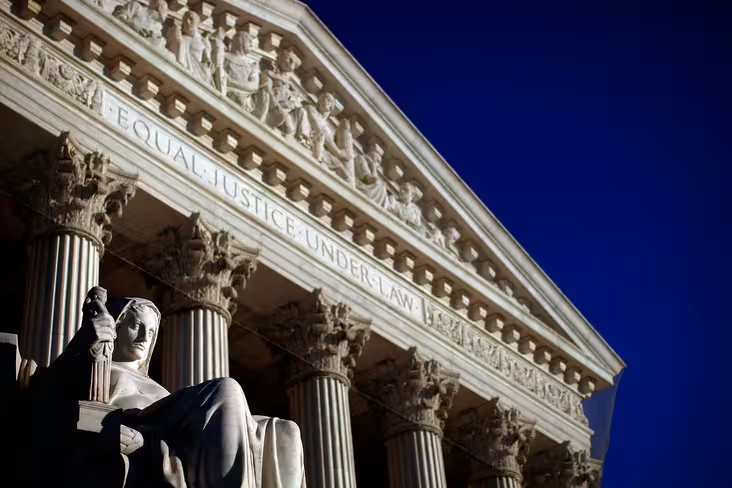
Learn how new legal precedents on location data will impact the future of location-aware AI applications.
30-Second TL;DR
What Changed
Geofence searches now legally require a warrant in the US.
Why It Matters
This ruling sets a major precedent for digital privacy and data usage. AI practitioners building location-based services must prepare for stricter data handling and compliance requirements.
What To Do Next
Review your data retention policies and location-tracking features to ensure compliance with evolving digital privacy laws.
Key Points
- •Geofence searches now legally require a warrant in the US.
- •The ruling addresses the privacy implications of minute-by-minute location tracking.
- •This marks a significant shift in how digital evidence is collected by law enforcement.
Deep Insight
AI-generated analysis for this event — not the original article.
Enhanced Key Takeaways
- •The Supreme Court ruling specifically addresses the 'reverse-location' search process, where law enforcement requests data for all devices present in a specific area during a specific timeframe.
- •The decision establishes that geofence data constitutes a 'search' under the Fourth Amendment, rejecting the argument that users voluntarily share location data with third-party service providers.
- •Justice-authored opinions in the ruling highlighted the 'mosaic theory' of privacy, noting that granular, long-term location tracking reveals intimate details of a person's life, including religious, political, and medical associations.
- •Tech companies like Google and Apple had previously implemented internal policy changes to limit geofence data retention, which the Court's ruling now codifies as a constitutional requirement.
- •The ruling explicitly distinguishes between 'targeted' warrants for specific individuals and 'dragnet' geofence requests, setting a higher probable cause threshold for the latter.
Technical Deep Dive
- Geofence searches rely on 'Sensorvault' or similar databases maintained by tech companies, which aggregate GPS, Wi-Fi, Bluetooth, and cellular tower triangulation data.
- The technical process involves a multi-step de-identification filter where law enforcement receives anonymous device IDs before requesting specific user identities via a secondary warrant.
- The ruling impacts the 'reverse-search' algorithm, which processes temporal and spatial coordinates against massive historical datasets to identify unique device signatures within a defined polygon.
Future ImplicationsAI analysis grounded in cited sources
Timeline
- 2018-04Initial reports emerge of law enforcement using Google's 'Sensorvault' for geofence warrants.
- 2022-08Google announces it will begin storing location history on-device rather than in the cloud to limit data availability.
- 2024-01Google officially ends the practice of responding to geofence warrants by transitioning to on-device storage.
- 2026-06Supreme Court issues final ruling mandating warrants for all geofence-style location data requests.
Weekly AI Recap
Read this week's curated digest of top AI events →
Related Updates



AI-curated news aggregator. All content rights belong to original publishers.
Original source: The Next Web (TNW) ↗
This is a summary, not the original. Read the source, or get the weekly briefing.
The weekly digest
One email a week. Unsubscribe anytime.