Sumitomo Rubber and Fujitsu Accelerate Tire FEM Analysis with AI
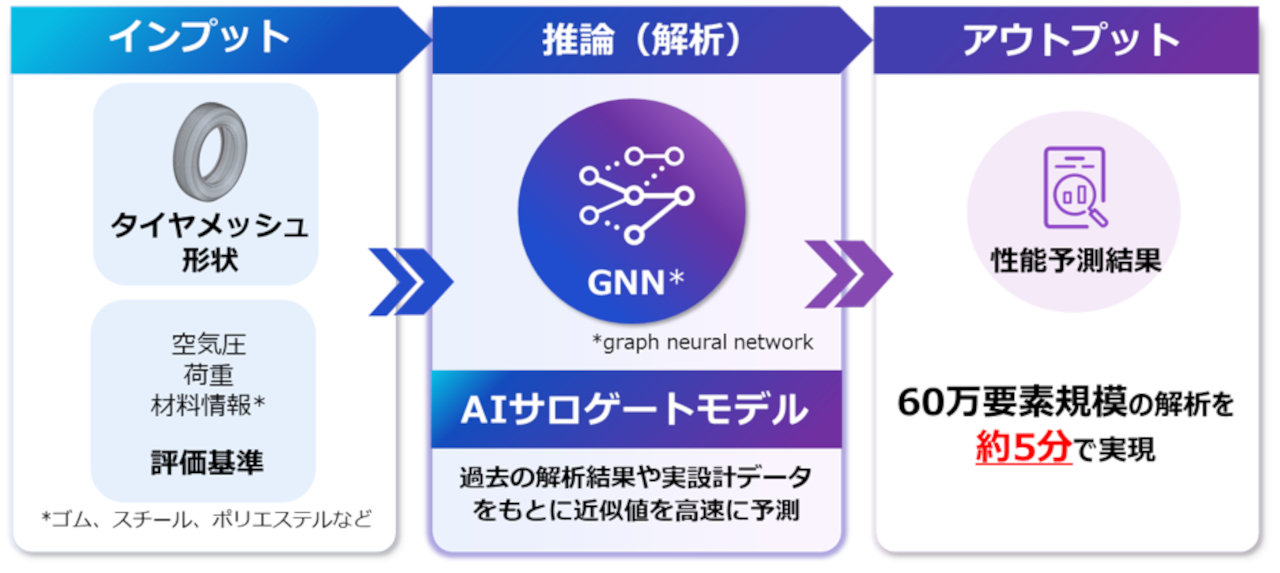
💡See how AI surrogate models are cutting industrial simulation times by 9x, transforming traditional R&D workflows.
⚡ 30-Second TL;DR
What Changed
Reduced tire FEM analysis time from 45 minutes to 5 minutes.
Why It Matters
This development demonstrates the practical application of AI surrogate models in industrial engineering to replace computationally expensive traditional simulations. It sets a precedent for accelerating R&D cycles in manufacturing through AI-driven digital twins.
What To Do Next
Investigate using surrogate modeling (e.g., Physics-Informed Neural Networks) to replace heavy numerical simulations in your own engineering workflows.
Key Points
- •Reduced tire FEM analysis time from 45 minutes to 5 minutes.
- •Successfully handled complex simulations involving 600,000 elements.
- •Joint development between Sumitomo Rubber Industries and Fujitsu.
- •AI surrogate modeling enables rapid iteration in tire performance prediction.
🧠 Deep Insight
Background and context from public sources — not the original article. 20 sources cited.
🔑 Enhanced Key Takeaways
- •The AI model leverages a Graph Neural Network (GNN) algorithm, trained using Sumitomo Rubber's tire design expertise and actual design data.
- •The technology achieved an average accuracy of 87.7% in predicting tire-to-road contact shape compared to traditional FEM analysis.
- •The AI surrogate model is optimized for Fujitsu's upcoming Arm-based FUJITSU-MONAKA processor, aiming for enhanced inference speed and power efficiency.
- •This initiative is a key component of Sumitomo Rubber's long-term digital transformation strategy, "R.I.S.E. 2035," for tire design and development.
- •Fujitsu plans to commercialize this AI inference platform, integrating FUJITSU-MONAKA and GNN, through its "Fujitsu Kozuchi" AI platform for broader application in manufacturing.
📊 Competitor Analysis▸ Show
| Feature/Company | Sumitomo Rubber/Fujitsu (AI Surrogate Model) | NEXEN TIRE (AI Performance Prediction System) | Dassault Systèmes SIMULIA (AI for Tire Optimization) | Altair (Physics AI) | NVIDIA PhysicsNeMo / Siml.ai | Energent.ai |
|---|---|---|---|---|---|---|
| Focus | Tire structural analysis (deformation, contact characteristics) | Key tire performance metrics (fuel efficiency, noise, handling, grip) | Tire design optimization (new sizes, trade-offs) | Durability and stiffness of automotive components | General physics-based AI surrogate modeling | AI-accelerated FEA, unstructured data processing |
| Technology | Graph Neural Network (GNN) surrogate model | Machine Learning | AI, Reduced-Order Models (ROMs) | Machine Learning | Physics-informed ML, Deep Learning | AI-powered platforms |
| Speedup | 90% reduction (45 min to 5 min) | "Quickly and accurately forecast" | "Speeding up design iterations" | 30% reduction in design/solution times | Near-real-time latency | Up to 100x faster structural predictions |
| Accuracy | 87.7% average accuracy for tire-road contact shape | Not specified (high accuracy claimed) | Not specified (precise answers claimed) | Accurate predictions | High-fidelity | Not specified for simulation, 94.4% for data parsing |
| Hardware | Optimized for Fujitsu-Monaka CPU | Not specified | Not specified | Not specified | Optimized for NVIDIA GPUs | Not specified |
| Availability | Practical implementation at Sumitomo Rubber by April 2027; Fujitsu Kozuchi platform for others | Established in 2022 | Commercial solutions available | Commercial solutions available | Open-source platform (PhysicsNeMo), commercial (Siml.ai) | Commercial platform |
🛠️ Technical Deep Dive
- The AI surrogate model is built upon a Graph Neural Network (GNN) algorithm.
- It is trained using accumulated finite element method (FEM) analysis results and Sumitomo Rubber's tire design expertise and actual design data.
- The model's function is to rapidly predict solutions to the governing equations used in FEM analysis.
- The proof-of-concept specifically evaluated tire deformation behavior and contact characteristics, including contact shape and pressure distribution under road contact conditions.
- The technology is optimized for Fujitsu's next-generation Arm-based CPU, FUJITSU-MONAKA, which is designed for high performance and energy efficiency.
- Fujitsu's broader AI Solver platform, which may underpin this solution, aims to convert physics-based simulators into AI simulators, achieving speedups from hours to milliseconds with minimal discrepancy.
- The solution is intended to be integrated into a tire design support tool, making it accessible to designers without requiring specialized machine learning expertise.
🔮 Future ImplicationsAI analysis grounded in cited sources
⏳ Timeline
📎 Sources (20)
Factual claims are grounded in the sources below. Forward-looking analysis is AI-generated interpretation.
Weekly AI Recap
Read this week's curated digest of top AI events →
👉Related Updates
AI-curated news aggregator. All content rights belong to original publishers.
Original source: ITmedia AI+ (日本) ↗
This is a summary, not the original. Read the source, or get the weekly briefing.
The weekly digest
One email a week. Unsubscribe anytime.