Student hacks high-speed rail with 19-year-old crypto keys
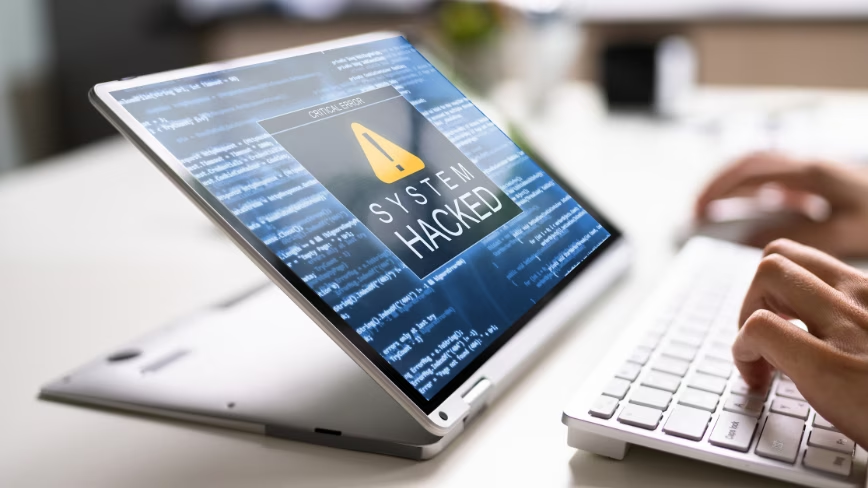
A critical security failure in industrial infrastructure caused by outdated crypto practices. Essential for security pro
30-Second TL;DR
What Changed
A student used a laptop and radio to transmit a falsified General Alarm signal.
Why It Matters
This incident highlights the critical danger of 'set-and-forget' security in legacy industrial control systems. It serves as a stark reminder for infrastructure operators to implement automated key rotation and modern authentication protocols.
What To Do Next
Audit your legacy infrastructure for hardcoded credentials or static cryptographic keys that haven't been rotated in over a year.
Key Points
- •A student used a laptop and radio to transmit a falsified General Alarm signal.
- •Four high-speed trains were forced into emergency manual braking at 300 km/h.
- •The vulnerability stemmed from cryptographic keys that were 19 years old.
- •The rail network experienced a 48-minute total service disruption.
Deep Insight
Background and context from public sources — not the original article. 13 sources cited.
Enhanced Key Takeaways
- •The student, identified as Lin, used commercially available Software-Defined Radio (SDR) equipment and a laptop to intercept, decode, and then spoof the signals of the Terrestrial Trunked Radio (TETRA) system.
- •An alleged 21-year-old accomplice, surnamed Chen, is suspected of providing critical Taiwan High-Speed Rail (THSR) communication parameters that enabled the attack.
- •The incident has prompted Taiwan's Ministry of Transportation and Communications to announce a one-month audit of rail communications and a pledge to harden railway system security.
- •The vulnerability exploited is not unique to Taiwan, as cybersecurity researchers have previously disclosed significant weaknesses in the TETRA protocol (e.g., Tetra:Burst and 2Tetra:2Burst in 2023 and 2025), and similar radio-based train disruption incidents occurred in Poland in August 2023.
- •Experts highlight that the incident underscores a global challenge with legacy operational technology (OT) infrastructure, which often lacks updated security mechanisms and is vulnerable to exploitation by inexpensive, widely available tools.
Technical Deep Dive
- The exploited system is TETRA (Terrestrial Trunked Radio), a standard developed in the 1990s for encrypted voice and data communication, used by emergency services, police, military, airports, and transport networks in approximately 120 countries.
- The attack involved using a Software-Defined Radio (SDR) filter to analyze THSRC signals, downloading data to a computer, cracking parameters, and then programming these codes into handheld radios to impersonate legitimate THSR beacons.
- The student bypassed seven verification layers due to the lack of cryptographic key rotation for 19 years.
- The specific type of encryption used by THSR's TETRA system is speculated to be the now-broken TEA1 encryption.
- The "General Alarm" signal is a high-priority message in THSR's safety protocol, requiring trains in the affected zone to immediately switch to manual emergency stop mode.
- The incident highlights the importance of Key Management Systems (KMS), which are crucial for generating, distributing, revoking, and managing cryptographic keys in railway communication systems like ERTMS and GSM-R to ensure secure train-to-ground communication.
Future ImplicationsAI analysis grounded in cited sources
Timeline
- 2007Taiwan High-Speed Rail (THSR) line opens, deploying the TETRA system with initial cryptographic keys that remained unchanged for 19 years.
- 2023Cybersecurity researchers disclose significant vulnerabilities in the TETRA protocol (Tetra:Burst and 2Tetra:2Burst), the same communication system used by THSR.
- 2026-04-05A 23-year-old student, Lin, uses a software-defined radio to transmit a falsified General Alarm signal, forcing four THSR trains into emergency braking.
- 2026-04-28Student Lin is arrested by police in connection with the high-speed rail disruption.
- 2026-05Taiwan's Ministry of Transportation and Communications announces a one-month audit of rail communications and pledges to enhance security.
Sources (13)
Factual claims are grounded in the sources below. Forward-looking analysis is AI-generated interpretation.
Weekly AI Recap
Read this week's curated digest of top AI events →
Related Updates



AI-curated news aggregator. All content rights belong to original publishers.
Original source: The Next Web (TNW) ↗
This is a summary, not the original. Read the source, or get the weekly briefing.
The weekly digest
One email a week. Unsubscribe anytime.