Streaming Benchmark Results to MLflow with SageMaker AI
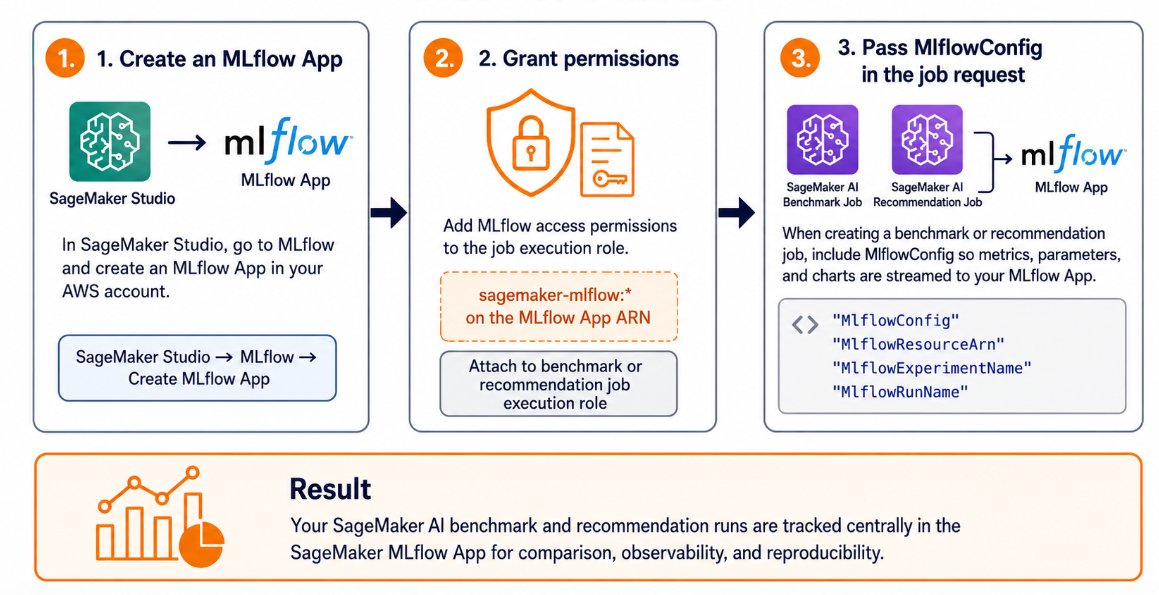
💡Streamline your ML experiment tracking by connecting SageMaker benchmarks directly to MLflow.
⚡ 30-Second TL;DR
What Changed
Real-time streaming of metrics to MLflow
Why It Matters
Enhances experiment visibility and reproducibility for ML engineers. It eliminates the need for manual logging and provides a centralized view of model performance.
What To Do Next
Enable the MLflow integration in your next SageMaker benchmark job to centralize your experiment tracking.
Key Points
- •Real-time streaming of metrics to MLflow
- •Unified tracking for inference recommendations and benchmarks
- •Supports serverless Amazon SageMaker MLflow App
🧠 Deep Insight
AI-generated analysis for this event — not the original article.
🔑 Enhanced Key Takeaways
- •The integration leverages the MLflow Tracking API, allowing SageMaker inference recommendation jobs to automatically log metrics such as latency, throughput, and instance cost efficiency.
- •This feature eliminates the need for manual post-processing of JSON output files from SageMaker Inference Recommender, reducing the time-to-insight for model deployment selection.
- •The serverless MLflow App on SageMaker acts as a managed tracking server, removing the operational overhead of hosting and maintaining a dedicated MLflow instance on EC2.
- •Users can now visualize comparative performance across different instance types (e.g., GPU vs. CPU) directly within the MLflow UI, facilitating data-driven hardware selection.
- •The streaming capability is compatible with existing MLflow SDKs, enabling seamless integration into CI/CD pipelines that trigger automated benchmarking upon model registration.
📊 Competitor Analysis▸ Show
| Feature | Amazon SageMaker + MLflow | Weights & Biases | Azure Machine Learning | Databricks MLflow |
|---|---|---|---|---|
| Streaming Benchmarks | Native Integration | Via SDK/API | Via Azure Monitor | Native Integration |
| Managed Tracking | Serverless App | SaaS/Private Cloud | Managed Service | Managed Service |
| Pricing | Pay-per-use (Serverless) | Tiered/Enterprise | Consumption-based | Consumption-based |
🛠️ Technical Deep Dive
- Implementation utilizes the MLflow Tracking URI configured to point to the SageMaker-managed MLflow endpoint.
- Inference Recommender jobs are configured via the SageMaker SDK to include an 'MLflowTrackingConfiguration' parameter.
- Metrics are streamed using the MLflow 'log_metric' and 'log_params' APIs during the benchmarking phase.
- The architecture supports asynchronous logging to ensure that the benchmarking process is not throttled by network latency to the tracking server.
- Authentication is handled via AWS IAM roles, ensuring secure communication between the SageMaker job and the MLflow tracking server without hardcoded credentials.
🔮 Future ImplicationsAI analysis grounded in cited sources
⏳ Timeline
Weekly AI Recap
Read this week's curated digest of top AI events →
👉Related Updates
AI-curated news aggregator. All content rights belong to original publishers.
Original source: AWS Machine Learning Blog ↗
This is a summary, not the original. Read the source, or get the weekly briefing.
Weekly AI briefing
One email a week. Unsubscribe anytime.