Strategic Talents Fuel AI-Driven Transformation
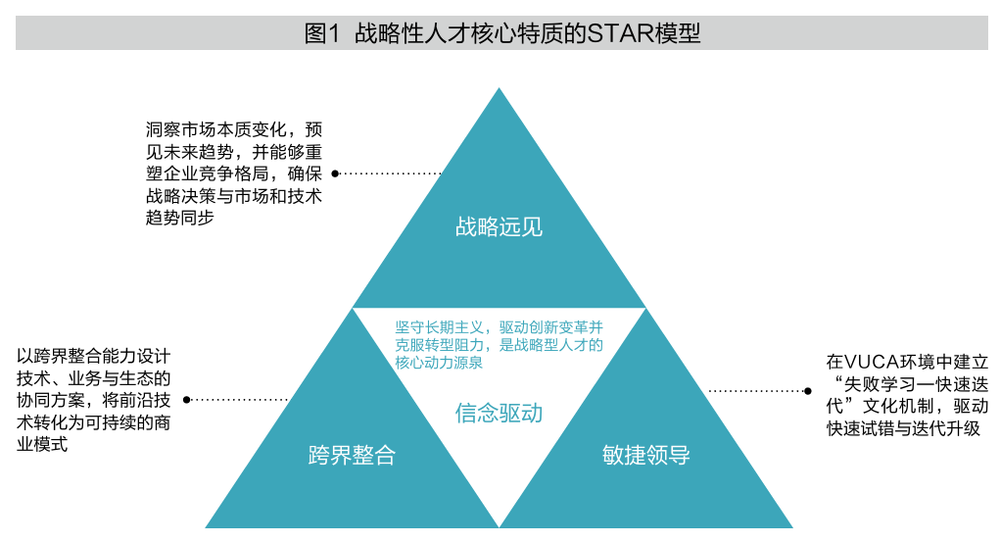
💡4 STAR traits enterprises demand for AI success amid $4T digital boom
⚡ 30-Second TL;DR
What Changed
Global digital investments hit $2.1T in 2023, projected to $4.4T by 2028, but gen AI yields low productivity gains without strategic talent.
Why It Matters
AI practitioners lacking business integration skills risk commoditization; developing STAR traits positions them as transformation leaders, boosting career value in high-investment era.
What To Do Next
Evaluate your fit against STAR traits and join a cross-functional AI-business project at work.
Key Points
- •Global digital investments hit $2.1T in 2023, projected to $4.4T by 2028, but gen AI yields low productivity gains without strategic talent.
- •STAR model defines core traits: Strategic Foresight for trend prediction, Cross-boundary Integration for tech-business fusion.
- •Agile Leadership via methods like Amazon's Working Backwards enables rapid iteration in VUCA environments.
- •Talent shortage tops CEO concerns, hindering 57-26% of transformation efforts per Gartner/IDC.
🧠 Deep Insight
Background and context from public sources — not the original article. 7 sources cited.
🔑 Enhanced Key Takeaways
- •Cloud Security Alliance launched STAR for AI in October 2025, a framework with self-assessment (Level 1) and ISO/IEC 42001-aligned validation (Level 2) for auditable AI systems, building on the AI Controls Matrix.[3]
- •Galbraith's Star Model, originating from organizational design theory, emphasizes alignment of strategy, structure, processes, rewards, and people to eliminate execution friction, distinct from talent-focused adaptations.[2][4]
- •BCG reports high-achieving AI firms achieve 3-4x ROI through end-to-end transformation via horizontal tech stacks integrating GenAI with predictive AI, prioritizing behavioral change and responsible governance.[5]
🔮 Future ImplicationsAI analysis grounded in cited sources
⏳ Timeline
📎 Sources (7)
Factual claims are grounded in the sources below. Forward-looking analysis is AI-generated interpretation.
- womensleadershipsuccess.com — AI Leadership Framework Open Care Model 2025
- umbrex.com — Galbraith Star Model
- cloudsecurityalliance.org — Cloud Security Alliance Launches Star for AI Establishing the Global Framework for Responsible and Auditable Artificial Intelligence
- umbrex.com — What Is Star Model
- bcg.com — The Leaders Guide to Transforming with AI
- cdomagazine.tech — 6 Best Practices for Implementing Commonly Available AI Governance Frameworks
- action.deloitte.com — AI Governance Operating Models and Framework
Weekly AI Recap
Read this week's curated digest of top AI events →
👉Related Updates
AI-curated news aggregator. All content rights belong to original publishers.
Original source: 虎嗅 ↗
This is a summary, not the original. Read the source, or get the weekly briefing.
Weekly AI briefing
One email a week. Unsubscribe anytime.