SpaceX Files for Historic IPO on Nasdaq
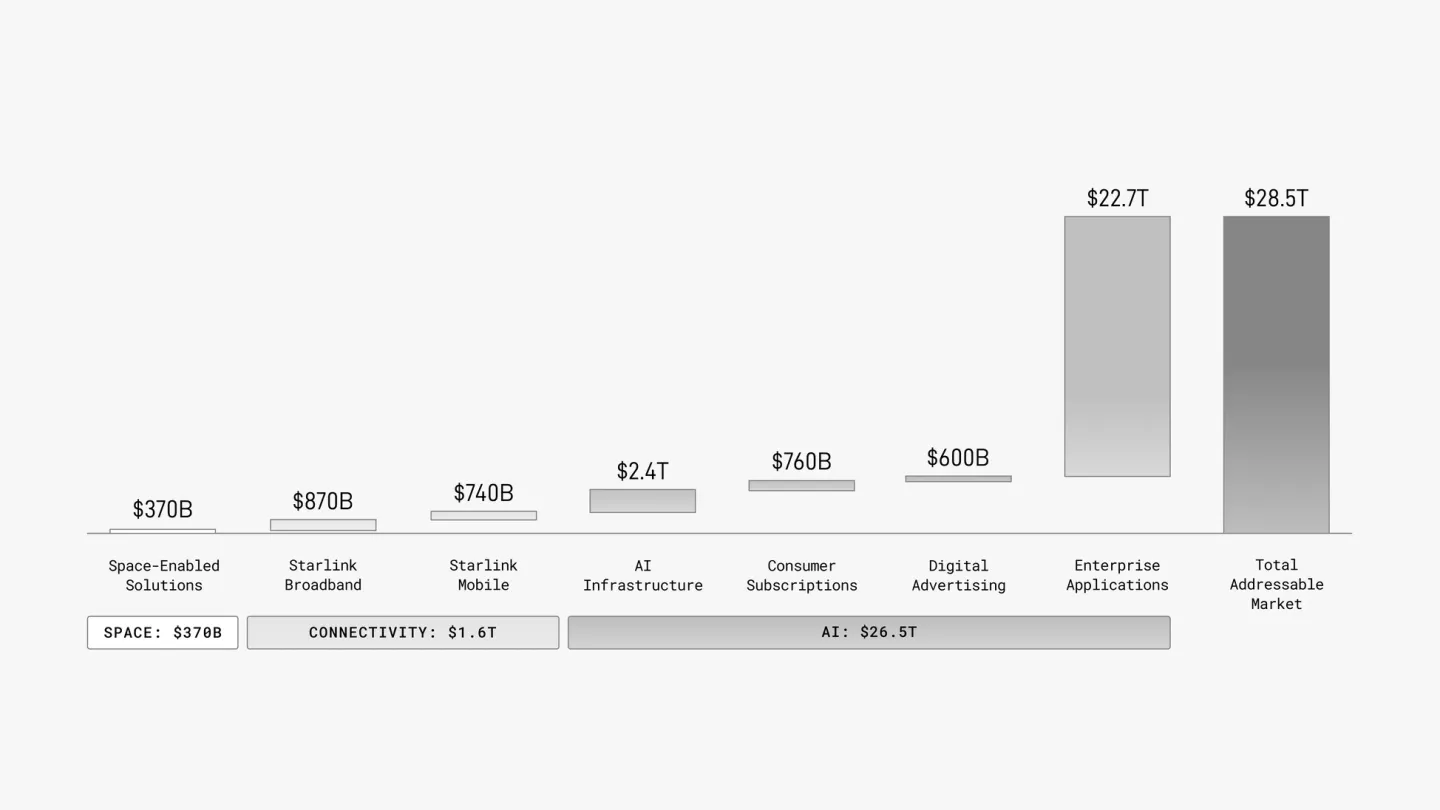
💡Get the first official look at the financials of the world's most influential space and AI infrastructure company.
⚡ 30-Second TL;DR
What Changed
Filed S-1 registration with SEC for Nasdaq listing
Why It Matters
The IPO will likely inject massive capital into SpaceX's Starlink and AI-driven autonomous space operations, potentially accelerating the pace of global satellite connectivity and space-based AI research.
What To Do Next
Monitor the S-1 filing for specific disclosures regarding Starlink's AI-driven network optimization and edge computing capabilities.
Key Points
- •Filed S-1 registration with SEC for Nasdaq listing
- •Ticker symbol confirmed as SPCX
- •Provides full transparency into integrated financials of space and AI business units
🧠 Deep Insight
Web-grounded analysis with 13 cited sources.
🔑 Enhanced Key Takeaways
- •The IPO is projected to value SpaceX at approximately $1.75 trillion, potentially making it the largest initial public offering in history, surpassing Saudi Aramco's 2019 record.
- •SpaceX's S-1 filing revealed $18.67 billion in revenue for 2025 and a $1.94 billion operating loss in Q1 2026, with Starlink's connectivity segment being the largest revenue driver at $3.26 billion in Q1 2026.
- •Elon Musk will maintain significant control over SpaceX post-IPO, holding 85.1% of the combined voting power through a dual-class share structure, allowing the company to qualify as a controlled company under Nasdaq rules.
- •SpaceX acquired xAI in February 2026, aiming to establish a vertically integrated platform combining AI, space-based internet, rockets, and direct-to-mobile communications, and also disclosed holdings of 18,712 BTC.
- •The company plans to deploy modular orbital AI compute shells by the end of the decade and monetize AI software and compute services, with its Starship V3 expected to deliver more powerful Starlink satellites and next-generation direct-to-mobile satellites.
📊 Competitor Analysis▸ Show
| Feature | SpaceX | Blue Origin | Amazon (Project Kuiper/Leo) | Eutelsat OneWeb |
|---|---|---|---|---|
| Primary Launch Vehicles | Falcon 9, Falcon Heavy, Starship (under development) | New Shepard, New Glenn (under development) | N/A (relies on third-party launches, including ULA, Arianespace, Blue Origin) | N/A (relies on third-party launches, including Soyuz, Falcon 9, GSLV Mk III) |
| Reusable Rocket Technology | Pioneering and extensively used (Falcon 9, Falcon Heavy boosters) | Developing (New Glenn first stage) | N/A | N/A |
| Satellite Internet Constellation | Starlink (over 10,000 satellites in orbit, ~9 million customers) | TerraWave (planning 5,400 satellites by end of 2027) | Amazon Leo (around 200 satellites in orbit, planning next-gen system in 2028) | OneWeb (648 satellites) |
| AI Integration | Deeply integrated across operations, acquired xAI, plans for orbital AI compute | Less publicly detailed AI initiatives | Less publicly detailed AI initiatives | Less publicly detailed AI initiatives |
| Primary Revenue Driver | Starlink connectivity (largest revenue driver) | N/A (private, focus on launch services) | N/A (part of larger Amazon, focus on satellite internet) | N/A (part of Eutelsat, focus on satellite internet) |
🛠️ Technical Deep Dive
- SpaceX utilizes AI for autonomous rocket landings, optimizing trajectories, and reducing fuel consumption for its Falcon 9 rockets.
- AI algorithms analyze data from sensors and cameras to determine rocket trajectory, account for environmental factors like wind speed, and adjust engines for precise landings.
- Advanced AI systems are integrated into the Crew Dragon spacecraft to support life support, communication, navigation, and complex docking procedures with the International Space Station.
- AI-powered data analysis is employed to process vast amounts of mission data, identify abnormalities, troubleshoot issues, and predict potential malfunctions in real-time.
- The Starlink satellite constellation relies on AI for advanced coordination, maneuvering, deployment, operation, and maintenance, including collision avoidance with space debris.
- SpaceX's acquisition of xAI aims to develop space-based AI infrastructure as a long-term alternative to terrestrial data centers, leveraging continuous solar power and reduced environmental constraints in orbit.
- The company plans to deploy modular orbital AI compute shells and monetize AI software and compute services, with Starship V3 designed to deliver more powerful Starlink satellites and next-generation direct-to-mobile satellites.
- SpaceX has partnered with Anthropic, allowing them to utilize the full capacity of SpaceX's Colossus 1 data center, which provides over 300 megawatts of computing power and more than 220,000 Nvidia GPUs.
🔮 Future ImplicationsAI analysis grounded in cited sources
⏳ Timeline
📎 Sources (13)
Factual claims are grounded in the sources below. Forward-looking analysis is AI-generated interpretation.
Weekly AI Recap
Read this week's curated digest of top AI events →
👉Related Updates



AI-curated news aggregator. All content rights belong to original publishers.
Original source: cnBeta (Full RSS) ↗