SJTU AI Startup Raises Seed for Materials Sim
💡AI hardware slashes materials sim time 10x, partners CATL/Huawei
⚡ 30-Second TL;DR
What Changed
Over 10M RMB seed funding from Qigao Capital and SJTU funds
Why It Matters
Accelerates new materials R&D from years to months, aiding batteries, rare earth magnets, and semiconductors. Strengthens China's AI-driven materials innovation amid national priorities.
What To Do Next
Test RBMD on national supercomputing platform for scalable MD simulations.
Key Points
- •Over 10M RMB seed funding from Qigao Capital and SJTU funds
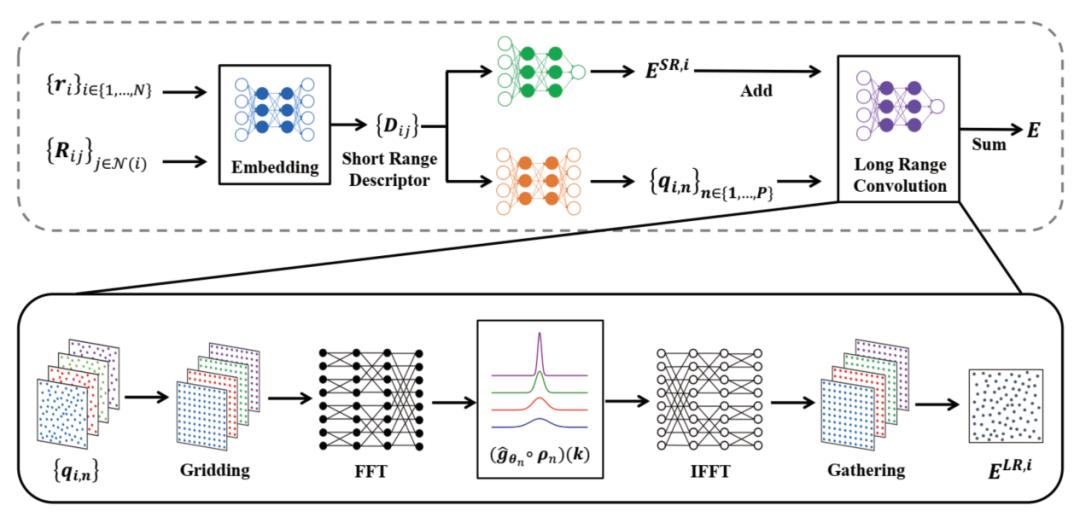
- •SOG-Net NN decomposes potentials for accurate long-range modeling
- •NanoTitan enables million-atom MD sims 10x+ faster on one GPU
- •RBMD software integrated into national supercomputing platform
- •Collaborations with CATL on lithium batteries and Huawei on chips
🧠 Deep Insight
Background and context from public sources — not the original article. 8 sources cited.
🔑 Enhanced Key Takeaways
- •SOG-Net uses a latent-variable learning network with Fourier convolution layers and sum-of-Gaussians multipliers to adaptively model diverse long-range decay behaviors without predefined electrostatics or Ewald summation.[1]
- •SOG-Net GitHub repository is publicly available, providing an open-source implementation for integrating long-range interactions into machine learning force fields.[2]
- •SOG-Net demonstrates superior accuracy over short-range models like 2G-HDNNP and CACE-SR in capturing long-range charge transfer effects, such as energy differences in Au on Al-doped MgO surfaces.[1]
🛠️ Technical Deep Dive
- •SOG-Net architecture: latent-variable network bridges short-range and long-range components; efficient Fourier convolution incorporates long-range effects via non-uniform fast Fourier transforms for close-to-linear complexity.[1]
- •Training and inference: learns sum-of-Gaussians multipliers across convolution layers to capture varying decay behaviors (e.g., 1/r); supports fast algorithm acceleration post-training without classical Ewald summation.[1]
- •Validation benchmarks: tested on NaCl electrolytes (1000 particles), Au on MgO(001); achieves lower energy errors and resolves equilibrium bond lengths for doped/undoped surfaces, outperforming SR baselines.[1]
🔮 Future ImplicationsAI analysis grounded in cited sources
⏳ Timeline
📎 Sources (8)
Factual claims are grounded in the sources below. Forward-looking analysis is AI-generated interpretation.
Weekly AI Recap
Read this week's curated digest of top AI events →
👉Related Updates

AI-curated news aggregator. All content rights belong to original publishers.
Original source: 36氪 ↗
This is a summary, not the original. Read the source, or get the weekly briefing.
Weekly AI briefing
One email a week. Unsubscribe anytime.