Huaqiangbei AI Hardware Boom: Affordable Mass Market Devices
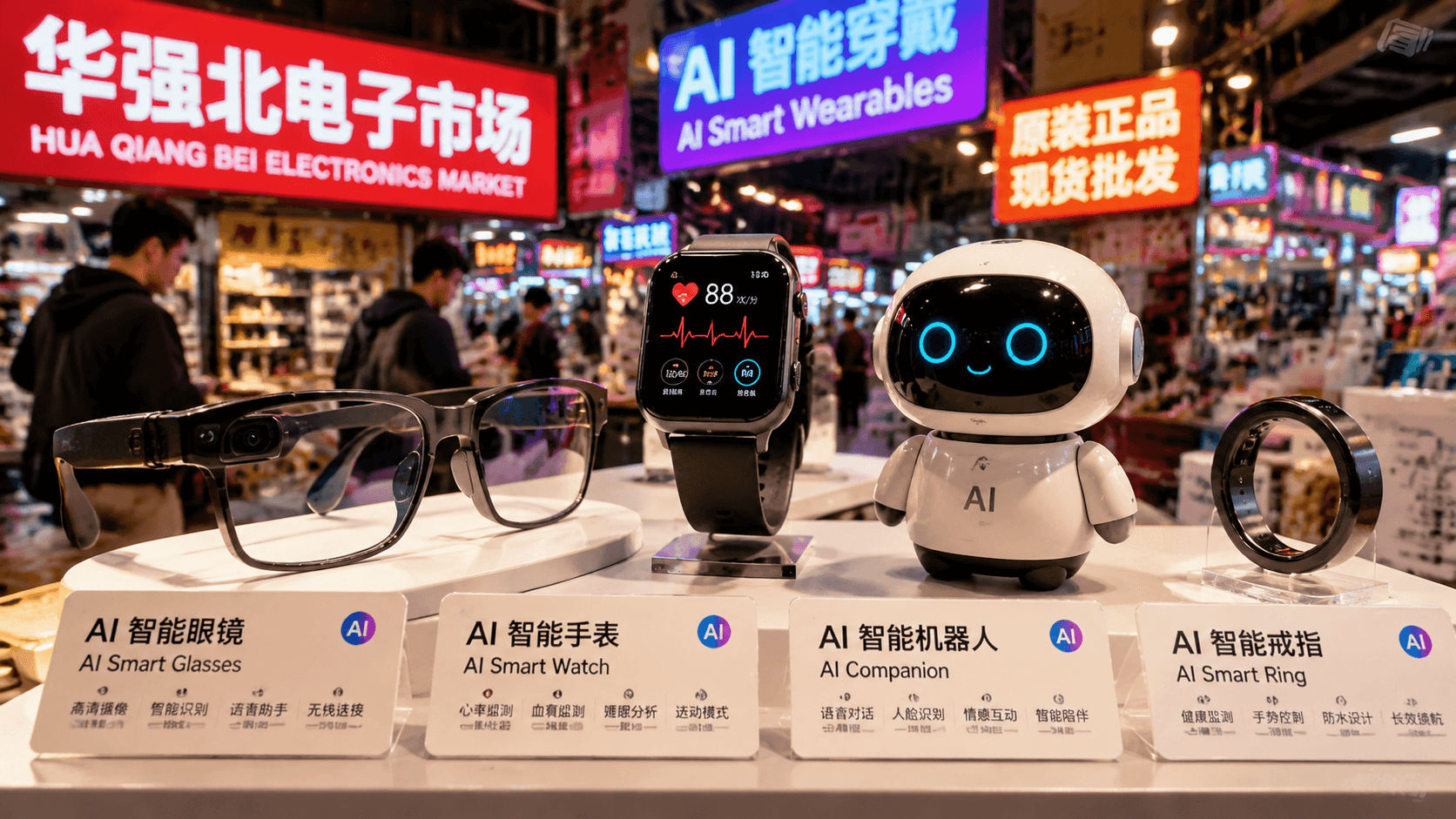
💡Discover how low-cost AI hardware is scaling rapidly in the world's largest electronics hub.
⚡ 30-Second TL;DR
What Changed
Four dominant categories: AI glasses, watches, companion toys, and rings.
Why It Matters
The rapid commoditization of AI hardware in Shenzhen suggests a massive influx of edge-AI devices that could lower the barrier for mass-market AI adoption.
What To Do Next
Monitor the supply chain trends in Huaqiangbei to identify potential low-cost hardware platforms for your edge-AI applications.
Key Points
- •Four dominant categories: AI glasses, watches, companion toys, and rings.
- •Extreme price accessibility with entry points as low as 100 yuan.
- •Huaqiangbei serves as a rapid prototyping and mass-market hub for AI hardware.
🧠 Deep Insight
AI-generated analysis for this event — not the original article.
🔑 Enhanced Key Takeaways
- •Huaqiangbei manufacturers are increasingly utilizing open-source LLMs like Llama 3 or specialized lightweight models (SLMs) optimized for edge computing to bypass cloud latency and subscription costs.
- •The supply chain has pivoted from traditional smartphone component assembly to integrating low-power NPU (Neural Processing Unit) chips from domestic vendors like Rockchip and Allwinner.
- •Regulatory scrutiny in China regarding AI-generated content and data privacy is forcing these low-cost manufacturers to implement local-only processing modes for sensitive user data.
- •The 'Shanzhai' (copycat) ecosystem has evolved to include rapid AI-wrapper integration, where hardware shells are designed to be modular, allowing for quick swaps of AI modules as new model APIs become available.
- •Local government initiatives in Shenzhen are providing subsidies for 'AI+Hardware' integration projects, incentivizing Huaqiangbei vendors to transition from pure white-label manufacturing to branded AI-enabled consumer electronics.
📊 Competitor Analysis▸ Show
| Feature | Huaqiangbei AI Devices | Tier-1 Global Brands (e.g., Meta/Apple) |
|---|---|---|
| Pricing | 100 - 500 CNY | 2,000 - 4,000+ CNY |
| Model Architecture | Edge-optimized SLMs / API wrappers | Proprietary multimodal foundation models |
| Privacy | Local-first / Minimal compliance | Cloud-heavy / Robust enterprise security |
| Build Quality | Prototyping-grade / Plastic-heavy | Premium materials / Ergonomic focus |
🛠️ Technical Deep Dive
- Hardware Architecture: Utilization of ARM-based SoCs (System on Chips) integrated with dedicated low-power NPUs to handle voice-to-text and basic computer vision tasks locally.
- Connectivity: Reliance on Bluetooth 5.3 and Wi-Fi 6 for tethering to smartphone companion apps, which act as the primary gateway for cloud-based LLM processing.
- Power Management: Implementation of high-density lithium-polymer batteries paired with aggressive power-gating firmware to compensate for the high energy consumption of AI inference.
- Software Stack: Custom Android-based forks or RTOS (Real-Time Operating Systems) stripped of non-essential services to prioritize AI model execution speed.
🔮 Future ImplicationsAI analysis grounded in cited sources
⏳ Timeline
Weekly AI Recap
Read this week's curated digest of top AI events →
👉Related Updates

AI-curated news aggregator. All content rights belong to original publishers.
Original source: Pandaily ↗
This is a summary, not the original. Read the source, or get the weekly briefing.
Weekly AI briefing
One email a week. Unsubscribe anytime.