🐯虎嗅•Stalecollected in 4m
Silicon Valley Abandons AI EdTech
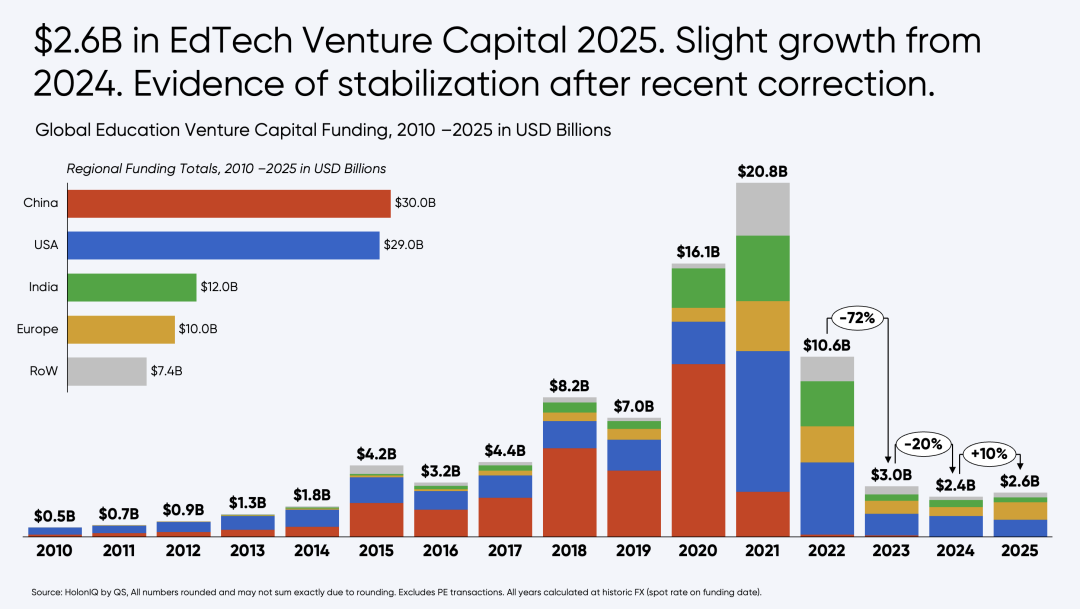
💡AI edtech funding crashes, low engagement warns founders to avoid education vertical
⚡ 30-Second TL;DR
What Changed
Khanmigo AI tutor: only 15% students actively interact after 3 years
Why It Matters
Cooling investor interest in AI edtech signals shift to higher-adoption verticals like healthcare or law. Practitioners should pivot from K-12 tools facing procurement and retention hurdles.
What To Do Next
Benchmark your AI tutor's engagement against Khanmigo's 15% metric using A/B tests.
Who should care:Founders & Product Leaders
Key Points
- •Khanmigo AI tutor: only 15% students actively interact after 3 years
- •AI-native edtech top 4 raised just $140M total, far below other sectors
- •Google shifts from major platform upgrades to minor AI assessment tool
- •Edtech funding plunged to 10-year low amid adoption barriers
- •Teacher discretion and union rules hinder high-frequency AI tool use
🧠 Deep Insight
AI-generated analysis for this event.
🔑 Enhanced Key Takeaways
- •Data privacy regulations, specifically the enforcement of COPPA and state-level student data privacy laws, have created significant legal friction, forcing AI developers to implement costly, restrictive 'walled garden' architectures that limit model utility.
- •The 'hallucination' rate in pedagogical contexts remains a critical barrier; school districts are increasingly rejecting AI tools that cannot guarantee 99.9% factual accuracy in curriculum-aligned content, leading to a shift toward 'human-in-the-loop' verification models that increase operational costs.
- •Institutional inertia in K-12 procurement cycles, which typically operate on 3-5 year budget horizons, has prevented AI startups from achieving the rapid growth metrics required by venture capital firms, leading to a 'funding gap' between pilot programs and district-wide adoption.
📊 Competitor Analysis▸ Show
| Feature | Khanmigo | Duolingo Max | Century Tech |
|---|---|---|---|
| Core Focus | Socratic Tutoring | Language Learning | Adaptive Curriculum |
| Pricing | $9/mo (B2C) | $30/mo (B2C) | Enterprise/District |
| AI Model | GPT-4o (Custom) | GPT-4o | Proprietary/Neural |
| Engagement | 15% (Reported) | High (Gamified) | Moderate (Required) |
🛠️ Technical Deep Dive
- •Khanmigo utilizes a fine-tuned GPT-4o architecture specifically constrained by a 'System Prompt' layer designed to prevent direct answer provision, enforcing Socratic questioning techniques.
- •Implementation relies on a RAG (Retrieval-Augmented Generation) pipeline that restricts the model's knowledge base to Khan Academy's verified library, attempting to mitigate hallucinations.
- •Integration with Learning Management Systems (LMS) like Canvas and Google Classroom is achieved via LTI (Learning Tools Interoperability) standards, which often creates latency issues during high-concurrency classroom sessions.
🔮 Future ImplicationsAI analysis grounded in cited sources
Consolidation of the AI EdTech market will accelerate through 2027.
Smaller startups lacking the capital to navigate complex district procurement and compliance requirements will be acquired by legacy publishers like Pearson or McGraw Hill.
AI tool development will pivot toward 'Teacher-Assist' rather than 'Student-Tutor' models.
Focusing on administrative automation and grading assistance bypasses the regulatory and pedagogical hurdles associated with direct student-AI interaction.
⏳ Timeline
2023-03
Khan Academy launches Khanmigo, an AI-powered tutor based on GPT-4.
2024-01
Khan Academy expands Khanmigo access to all US school districts.
2025-06
Major venture capital firms report a 40% year-over-year decline in new AI EdTech funding.
2026-02
Google announces a strategic pivot, scaling back 'Gemini for Education' platform features.
📰
Weekly AI Recap
Read this week's curated digest of top AI events →
👉Related Updates


AI-curated news aggregator. All content rights belong to original publishers.
Original source: 虎嗅 ↗