Self Variable Pays Homes for Robot Data
💡Self Variable is paying families for long-duration robot data—the embodied AI economics are shifting from service to tra
⚡ 30-Second TL;DR
What Changed
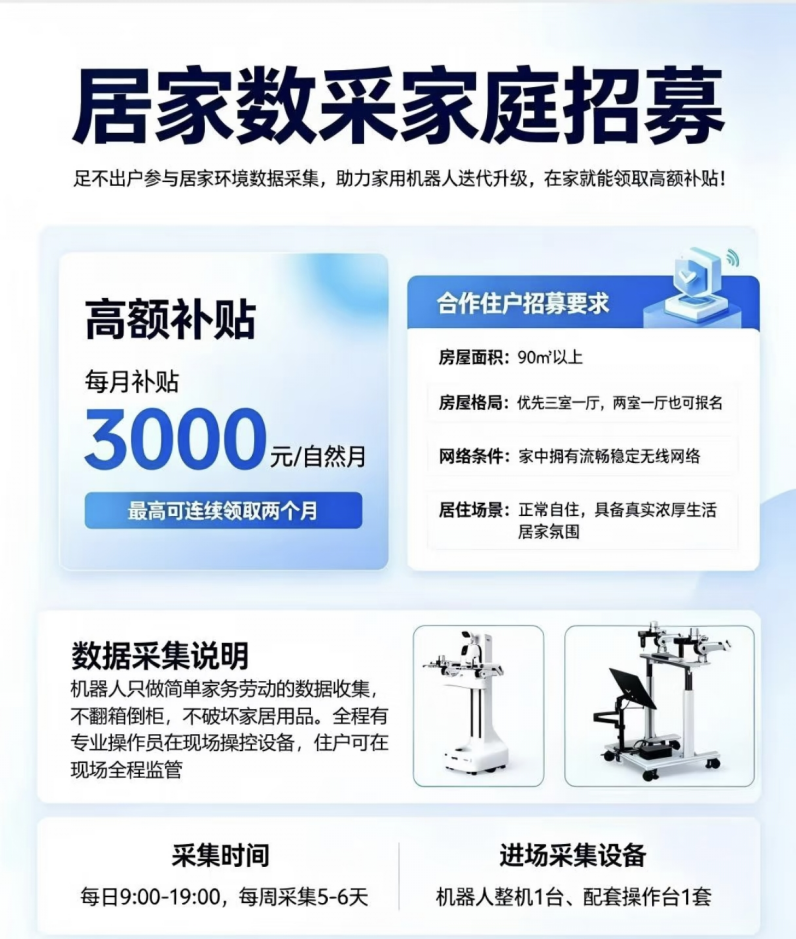
Self Variable is recruiting homes larger than 90 square meters for robot data collection, with stable internet and an authentic living environment.
Why It Matters
Paying households for access may be a cost-effective way to obtain long-horizon embodied data, but it shifts the product from service delivery toward data acquisition. The approach also raises practical issues around privacy, consent, remote operation, household safety, and whether two months in one home provides enough diversity for robust generalization.
What To Do Next
Before deploying home robots for data collection, implement explicit household consent, sensor-level privacy redaction, operator access logs, and a coverage dashboard tracking rooms, objects, and failure cases.
Key Points
- •Self Variable is recruiting homes larger than 90 square meters for robot data collection, with stable internet and an authentic living environment.
- •Operators may bring a full robot and control station into the home from 9:00 to 19:00, five to six days per week.
- •Participating households can receive up to 3,000 yuan per month, capped at 6,000 yuan for two months.
- •The company abandoned or reduced emphasis on its 149-yuan robot cleaning service because robots were slower and less capable than human cleaners.
- •The strategy treats messy, changing home environments as high-value training data for WALL-B’s generalization.
🧠 Deep Insight
Background and context from public sources — not the original article. 10 sources cited.
🔑 Enhanced Key Takeaways
- •Self-Variable Robotics has achieved a valuation exceeding 20 billion RMB, establishing it as the first unicorn in the Greater Bay Area's embodied intelligence sector.
- •The company secured four rounds of financing within a two-month window, backed by a strategic coalition including Meituan, Alibaba, ByteDance, and Xiaomi.
- •In April 2026, the company launched the 'Unified World Model,' a foundational architecture designed to enable robot navigation and interaction within complex domestic environments.
- •The firm maintains a strategic partnership with 58 Home (58到家) to conduct real-world validation of its service robots in residential settings.
- •Industry reports indicate that Self-Variable Robotics derives a significant portion of its operational revenue from data collection services rather than traditional hardware sales.
🛠️ Technical Deep Dive
- The WALL-B system utilizes a Unified World Model architecture, which integrates multi-modal sensory input to predict environmental state changes in real-time.
- Data acquisition protocols involve high-fidelity teleoperation stations that record human-in-the-loop demonstrations to train the robot's policy network.
- The system is optimized for generalization across unstructured, dynamic home environments, moving away from rigid, pre-programmed task execution.
🔮 Future ImplicationsAI analysis grounded in cited sources
⏳ Timeline
📎 Sources (10)
Factual claims are grounded in the sources below. Forward-looking analysis is AI-generated interpretation.
Weekly AI Recap
Read this week's curated digest of top AI events →
👉Related Updates



AI-curated news aggregator. All content rights belong to original publishers.
Original source: 虎嗅 ↗
This is a summary, not the original. Read the source, or get the weekly briefing.
Weekly AI briefing
One email a week. Unsubscribe anytime.