Huawei R&D Hits Record as Profit Falls
💡Huawei’s AI and vehicle expansion reveals how memory shortages can hit R&D budgets, cash flow, and product pricing.
⚡ 30-Second TL;DR
What Changed
Revenue increased 9.55% year over year, but parent-company net profit dropped 36.8% to 23.428 billion yuan.
Why It Matters
Huawei’s spending pattern signals that AI hardware, memory, and automotive computing are becoming strategically linked. Persistent component inflation could raise prices and force AI and device companies to make earlier procurement commitments or redesign around alternative parts.
What To Do Next
Check your hardware supplier’s LPDDR5X, DRAM, and automotive-chip quotes, then run a six-month cost sensitivity model before locking your AI product roadmap.
Key Points
- •Revenue increased 9.55% year over year, but parent-company net profit dropped 36.8% to 23.428 billion yuan.
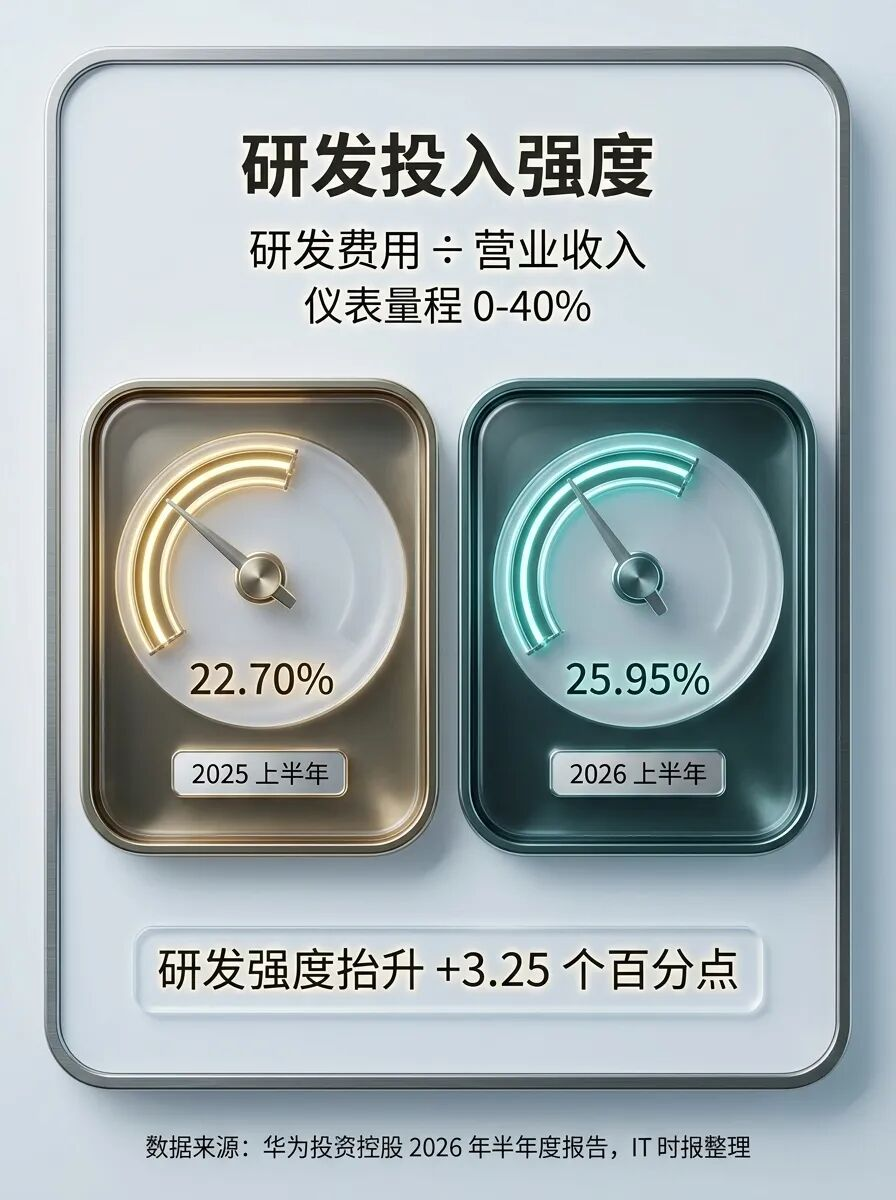
- •R&D spending reached a record 121.382 billion yuan, equal to 25.9% of revenue.
- •Inventory rose 42.3% to 277.494 billion yuan as Huawei stocked memory and automotive components.
- •Operating cash flow shifted from a positive 31.183 billion yuan to a negative 39.885 billion yuan.
- •Huawei is raising prices on major smartphone models from September 1 to offset cost pressure.
🧠 Deep Insight
Background and context from public sources — not the original article. 12 sources cited.
🔑 Enhanced Key Takeaways
- •Huawei's R&D intensity of 25.95% represents a 25.2% year-on-year increase in absolute spending, highlighting an acceleration in capital allocation toward fundamental technology.
- •The profit decline marks the second consecutive year of falling first-half net profits, indicating a sustained multi-year strategy of prioritizing market share and ecosystem building over immediate bottom-line performance.
- •Operating costs rose by 12.39%, outpacing revenue growth, which suggests that Huawei is absorbing significant inflationary pressures in the supply chain rather than passing them entirely to consumers until the September 1 price adjustment.
- •Huawei is actively positioning its Ascend AI chip architecture as a domestic alternative to Western hardware, specifically targeting the Chinese startup ecosystem to mitigate the impact of U.S. export restrictions.
- •In a divergent industry trend, domestic competitor ZTE has moved to reduce its research spending by 14%, contrasting with Huawei's aggressive, high-expenditure approach to technological self-reliance.
📊 Competitor Analysis▸ Show
| Feature/Metric | Huawei | ZTE | Apple |
|---|---|---|---|
| R&D Strategy | Aggressive Expansion (+25.2%) | Cost Reduction (-14%) | Stable/Incremental |
| AI Hardware | Ascend AI (Domestic Focus) | N/A (Focus on Telecom) | Apple Silicon/Private Cloud |
| Pricing Strategy | Increasing (Sept 2026) | Competitive/Stable | Premium/Stable |
🛠️ Technical Deep Dive
- Ascend AI Architecture: Focuses on high-performance computing clusters designed to serve as a domestic replacement for GPU-accelerated AI training and inference.
- Operating System Integration: Deep optimization of HarmonyOS across smart vehicle cockpits and mobile devices to create a unified cross-platform ecosystem.
- Autonomous Driving: Development of proprietary perception and decision-making algorithms integrated into smart vehicle platforms to reduce reliance on third-party software stacks.
🔮 Future ImplicationsAI analysis grounded in cited sources
⏳ Timeline
📎 Sources (12)
Factual claims are grounded in the sources below. Forward-looking analysis is AI-generated interpretation.
Weekly AI Recap
Read this week's curated digest of top AI events →
👉Related Updates

AI-curated news aggregator. All content rights belong to original publishers.
Original source: 虎嗅 ↗
This is a summary, not the original. Read the source, or get the weekly briefing.
Weekly AI briefing
One email a week. Unsubscribe anytime.