Secure Claude Code from Commit to Production
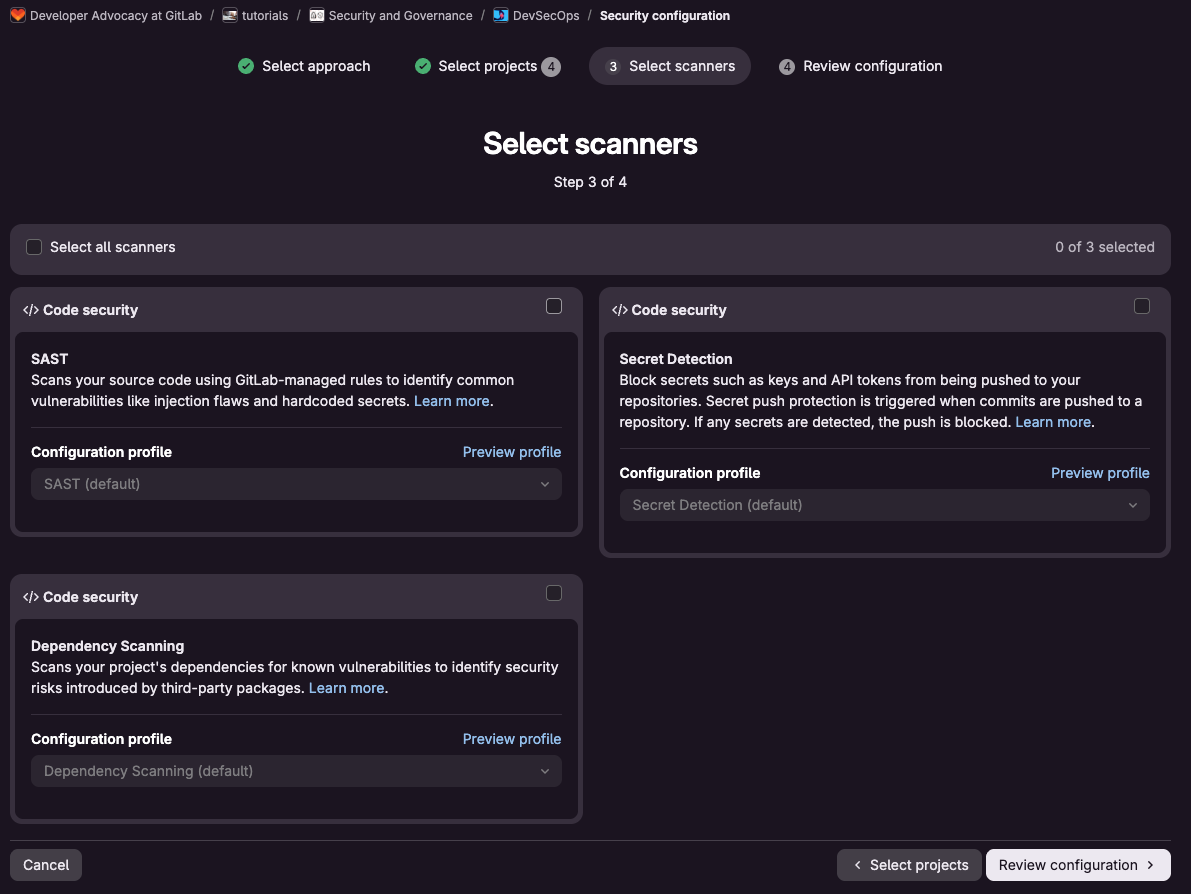
Learn how to turn Claude’s in-session security checks into enforced production and audit controls.
30-Second TL;DR
What Changed
The GitLab MCP server connects Claude security guidance and Claude Security context to downstream delivery controls.
Why It Matters
This approach helps enterprises extend security governance to agent-generated changes instead of relying only on protections inside an AI coding session. It may reduce the risk of agents self-approving vulnerable code while simplifying SOC 2, PCI DSS, and FedRAMP evidence collection.
What To Do Next
Connect your Claude workflow to the GitLab MCP server and configure merge request approval policies that block unresolved critical vulnerabilities.
Key Points
- •The GitLab MCP server connects Claude security guidance and Claude Security context to downstream delivery controls.
- •Security configuration profiles apply required scans consistently across projects and pipelines, outside individual repositories.
- •Merge request approval policies enforce separation of duties and can block unresolved critical vulnerabilities from production.
- •Vulnerability reports, security dashboards, pipeline logs, and approval records provide persistent audit evidence.
Deep Insight
AI-generated analysis for this event — not the original article.
Enhanced Key Takeaways
- •The GitLab MCP (Model Context Protocol) server implementation allows Claude to natively query GitLab's internal security policy engine, enabling real-time compliance checks before code is even committed.
- •GitLab's integration leverages 'Security Policy Projects,' which act as centralized repositories to enforce compliance rules across thousands of projects simultaneously, preventing developers from bypassing security configurations.
- •The integration supports automated 'Security Orchestration,' where Claude-generated code is automatically tagged with metadata identifying it as AI-authored, triggering specific, more rigorous pipeline scanning requirements.
- •GitLab has introduced 'AI Impact Analysis' dashboards that correlate Claude-generated code commits with subsequent vulnerability detection rates to help teams measure the security efficacy of their AI-assisted development workflows.
- •The system utilizes GitLab's 'Compliance Frameworks' to automatically apply 'Compliance Pipelines' to Claude-authored merge requests, ensuring that even if a developer modifies the pipeline configuration, the security scans remain mandatory.
Competitor Analysis
- GitLab (Claude MCP)
- Centralized Policy Projects
- GitHub (Copilot Extensions)
- Organization-level policies
- Snyk (AI Security)
- Policy-as-Code (Snyk Policy)
- GitLab (Claude MCP)
- Native/First-class
- GitHub (Copilot Extensions)
- Limited/Beta
- Snyk (AI Security)
- Via API integrations
- GitLab (Claude MCP)
- Full pipeline/MR integration
- GitHub (Copilot Extensions)
- GitHub Actions logs
- Snyk (AI Security)
- Snyk reporting dashboard
- GitLab (Claude MCP)
- Included in Ultimate tier
- GitHub (Copilot Extensions)
- Copilot Enterprise add-on
- Snyk (AI Security)
- Per-seat/Usage based
| Feature | GitLab (Claude MCP) | GitHub (Copilot Extensions) | Snyk (AI Security) |
|---|---|---|---|
| Security Governance | Centralized Policy Projects | Organization-level policies | Policy-as-Code (Snyk Policy) |
| MCP Support | Native/First-class | Limited/Beta | Via API integrations |
| Auditability | Full pipeline/MR integration | GitHub Actions logs | Snyk reporting dashboard |
| Pricing | Included in Ultimate tier | Copilot Enterprise add-on | Per-seat/Usage based |
Technical Deep Dive
- The GitLab MCP server acts as a bridge between the Claude environment and the GitLab API, utilizing the Model Context Protocol to expose GitLab's security scanner endpoints as tools for the LLM.
- Security Policy Projects utilize YAML-based definitions that are parsed by the GitLab runner to inject mandatory security jobs into the .gitlab-ci.yml file of target repositories.
- The system uses a persistent 'Security Context' object that travels with the code, storing the model version, system prompt, and security scan results associated with the specific AI-generated block.
- Integration with GitLab's Vulnerability Database allows the MCP server to provide Claude with real-time feedback on known insecure patterns, effectively performing 'in-context' security training during the coding session.
Future ImplicationsAI analysis grounded in cited sources
Timeline
- 2024-09GitLab announces expanded AI-powered security features in the DevSecOps platform.
- 2025-03GitLab integrates Model Context Protocol (MCP) support to standardize AI tool connectivity.
- 2025-11GitLab launches centralized Security Policy Projects for enterprise-wide governance.
- 2026-05GitLab enhances AI-authored code tracking to improve vulnerability attribution.
Weekly AI Recap
Read this week's curated digest of top AI events →
AI-curated news aggregator. All content rights belong to original publishers.
Original source: GitLab Blog ↗
This is a summary, not the original. Read the source, or get the weekly briefing.
The weekly digest
One email a week. Unsubscribe anytime.