Scientists challenge Microsoft's Majorana quantum computing claims
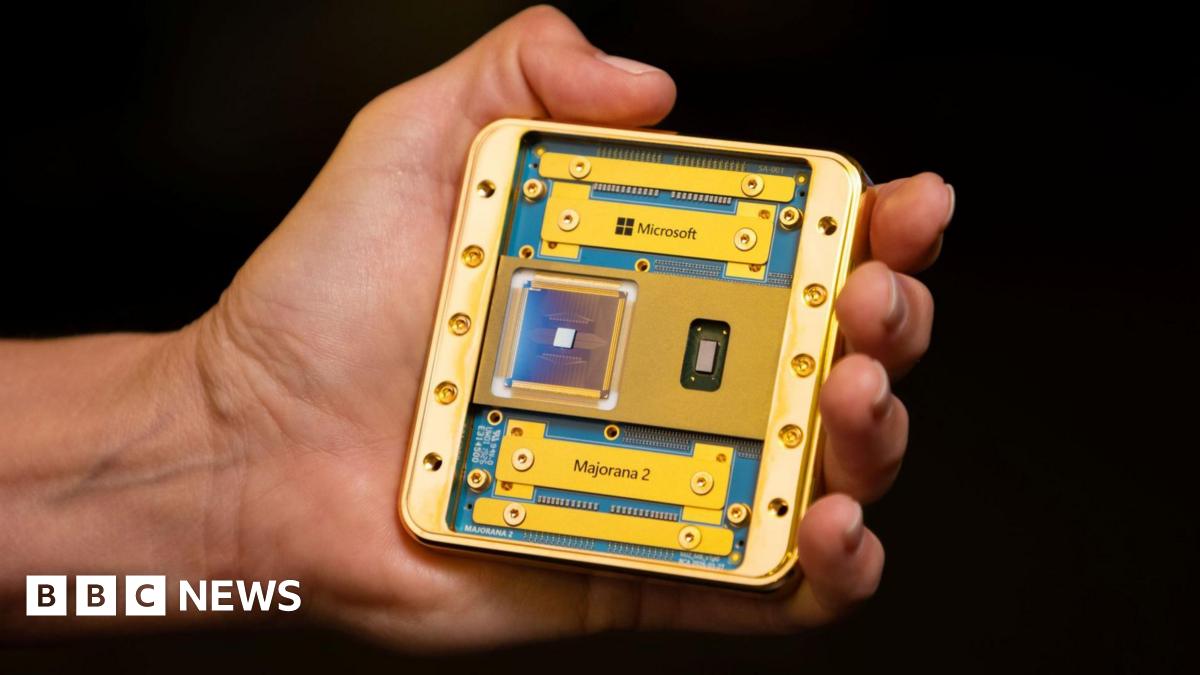
Understand the scientific controversy surrounding Microsoft's quantum hardware claims and its impact on future AI comput
30-Second TL;DR
What Changed
Microsoft maintains confidence in its Majorana chip research program.
Why It Matters
The ongoing dispute could affect investor confidence and the perceived timeline for Microsoft's quantum supremacy goals. It underscores the difficulty of verifying breakthroughs in experimental quantum hardware.
What To Do Next
Monitor Microsoft's Azure Quantum documentation for peer-reviewed updates to verify if their hardware roadmap remains viable.
Key Points
- •Microsoft maintains confidence in its Majorana chip research program.
- •Independent scientists have published fresh doubts regarding the experimental data.
- •The controversy highlights the high-stakes nature of topological quantum computing development.
Deep Insight
AI-generated analysis for this event — not the original article.
Enhanced Key Takeaways
- •The controversy centers on the interpretation of 'zero-bias conductance peaks' in nanowire devices, which Microsoft claims are signatures of Majorana bound states but critics argue could be trivial Andreev bound states.
- •Microsoft retracted a 2022 paper published in Nature due to concerns regarding the analysis of data, which served as a major catalyst for the current wave of independent scrutiny.
- •Topological quantum computing relies on braiding Majorana zero modes, which are theoretically protected from decoherence by their non-local nature, offering a potential path to fault-tolerant qubits.
- •In 2023, Microsoft reported a breakthrough in creating 'topological gaps' in their devices, which they claim provides stronger evidence for the existence of Majorana particles than previous experiments.
- •The debate has spurred a broader movement in the quantum community toward 'open science' practices, with many researchers now demanding raw data access to verify claims of quantum advantage.
Competitor Analysis
- Microsoft (Topological)
- Majorana Bound States
- IBM (Superconducting)
- Transmon Qubits
- Google (Superconducting)
- Transmon Qubits
- IonQ (Trapped Ion)
- Trapped Ytterbium Ions
- Microsoft (Topological)
- Hardware-level (Topological)
- IBM (Superconducting)
- Software-level (Surface Code)
- Google (Superconducting)
- Software-level (Surface Code)
- IonQ (Trapped Ion)
- Software-level (Error Mitigation)
- Microsoft (Topological)
- Experimental/Research
- IBM (Superconducting)
- Commercial/Cloud Access
- Google (Superconducting)
- Commercial/Cloud Access
- IonQ (Trapped Ion)
- Commercial/Cloud Access
- Microsoft (Topological)
- High (Theoretical)
- IBM (Superconducting)
- Moderate
- Google (Superconducting)
- Moderate
- IonQ (Trapped Ion)
- Moderate
| Feature | Microsoft (Topological) | IBM (Superconducting) | Google (Superconducting) | IonQ (Trapped Ion) |
|---|---|---|---|---|
| Qubit Type | Majorana Bound States | Transmon Qubits | Transmon Qubits | Trapped Ytterbium Ions |
| Error Correction | Hardware-level (Topological) | Software-level (Surface Code) | Software-level (Surface Code) | Software-level (Error Mitigation) |
| Maturity | Experimental/Research | Commercial/Cloud Access | Commercial/Cloud Access | Commercial/Cloud Access |
| Scalability | High (Theoretical) | Moderate | Moderate | Moderate |
Technical Deep Dive
- Majorana bound states are quasiparticles that act as their own antiparticles, emerging at the ends of semiconductor-superconductor hybrid nanowires.
- The experimental setup involves an indium antimonide (InSb) nanowire coupled with an aluminum superconductor, subjected to a strong magnetic field.
- Detection relies on tunneling spectroscopy to observe a quantized conductance peak at zero energy, theoretically predicted to be 2e^2/h.
- Topological protection is achieved by encoding quantum information in the non-local state of a pair of Majorana zero modes, making the qubit immune to local environmental noise.
- Recent technical refinements focus on improving the interface quality between the semiconductor and superconductor to reduce disorder-induced trivial states.
Future ImplicationsAI analysis grounded in cited sources
Timeline
- 2018-03Microsoft publishes a landmark paper in Nature claiming evidence of Majorana fermions.
- 2021-04Microsoft issues a correction to the 2018 paper following concerns about data interpretation.
- 2022-03Microsoft retracts the 2022 Nature paper due to technical errors in data analysis.
- 2023-05Microsoft announces the achievement of topological gaps in their quantum devices.
- 2024-09Independent research groups publish peer-reviewed critiques challenging the 2023 topological gap findings.
Weekly AI Recap
Read this week's curated digest of top AI events →
Related Updates

AI-curated news aggregator. All content rights belong to original publishers.
Original source: BBC Technology ↗
This is a summary, not the original. Read the source, or get the weekly briefing.
The weekly digest
One email a week. Unsubscribe anytime.