Scaling Decision Making with Mathematical Optimization
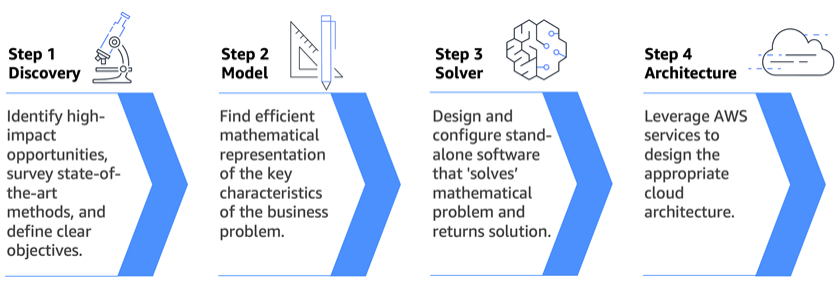
💡Discover how to combine AI with mathematical optimization for superior, data-driven business decisions.
⚡ 30-Second TL;DR
What Changed
Mathematical optimization solves complex constraint-based problems
Why It Matters
Organizations can move beyond predictive analytics to prescriptive decision-making, optimizing resources and operations at scale.
What To Do Next
Identify a high-stakes operational bottleneck in your business and evaluate if mathematical optimization can replace heuristic-based decision processes.
Key Points
- •Mathematical optimization solves complex constraint-based problems
- •Complements machine learning by providing actionable, deterministic decisions
- •Showcases real-world applications for enterprise decision-making
🧠 Deep Insight
Background and context from public sources — not the original article. 16 sources cited.
🔑 Enhanced Key Takeaways
- •The synergy between mathematical optimization and AI is evolving beyond traditional machine learning to include generative AI (GenAI), with enterprises increasingly experimenting with GenAI integration for tasks like model generation and natural language interfaces for optimization problems.
- •AWS facilitates mathematical optimization by providing scalable cloud infrastructure for running various commercial (e.g., CPLEX, Gurobi) and open-source solvers (e.g., COIN-OR LP, HIGHS, SCIP), and supports diverse approaches including reinforcement learning on Amazon SageMaker and quantum computing on Amazon Braket for Operations Research problems.
- •Mathematical optimization is becoming democratized through AI-powered platforms, enabling non-experts to interact with and interpret complex optimization problems using natural language, thereby lowering the barrier to entry for applying these techniques in real-world scenarios.
- •The AWS Generative AI Innovation Center leverages a multidisciplinary approach, combining expertise in AI, mathematical modeling, optimization, quantum computing, and high-performance computing to solve high-impact customer problems and deliver measurable business outcomes.
- •The integration of mathematical optimization with AI is leading to the development of 'decision intelligence platforms' and 'agentic AI' systems that combine reasoning, optimization, and data-driven actions to automate and enhance strategic and operational decision-making.
📊 Competitor Analysis▸ Show
| Feature / Platform | AWS (via SageMaker, Braket, Innovation Center) | Sedai | CAST AI | IBM Turbonomic |
|---|---|---|---|---|
| Core Focus | General-purpose mathematical optimization, OR, ML-optimization synergy, GenAI integration | Autonomous cloud optimization (cost, performance, reliability) | Kubernetes-focused cost optimization | Hybrid/multi-cloud resource optimization |
| AI/ML Integration | Deep integration with ML for 'predict-then-optimize', GenAI for model generation, RL, Quantum Computing | Machine learning to understand application behavior and evaluate tradeoffs | Machine learning to dynamically adjust nodes and workloads | AI models application demand & infrastructure supply |
| Optimization Scope | Broad, including supply chain, scheduling, resource allocation, complex constraint-based problems | Cloud cost, performance, and reliability across AWS, Azure, GCP, Kubernetes | Kubernetes node and workload efficiency, Spot instance usage | Cost-performance optimization across hybrid/multi-cloud |
| Automation Level | Provides tools and frameworks; Innovation Center offers custom solutions | Autonomous actions within safety guardrails (often 'copilot' mode in practice) | Automated cluster & workload efficiency | Automated actions within policy guardrails |
| Solvers/Algorithms | Supports commercial (CPLEX, Gurobi) & open-source (GLPK, CBC) solvers, genetic algorithms, linear/integer/nonlinear programming, quantum algorithms | Behavior-based resource rightsizing, headroom reduction | Node optimization, workload rightsizing | Demand modeling, automated scaling & placement |
| Pricing Model | Pay-as-you-go for underlying AWS services, custom engagement for Innovation Center | Subscription-based, often enterprise-focused | Subscription-based, enterprise-focused | Enterprise subscription model |
🛠️ Technical Deep Dive
- Solver Integration: AWS enables users to run various optimization solvers, including commercial ones like Gurobi and CPLEX, and open-source options such as COIN-OR LP (CLP), HIGHS, and SCIP.
- Cloud Infrastructure for Solvers: Customers can run optimization solvers on AWS by leveraging scalable compute resources and managed services. This includes using Amazon SageMaker Processing to build and deploy Docker images containing Python interfaces (e.g., Pyomo, PuLP) to connect with solvers.
- Algorithm Diversity: AWS supports a range of mathematical optimization algorithms, including linear programming, integer programming, nonlinear programming, and stochastic optimization. Genetic algorithms are also demonstrated for problems like optimal data orderings and subsets.
- Emerging Technologies for OR: Beyond traditional solvers, AWS explores reinforcement learning (RL) algorithms on Amazon SageMaker and quantum computing algorithms (e.g., D-Wave's QBSolv for Quadratic Unconstrained Binary Optimization (QUBO) problems) on Amazon Braket for Operations Research challenges.
- AI-Optimization Synergy: The approach often involves 'predict-then-optimize' pipelines, where machine learning models provide forecasts or predictions that are then fed into optimization models to make optimal decisions.
- Generative AI for Modeling: Large Language Models (LLMs) are being explored to assist in formulating mathematical optimization problems and generating optimization models, making expert-level optimization more accessible.
- Distributed Optimization: For large-scale AI systems, distributed optimization techniques like decentralized Stochastic Gradient Descent (SGD) and federated learning are crucial for training models efficiently across multiple devices and cloud platforms.
🔮 Future ImplicationsAI analysis grounded in cited sources
⏳ Timeline
📎 Sources (16)
Factual claims are grounded in the sources below. Forward-looking analysis is AI-generated interpretation.
Weekly AI Recap
Read this week's curated digest of top AI events →
👉Related Updates

AI-curated news aggregator. All content rights belong to original publishers.
Original source: AWS Machine Learning Blog ↗
This is a summary, not the original. Read the source, or get the weekly briefing.
The weekly digest
One email a week. Unsubscribe anytime.