來源AWS Machine Learning Blog•較早收集於 30m
利用數學最佳化實現大規模決策
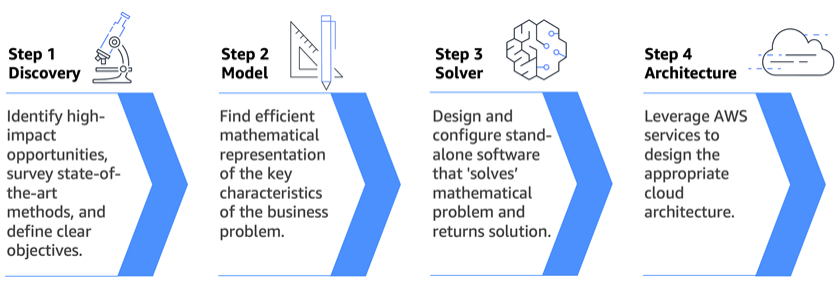
#optimization#decision-science#operations-researchmathematical-optimizationaws
💡了解如何結合 AI 與數學最佳化,以做出更卓越的資料驅動商業決策。
⚡ 30 秒速覽
有什麼變化
數學最佳化能解決複雜的基於約束的問題
為什麼重要
組織可以從預測性分析轉向規範性決策,從而大規模優化資源與營運。
下一步行動
找出您業務中高風險的營運瓶頸,並評估數學最佳化是否能取代基於啟發式的決策流程。
誰應關注:Enterprise & Security Teams
關鍵要點
- •數學最佳化能解決複雜的基於約束的問題
- •透過提供可執行的確定性決策來輔助機器學習
- •展示企業決策的實際應用案例
🧠 深度解析
背景與延伸:來自公開資料,非原文內容。引用 16 個來源。
🔑 增強重點摘要
- •The synergy between mathematical optimization and AI is evolving beyond traditional machine learning to include generative AI (GenAI), with enterprises increasingly experimenting with GenAI integration for tasks like model generation and natural language interfaces for optimization problems.
- •AWS facilitates mathematical optimization by providing scalable cloud infrastructure for running various commercial (e.g., CPLEX, Gurobi) and open-source solvers (e.g., COIN-OR LP, HIGHS, SCIP), and supports diverse approaches including reinforcement learning on Amazon SageMaker and quantum computing on Amazon Braket for Operations Research problems.
- •Mathematical optimization is becoming democratized through AI-powered platforms, enabling non-experts to interact with and interpret complex optimization problems using natural language, thereby lowering the barrier to entry for applying these techniques in real-world scenarios.
- •The AWS Generative AI Innovation Center leverages a multidisciplinary approach, combining expertise in AI, mathematical modeling, optimization, quantum computing, and high-performance computing to solve high-impact customer problems and deliver measurable business outcomes.
- •The integration of mathematical optimization with AI is leading to the development of 'decision intelligence platforms' and 'agentic AI' systems that combine reasoning, optimization, and data-driven actions to automate and enhance strategic and operational decision-making.
📊 競品分析▸ Show
| Feature / Platform | AWS (via SageMaker, Braket, Innovation Center) | Sedai | CAST AI | IBM Turbonomic |
|---|---|---|---|---|
| Core Focus | General-purpose mathematical optimization, OR, ML-optimization synergy, GenAI integration | Autonomous cloud optimization (cost, performance, reliability) | Kubernetes-focused cost optimization | Hybrid/multi-cloud resource optimization |
| AI/ML Integration | Deep integration with ML for 'predict-then-optimize', GenAI for model generation, RL, Quantum Computing | Machine learning to understand application behavior and evaluate tradeoffs | Machine learning to dynamically adjust nodes and workloads | AI models application demand & infrastructure supply |
| Optimization Scope | Broad, including supply chain, scheduling, resource allocation, complex constraint-based problems | Cloud cost, performance, and reliability across AWS, Azure, GCP, Kubernetes | Kubernetes node and workload efficiency, Spot instance usage | Cost-performance optimization across hybrid/multi-cloud |
| Automation Level | Provides tools and frameworks; Innovation Center offers custom solutions | Autonomous actions within safety guardrails (often 'copilot' mode in practice) | Automated cluster & workload efficiency | Automated actions within policy guardrails |
| Solvers/Algorithms | Supports commercial (CPLEX, Gurobi) & open-source (GLPK, CBC) solvers, genetic algorithms, linear/integer/nonlinear programming, quantum algorithms | Behavior-based resource rightsizing, headroom reduction | Node optimization, workload rightsizing | Demand modeling, automated scaling & placement |
| Pricing Model | Pay-as-you-go for underlying AWS services, custom engagement for Innovation Center | Subscription-based, often enterprise-focused | Subscription-based, enterprise-focused | Enterprise subscription model |
🛠️ 技術深入
- Solver Integration: AWS enables users to run various optimization solvers, including commercial ones like Gurobi and CPLEX, and open-source options such as COIN-OR LP (CLP), HIGHS, and SCIP.
- Cloud Infrastructure for Solvers: Customers can run optimization solvers on AWS by leveraging scalable compute resources and managed services. This includes using Amazon SageMaker Processing to build and deploy Docker images containing Python interfaces (e.g., Pyomo, PuLP) to connect with solvers.
- Algorithm Diversity: AWS supports a range of mathematical optimization algorithms, including linear programming, integer programming, nonlinear programming, and stochastic optimization. Genetic algorithms are also demonstrated for problems like optimal data orderings and subsets.
- Emerging Technologies for OR: Beyond traditional solvers, AWS explores reinforcement learning (RL) algorithms on Amazon SageMaker and quantum computing algorithms (e.g., D-Wave's QBSolv for Quadratic Unconstrained Binary Optimization (QUBO) problems) on Amazon Braket for Operations Research challenges.
- AI-Optimization Synergy: The approach often involves 'predict-then-optimize' pipelines, where machine learning models provide forecasts or predictions that are then fed into optimization models to make optimal decisions.
- Generative AI for Modeling: Large Language Models (LLMs) are being explored to assist in formulating mathematical optimization problems and generating optimization models, making expert-level optimization more accessible.
- Distributed Optimization: For large-scale AI systems, distributed optimization techniques like decentralized Stochastic Gradient Descent (SGD) and federated learning are crucial for training models efficiently across multiple devices and cloud platforms.
🔮 前景展望基於引用來源的 AI 分析
Mathematical optimization will become a cornerstone of 'decision intelligence platforms' and 'agentic AI' systems.
The increasing integration of optimization with generative AI and machine learning is leading towards autonomous systems that combine reasoning, optimization, and data-driven actions for comprehensive decision-making.
The accessibility of mathematical optimization will significantly increase for non-experts.
AI systems, particularly large language models, will act as co-pilots, enabling users to define and solve optimization problems through natural language interfaces, abstracting away complex coding.
Real-time optimization will become a standard capability across various industries.
AI's ability to process and learn from streaming data will make real-time optimization more feasible and accessible, benefiting dynamic environments like logistics, energy, and autonomous systems.
⏳ 時間線
1947
George Dantzig develops the Simplex method, a foundational algorithm for linear programming.
1984
Narendra Karmarkar introduces the interior-point method, significantly speeding up large-scale linear optimization.
2008
Gurobi Optimizer, a leading commercial mathematical optimization solver, is founded.
2021-02
AWS publishes guidance on solving numerical optimization problems using Amazon SageMaker Processing.
2021-09
AWS highlights emerging solutions for Operations Research, including ML algorithms on SageMaker and quantum computing on Amazon Braket.
2024-10
AWS discusses the integration of Operations Research optimization with generative AI, including LLMs for model generation.
📎 來源 (16)
Factual claims are grounded in the sources below. Forward-looking analysis is AI-generated interpretation.
📰
AI 週報
閱讀本週精選 AI 大事摘要 →
👉相關動態

AI 策展新聞聚合。所有內容版權歸原始發布者所有。
原始來源: AWS Machine Learning Blog ↗
每週電子報
每週一封,可隨時退訂。