Samsung's Risky Native Anti-Peep Screen
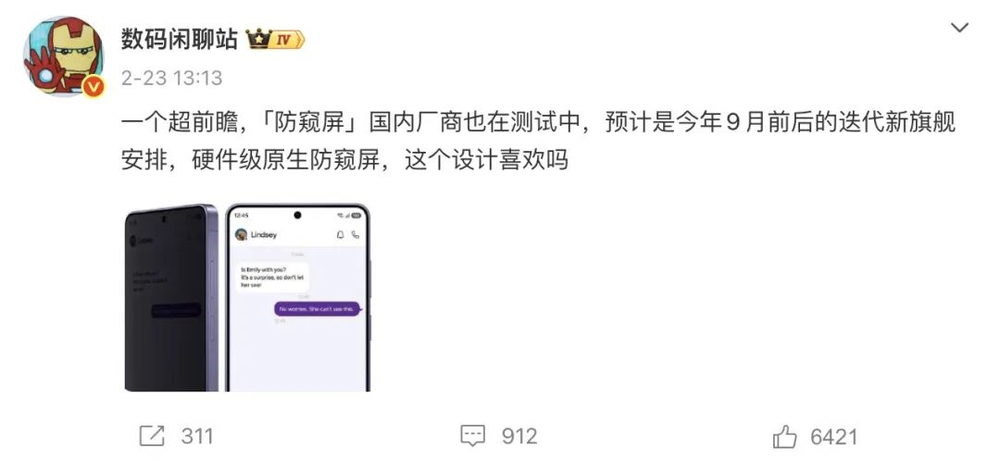
💡Samsung pixel privacy tech eyes Android std; impacts AI app security displays.
⚡ 30-Second TL;DR
What Changed
Full-screen or selective anti-peep blacks out at 25-30° side angles.
Why It Matters
May push privacy hardware standard in flagships, but eye strain and brightness drops could hinder mass adoption despite market-validated demand.
What To Do Next
Test Samsung Display SDK for integrating privacy modes in custom Android UIs.
Key Points
- •Full-screen or selective anti-peep blacks out at 25-30° side angles.
- •Granular control for apps, SMS codes, or keyboards only.
- •OLED sub-pixel optics and current tweaks limit light to frontal view.
🧠 Deep Insight
Background and context from public sources — not the original article. 6 sources cited.
🔑 Enhanced Key Takeaways
- •Independent testing by UL Solutions recorded a side-to-front brightness ratio of 3.5% at 45 degrees and 0.9% or lower at 60 degrees, outperforming typical smartphone screens that retain around 40% visibility at similar angles.[1][2]
- •Privacy Display uses second-generation Flex Magic Pixel technology, branded as LEAD 2.0, which enhances off-axis blocking and panel efficiency compared to the initial version.[1]
- •The technology re-engineers the Black Matrix into a multi-layer light-blocking structure to control light spread from subpixels just a few micrometers wide, paired with a polarizer-free OLED platform.[2]
🛠️ Technical Deep Dive
- •Flex Magic Pixel consists of Narrow pixels (active in privacy mode for forward light emission) and Wide pixels (minimized in privacy mode; fully active otherwise for omnidirectional light).[1][4]
- •Black Matrix is re-engineered as a multi-layer structure separating RGB subpixels to precisely limit light dispersion from each subpixel.[2]
- •LEAD 2.0 integrates Flex Magic Pixel with polarizer-free OLED for higher brightness, lower power use, and privacy control across top, bottom, and side angles.[1][2]
- •Maximum privacy mode intensifies effect by reducing bright areas and enhancing dark ones for stronger side blackout.[3][6]
🔮 Future ImplicationsAI analysis grounded in cited sources
⏳ Timeline
📎 Sources (6)
Factual claims are grounded in the sources below. Forward-looking analysis is AI-generated interpretation.
- sammobile.com — Galaxy S26 Ultra Privacy Display Excellent Score Independent Test
- androidauthority.com — Samsung Privacy Display Ul Solutions Verification 3644471
- TechCrunch — Samsung Shows Off New Display Tech That Adds a Privacy Screen to Apps and Notifications
- sammobile.com — Galaxy S26 Ultra Privacy Display Explained
- tomsguide.com — Samsung Galaxy S26 Ultra Has the Worlds First Privacy Display Heres How It Works
- youtube.com — Watch
Weekly AI Recap
Read this week's curated digest of top AI events →
👉Related Updates

AI-curated news aggregator. All content rights belong to original publishers.
Original source: 虎嗅 ↗
This is a summary, not the original. Read the source, or get the weekly briefing.
Weekly AI briefing
One email a week. Unsubscribe anytime.