Samsung Plans Floating AI Data Centers in Texas
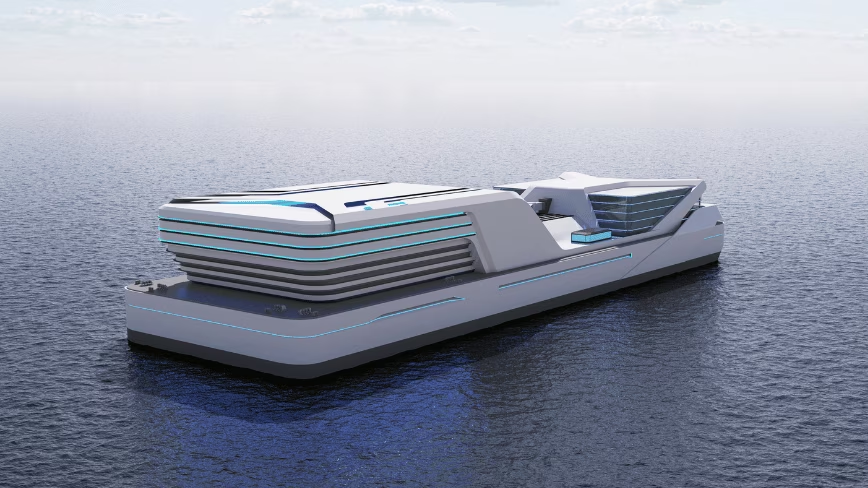
Samsung is turning floating AI data centers from a concept into an engineering project.
30-Second TL;DR
What Changed
Samsung Heavy Industries and Mousterian will design a moored floating data center.
Why It Matters
Floating facilities could give AI operators more flexibility in locating compute capacity, especially where land and water are constrained. However, grid access, mooring, cooling, maintenance, and permitting remain major deployment risks.
What To Do Next
Compare your next GPU deployment against floating and land-based options using power availability, cooling water, permitting, and network latency as evaluation criteria.
Key Points
- •Samsung Heavy Industries and Mousterian will design a moored floating data center.
- •Texas is expected to host the first project.
- •The approach targets land availability and data-center water consumption constraints.
Deep Insight
AI-generated analysis for this event — not the original article.
Enhanced Key Takeaways
- •The floating data center design utilizes seawater for cooling, significantly reducing the Power Usage Effectiveness (PUE) compared to traditional land-based facilities.
- •Mousterian specializes in modular, scalable data center architecture, which allows for rapid deployment and integration with existing offshore energy grids.
- •The project leverages Samsung Heavy Industries' expertise in shipbuilding and offshore platform stability to ensure the data center can withstand extreme weather conditions common in the Gulf Coast region.
- •Regulatory discussions are underway regarding the classification of floating data centers under maritime law versus terrestrial zoning laws in Texas.
- •The design incorporates advanced vibration-dampening technology to protect sensitive AI hardware, such as high-density GPU clusters, from wave-induced motion.
Competitor Analysis
- Samsung/Mousterian (Floating)
- Seawater / Closed-loop
- Nautilus Data Technologies (Floating)
- Seawater / Open-loop
- Traditional Land-Based Data Centers
- Air / Chilled Water
- Samsung/Mousterian (Floating)
- High (Modular)
- Nautilus Data Technologies (Floating)
- Moderate
- Traditional Land-Based Data Centers
- Low (Fixed)
- Samsung/Mousterian (Floating)
- Rapid
- Nautilus Data Technologies (Floating)
- Rapid
- Traditional Land-Based Data Centers
- Slow
- Samsung/Mousterian (Floating)
- Maritime Regulation
- Nautilus Data Technologies (Floating)
- Coastal Access
- Traditional Land-Based Data Centers
- Land/Power Availability
| Feature | Samsung/Mousterian (Floating) | Nautilus Data Technologies (Floating) | Traditional Land-Based Data Centers |
|---|---|---|---|
| Cooling Method | Seawater / Closed-loop | Seawater / Open-loop | Air / Chilled Water |
| Scalability | High (Modular) | Moderate | Low (Fixed) |
| Deployment Speed | Rapid | Rapid | Slow |
| Primary Constraint | Maritime Regulation | Coastal Access | Land/Power Availability |
Technical Deep Dive
- Cooling System: Employs a closed-loop seawater heat exchange system to minimize environmental impact on marine ecosystems.
- Structural Integrity: Utilizes semi-submersible platform technology derived from offshore oil and gas rigs to maintain stability in high-wind environments.
- Power Integration: Designed to interface directly with offshore wind farms or coastal grid substations to support high-density AI compute loads.
- Modular Architecture: Uses standardized ISO-container-sized modules for server racks, allowing for hot-swapping and incremental capacity upgrades.
Future ImplicationsAI analysis grounded in cited sources
Timeline
- 2025-03Mousterian announces initial research into modular offshore data infrastructure.
- 2025-11Samsung Heavy Industries identifies offshore data centers as a strategic growth area for maritime engineering.
- 2026-06Samsung Heavy Industries and Mousterian formalize the engineering partnership for the Texas project.
Weekly AI Recap
Read this week's curated digest of top AI events →
Related Updates


AI-curated news aggregator. All content rights belong to original publishers.
Original source: The Next Web (TNW) ↗
This is a summary, not the original. Read the source, or get the weekly briefing.
The weekly digest
One email a week. Unsubscribe anytime.