Samsung Launches World's First 4K 360Hz QD-OLED Display
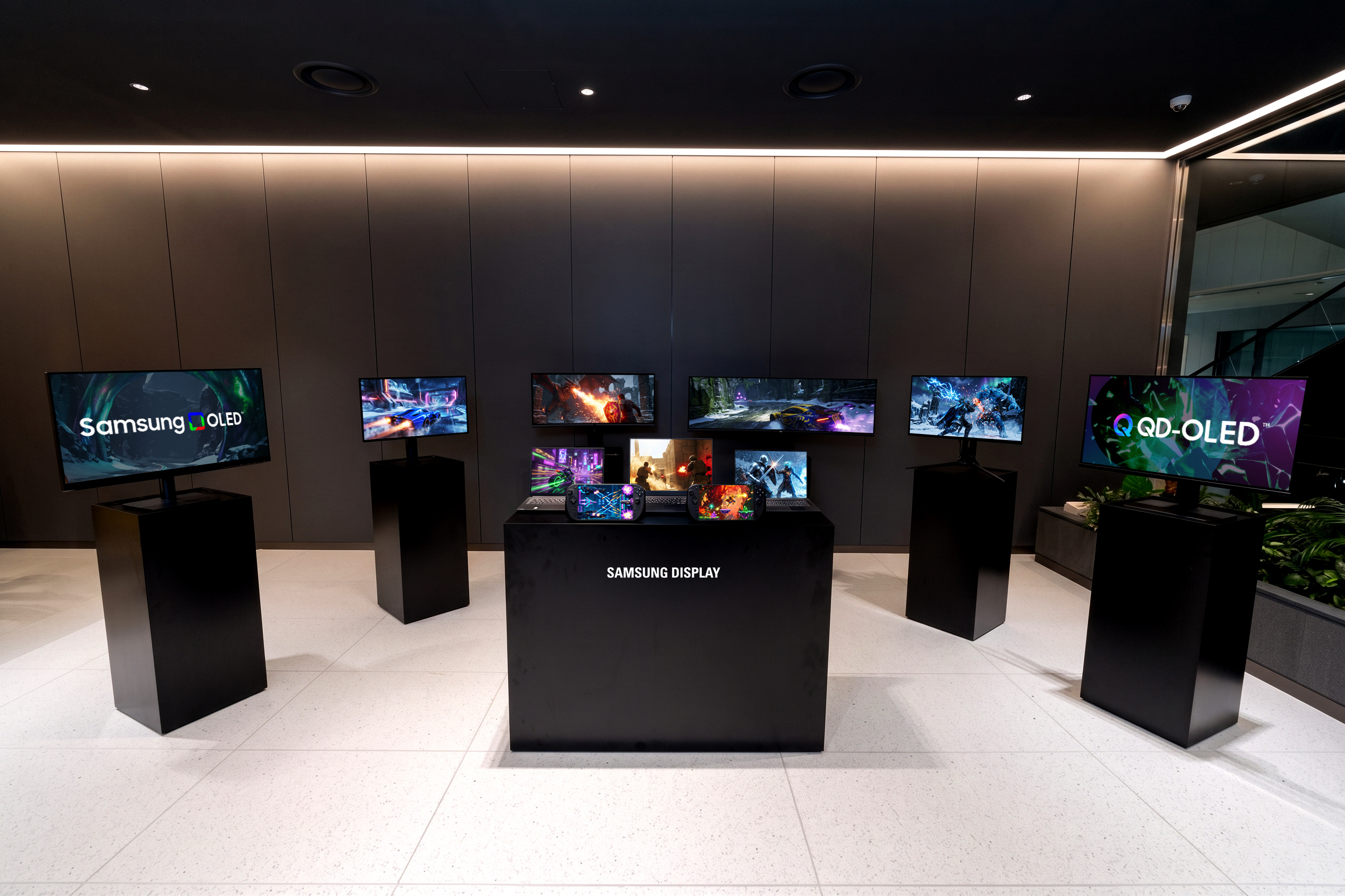
💡New display tech from Samsung sets a benchmark for high-performance visual hardware, critical for AI simulation workflow
⚡ 30-Second TL;DR
What Changed
Global debut of 4K 360Hz QD-OLED display
Why It Matters
High-refresh, high-resolution displays are essential for professional AI-assisted design and simulation environments requiring low-latency visual feedback.
What To Do Next
Evaluate whether your AI simulation or visualization software can leverage high-refresh-rate displays to improve real-time interaction latency.
Key Points
- •Global debut of 4K 360Hz QD-OLED display
- •Introduction of RGB Penta Tandem technology
- •Product range covers 8.8-inch to 49-inch sizes
- •New 'Ultra Slim' panel design for laptops
🧠 Deep Insight
Background and context from public sources — not the original article. 17 sources cited.
🔑 Enhanced Key Takeaways
- •The new 31.5-inch 4K 360Hz QD-OLED display features a 'Dual Mode' that allows users to switch to a Full HD resolution to achieve an even higher refresh rate of 680Hz, catering to competitive gaming scenarios.
- •Samsung's RGB Penta Tandem technology, which utilizes a five-layer blue OLED stacked structure, is claimed to improve luminous efficiency by approximately 1.3 times and potentially double the panel's lifespan compared to previous four-layer QD-OLED generations.
- •The new QD-OLED panel is certified with VESA DisplayHDR True Black 600, indicating a peak brightness of 600 nits and deep black levels of 0.0005 nits or lower, and incorporates a V-stripe pixel structure designed to enhance text readability.
- •Samsung Display's 'Ultra Slim' panel design for laptops achieves a thickness reduction of over 20% at the module's outer edge by etching both the Thin Film Transistor (TFT) substrate glass and encapsulation glass by more than 30%.
- •MSI has already confirmed a monitor, the MPG OLED 322URDX36, based on Samsung's new 4K 360Hz QD-OLED panel, which will debut at Computex 2026 and offers a 'Triple Mode' that includes a 1440p resolution at 520Hz in addition to the native 4K 360Hz and FHD 680Hz options.
📊 Competitor Analysis▸ Show
While specific pricing and detailed benchmarks for the newly announced Samsung 4K 360Hz QD-OLED panel are not yet available, a comparison can be made against existing high-end OLED gaming monitors from competitors based on announced specifications:
| Feature / Product | Samsung 31.5" 4K 360Hz QD-OLED (New) | ASUS ROG Swift OLED PG27UCDM (27" 4K QD-OLED) | Alienware AW2725Q (27" 4K QD-OLED) | MSI MPG 321URXW QD-OLED (32" 4K QD-OLED) | ASUS ROG Strix XG32UCWMG (32" 4K WOLED) |
|---|---|---|---|---|---|
| Panel Technology | QD-OLED (Penta Tandem) | QD-OLED | QD-OLED | QD-OLED | WOLED (Glossy) |
| Resolution | 4K (3840x2160) | 4K (3840x2160) | 4K (3840x2160) | 4K (3840x2160) | 4K (3840x2160) |
| Refresh Rate (Native) | 360Hz | 240Hz | 240Hz | 240Hz | 240Hz |
| Dual/Triple Mode | FHD 680Hz (Dual Mode) | N/A | N/A | N/A | FHD 480Hz (Dual Mode) |
| Peak Brightness (HDR) | VESA DisplayHDR True Black 600 (600 nits) | VESA DisplayHDR True Black 400/600 (typically 400-600 nits) | VESA DisplayHDR True Black 400/600 (typically 400-600 nits) | VESA DisplayHDR True Black 400/600 (typically 400-600 nits) | VESA DisplayHDR True Black 400/600 (typically 400-600 nits) |
| Pixel Structure | V-stripe RGB | Standard QD-OLED subpixel | Standard QD-OLED subpixel | Standard QD-OLED subpixel | RGB subpixel (LG WOLED) |
| Connectivity | DisplayPort 2.1 (UHBR20), USB-C (98W PD) (MSI implementation) | DisplayPort 1.4, HDMI 2.1 | DisplayPort 1.4, HDMI 2.1 | DisplayPort 2.1, USB-C | DisplayPort 2.1, HDMI 2.1, USB-C |
| Key Differentiator | First to combine 4K and 360Hz simultaneously | High-end 4K QD-OLED | Often more affordable 4K QD-OLED | Strong USB connectivity | WOLED panel, dual mode, glossy finish |
Note: Pricing for the new Samsung 4K 360Hz QD-OLED panel is not yet released, as it is a panel announcement. The MSI MPG OLED 322URDX36 is the first confirmed monitor using this panel.
🛠️ Technical Deep Dive
- RGB Penta Tandem Technology: This is a five-layer blue OLED stacked structure that utilizes the latest organic materials. It significantly boosts the efficiency, lifespan, and luminance of QD-OLED panels, leading to approximately 1.3 times higher luminous efficiency and potentially doubling the panel's lifespan compared to previous four-layer QD-OLED generations.
- Dual Mode Functionality: The 31.5-inch 4K 360Hz QD-OLED panel is the first QD-OLED to feature a dual-mode. This allows users to operate the display at its native 4K (3840x2160) resolution with a 360Hz refresh rate, or switch to a Full HD (1920x1080) resolution to achieve an ultra-high refresh rate of 680Hz.
- Optimized Panel Circuitry and Driving System: The simultaneous achievement of 4K resolution and a 360Hz refresh rate was made possible through an optimized panel circuitry and driving system, which handles the massive surge in pixel data processing per second.
- V-stripe Pixel Structure: The new panel incorporates a V-stripe pixel structure, which is designed to maximize text readability, a crucial improvement for both gaming and professional use.
- VESA DisplayHDR True Black 600 Certification: This certification confirms the display's ability to achieve a peak brightness of 600 nits and deep black levels of 0.0005 nits or lower, ensuring excellent contrast.
- Ultra Slim Panel Design: For laptops, Samsung Display developed an 'Ultra Slim' OLED panel by etching both the Thin Film Transistor (TFT) substrate glass and the encapsulation glass by more than 30%. This process reduces the module's outer-edge thickness by over 20% compared to existing mass-produced panels, while proprietary know-how resolves potential warping issues.
🔮 Future ImplicationsAI analysis grounded in cited sources
⏳ Timeline
📎 Sources (17)
Factual claims are grounded in the sources below. Forward-looking analysis is AI-generated interpretation.
Weekly AI Recap
Read this week's curated digest of top AI events →
👉Related Updates
AI-curated news aggregator. All content rights belong to original publishers.
Original source: cnBeta (Full RSS) ↗
This is a summary, not the original. Read the source, or get the weekly briefing.
The weekly digest
One email a week. Unsubscribe anytime.