Source虎嗅•Stalecollected in 20m
Samsung Exits China Appliances for AI Storage Goldmine
#memory-shortage#semiconductor-shift#ai-supply-chainsamsung-dramsamsungsk-hynixmicron
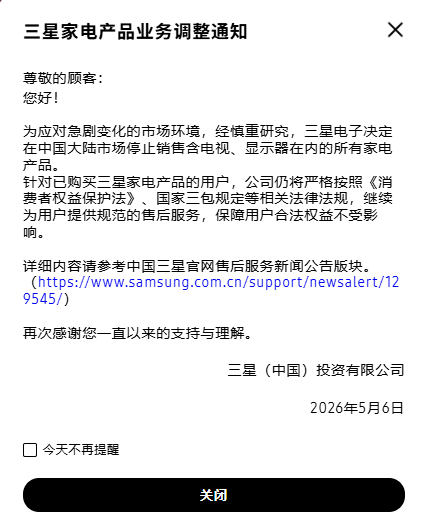
Samsung dumps low-margin appliances to ride AI memory shortage wave.
30-Second TL;DR
What Changed
Samsung ends sales of TVs, fridges, washers etc. in China
Why It Matters
Frees resources for AI infra; highlights storage as chokepoint, benefiting Samsung/SK Hynix over China entrants lacking scale.
What To Do Next
Monitor Samsung DRAM pricing for AI training cost forecasts in HBM alternatives.
Who should care:Enterprise & Security Teams
Key Points
- •Samsung ends sales of TVs, fridges, washers etc. in China
- •Appliance sales share <1-4%, vs 94% domestic brands
- •DS division Q1 profit 53.7T KRW vs 0.2T for appliances
- •Storage demand gap widens to 2027+ from AI servers
- •Samsung city value surges 4x to $1T in a year
Key numbers$11.4%65.7%
Deep Insight
AI-generated analysis for this event — not the original article.
Enhanced Key Takeaways
- •Samsung's strategic pivot aligns with the 'Samsung Semiconductor 2030' vision, which prioritizes high-bandwidth memory (HBM) and advanced packaging solutions over low-margin consumer hardware in saturated markets.
- •The exit from the Chinese appliance market follows a multi-year decline in local manufacturing footprint, with Samsung having already shuttered its last major home appliance factory in Suzhou by 2020.
- •The surge in valuation is heavily attributed to Samsung's dominance in the HBM3E and HBM4 supply chain, which are critical components for next-generation AI accelerators from major US hyperscalers.
Competitor Analysis
Market Focus
- Samsung (HBM/Storage)
- AI Server/Enterprise
- SK Hynix
- AI Server/Mobile
- Micron
- AI Server/Consumer
HBM Leadership
- Samsung (HBM/Storage)
- HBM3E/HBM4 (High)
- SK Hynix
- HBM3E (High)
- Micron
- HBM3E (Moderate)
Pricing Strategy
- Samsung (HBM/Storage)
- Premium/Supply-constrained
- SK Hynix
- Competitive/Volume-driven
- Micron
- Value-oriented
2026 Status
- Samsung (HBM/Storage)
- Market Cap Leader
- SK Hynix
- Aggressive Capacity Expansion
- Micron
- Capacity Scaling
| Feature | Samsung (HBM/Storage) | SK Hynix | Micron |
|---|---|---|---|
| Market Focus | AI Server/Enterprise | AI Server/Mobile | AI Server/Consumer |
| HBM Leadership | HBM3E/HBM4 (High) | HBM3E (High) | HBM3E (Moderate) |
| Pricing Strategy | Premium/Supply-constrained | Competitive/Volume-driven | Value-oriented |
| 2026 Status | Market Cap Leader | Aggressive Capacity Expansion | Capacity Scaling |
Technical Deep Dive
- HBM3E/HBM4 Architecture: Utilizes Through-Silicon Via (TSV) technology to stack DRAM dies, significantly increasing bandwidth while reducing power consumption per bit compared to traditional DDR5.
- Advanced Packaging: Implementation of I-Cube and H-Cube (2.5D/3D packaging) to integrate logic and memory dies, essential for reducing latency in AI training clusters.
- Storage Density: Transition to 300+ layer V-NAND technology to meet the massive capacity requirements of AI data centers, enabling higher storage density per rack unit.
Future ImplicationsAI analysis grounded in cited sources
Samsung will divest remaining non-core consumer electronics manufacturing assets in secondary markets by 2028.
The shift toward high-margin semiconductor dominance necessitates a leaner operational structure focused exclusively on high-growth AI infrastructure.
Global memory prices will remain elevated through Q4 2027 due to HBM supply constraints.
The massive capital expenditure required for HBM production limits the capacity available for traditional DRAM, creating a persistent supply-demand imbalance.
Timeline
2020-12
Samsung completes the closure of its Suzhou home appliance factory, signaling a shift in manufacturing strategy.
2023-05
Samsung announces a massive investment in HBM production capacity to meet surging AI demand.
2025-02
Samsung reports record-breaking profits in the DS (Device Solutions) division driven by AI-related memory sales.
2026-05
Samsung officially terminates all remaining home appliance sales operations in the Chinese market.
- 2020-12Samsung completes the closure of its Suzhou home appliance factory, signaling a shift in manufacturing strategy.
- 2023-05Samsung announces a massive investment in HBM production capacity to meet surging AI demand.
- 2025-02Samsung reports record-breaking profits in the DS (Device Solutions) division driven by AI-related memory sales.
- 2026-05Samsung officially terminates all remaining home appliance sales operations in the Chinese market.
Event Coverage
Weekly AI Recap
Read this week's curated digest of top AI events →
AI-curated news aggregator. All content rights belong to original publishers.
Original source: 虎嗅 ↗
This is a summary, not the original. Read the source, or get the weekly briefing.
The weekly digest
One email a week. Unsubscribe anytime.