Russia recruits students for wartime drone pilot training
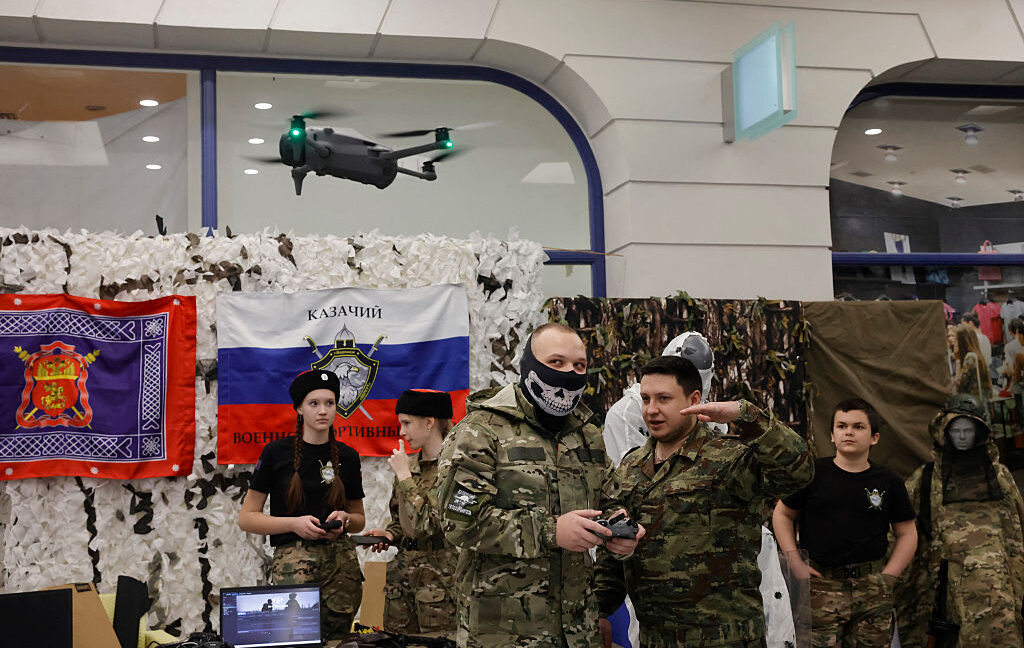
Understand the growing intersection of academic talent and military drone deployment in modern warfare.
30-Second TL;DR
What Changed
Universities are acting as recruitment hubs for military drone operators
Why It Matters
The integration of academic talent into military drone operations signals an escalation in the demand for specialized human-in-the-loop drone expertise in active conflict zones.
What To Do Next
Monitor the evolution of human-machine interface requirements in defense-related drone software development.
Key Points
- •Universities are acting as recruitment hubs for military drone operators
- •Incentives include special perks and promises of avoiding frontline combat
- •The initiative highlights the strategic shift toward autonomous and remote-piloted warfare
Deep Insight
Background and context from public sources — not the original article. 22 sources cited.
Enhanced Key Takeaways
- •Russia has established a dedicated "Unmanned Systems Forces" (USF) within its armed forces, formally recognizing the centrality of drone warfare and aiming to significantly expand its personnel to over 100,000 by spring 2026, with targets of 165,500 by the end of 2026 and 210,000 by 2030.
- •The recruitment drive extends beyond universities to include vocational colleges and even schoolchildren, with drone assembly and operation integrated into school curricula and textbooks, and national drone piloting championships planned for children as young as seven.
- •Incentives for student recruits are substantial, including annual payments potentially exceeding $87,000, free tuition, academic leave, combat veteran status, tax holidays, loan forgiveness, and even free land, though reports also suggest coercion and threats of expulsion for refusal.
- •Russia's drone strategy involves mass production of various types, including FPV drones, Molniya, Lancet, and Shahed-type (Geran) drones, with plans to produce 110,000 long-range drones in 2026, and is increasingly employing "mothership drones" and fiber-optic drones to extend range and bypass electronic warfare.
- •The Russian military is actively "ripping off" and copying Ukraine's drone force model, adapting its tactics, techniques, and procedures, and is also developing AI capabilities for drone swarms to control multiple FPV UAVs simultaneously and potentially shorten operator training.
Technical Deep Dive
- Drone Types:
- FPV Drones: Widely used, including for striking civilian targets and vehicles.
- Molniya Drones: Modernized with reduced cost (approx. $1,500), increased warhead (10 kg), and mass-produced (1.1 million ordered).
- Lancet Drones: High-tech fixed-wing strike drones.
- Shahed-type (Geran) Drones: Long-range strike drones, including jet-powered variants (Geran-3, Geran-4, Geran-5).
- Geran-3: Equipped with Chinese Telefly JT80 turbojet engine, cruising speed 300 km/h, max speed 370 km/h, range 1,000 km.
- Geran-4: Upgraded for higher speeds (up to 500 km/h), experimented with R-60 air-to-air missile.
- Geran-5: Described as a low-cost, compact cruise missile, speeds up to 600 km/h, range up to 1,000 km.
- Orlan-10 Drones: Used for reconnaissance and as "mothership drones" to transport FPV drones.
- Gerbera Drones: Long-range (300-600 km) drones, also used as mothership drones for FPVs.
- Operational Tactics & Technologies:
- Mothership Drones: Larger drones (e.g., Orlan, Gerbera) transport smaller FPV drones deeper into enemy territory, extending their range and overcoming EW interference.
- Fiber-Optic Drones: Introduced to bypass electronic warfare systems and extend operational range up to 50-60 kilometers, functioning as repeater drones.
- AI Capabilities: Reportedly combat-tested for drone swarms, allowing operators to control multiple FPV UAVs simultaneously and switch control in cruise mode to conserve battery, potentially shortening training time.
- Electronic Warfare (EW): Russian forces use mobile EW systems (e.g., Krasukha-4) to protect assets and jam enemy drones, and are expanding their use in border regions.
- Training Infrastructure: Schools are equipped with 3D printers, virtual reality headsets, and flight simulators for drone education.
- Production Targets: Russia plans to produce 110,000 long-range drones (60,000 strike, 50,000 decoy) in 2026, with a projected daily output of 455 drones by December 2026, potentially reaching 500 per day by early 2027. They also plan to produce 7.3 million FPV (first-person view) drones and 7.8 million combat unmanned aerial vehicle parts in 2026.
Future ImplicationsAI analysis grounded in cited sources
Timeline
- 2008Georgian War exposed shortcomings in Russia's drone fleet, prompting a prioritization of drone development.
- 2023President Vladimir Putin endorsed the inclusion of drone instruction in Russia's national school curriculum.
- 2024-05Russia's Minister of Science and Higher Education announced an ambitious plan to train one million drone specialists by 2030.
- 2025-11The Unmanned Systems Forces (USF), a dedicated branch for drone warfare, was officially established within the Russian Armed Forces.
- 2026-01The Russian government formally added drone assembly and operation to the school subject "Fundamentals of Homeland Security" (OBZR).
- 2026-01The Russian Defense Ministry launched a significant recruitment drive for its newly formed Unmanned Systems Forces, actively targeting university and college students.
Sources (22)
Factual claims are grounded in the sources below. Forward-looking analysis is AI-generated interpretation.
Weekly AI Recap
Read this week's curated digest of top AI events →
AI-curated news aggregator. All content rights belong to original publishers.
Original source: Ars Technica ↗
This is a summary, not the original. Read the source, or get the weekly briefing.
The weekly digest
One email a week. Unsubscribe anytime.