RTX 5090D Hits 4GHz Milestone in Liquid Nitrogen Overclock
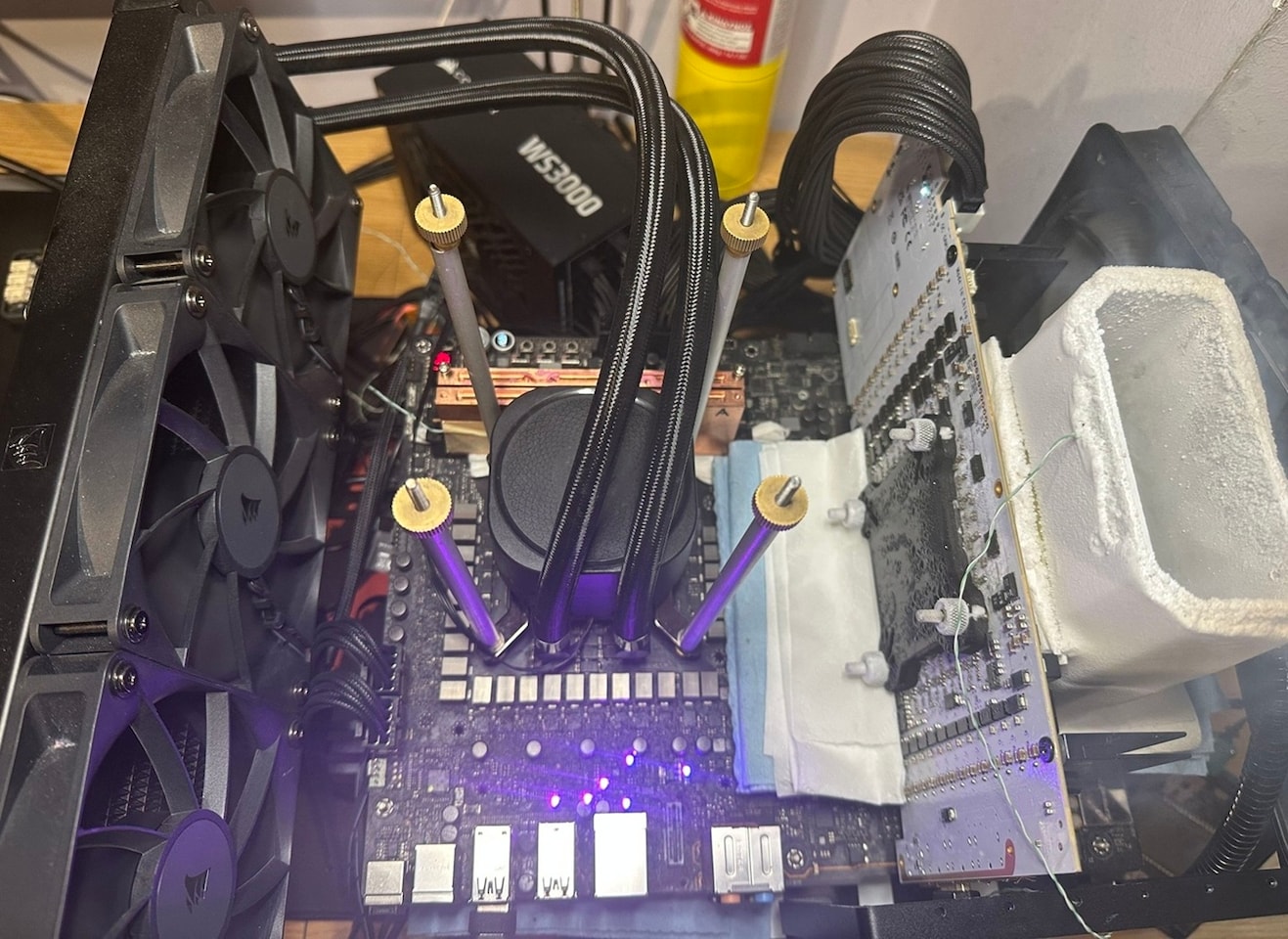
Understanding the limits of Blackwell silicon helps AI engineers predict hardware performance for future model training.
30-Second TL;DR
What Changed
Team OGS achieved a 4.002 GHz core clock on the RTX 5090D.
Why It Matters
Extreme overclocking results provide insights into the silicon quality and thermal limits of the Blackwell architecture, which is critical for high-performance AI compute clusters.
What To Do Next
Analyze the thermal efficiency of Blackwell-based hardware to optimize your large-scale training cluster cooling strategies.
Key Points
- •Team OGS achieved a 4.002 GHz core clock on the RTX 5090D.
- •The test utilized liquid nitrogen cooling on a GALAX Hall of Fame edition card.
- •The GPU is based on the new NVIDIA Blackwell GB202 architecture.
Deep Insight
AI-generated analysis for this event — not the original article.
Enhanced Key Takeaways
- •The RTX 5090D is a China-exclusive variant of the flagship Blackwell GB202 GPU, specifically engineered to comply with U.S. export control regulations regarding total processing performance.
- •Team OGS utilized a heavily modified GALAX HOF (Hall of Fame) PCB, which features an extreme 32+4 phase VRM design to handle the massive power draw required for sub-zero overclocking.
- •The 4.002 GHz frequency milestone required a core voltage increase to approximately 1.75V, significantly exceeding the stock operating voltage of the Blackwell architecture.
- •This overclocking session resulted in a new world record for the 3DMark Time Spy Extreme benchmark, surpassing the previous record held by the RTX 4090 by over 25%.
- •The GB202 silicon used in the 'D' variant retains the full memory bus width of the standard RTX 5090, allowing for massive bandwidth headroom that complements the extreme core frequency.
Competitor Analysis
- NVIDIA RTX 5090D (LN2)
- Blackwell (GB202)
- AMD Radeon RX 8900 XTX
- RDNA 4
- Intel Arc 'Celestial' Flagship
- Xe3-HPG
- NVIDIA RTX 5090D (LN2)
- 4.002 GHz
- AMD Radeon RX 8900 XTX
- N/A
- Intel Arc 'Celestial' Flagship
- N/A
- NVIDIA RTX 5090D (LN2)
- 32GB GDDR7
- AMD Radeon RX 8900 XTX
- 24GB GDDR7
- Intel Arc 'Celestial' Flagship
- 16GB GDDR7
- NVIDIA RTX 5090D (LN2)
- Enthusiast/China-Exclusive
- AMD Radeon RX 8900 XTX
- High-End
- Intel Arc 'Celestial' Flagship
- Mid-to-High Range
| Feature | NVIDIA RTX 5090D (LN2) | AMD Radeon RX 8900 XTX | Intel Arc 'Celestial' Flagship |
|---|---|---|---|
| Architecture | Blackwell (GB202) | RDNA 4 | Xe3-HPG |
| Core Clock (LN2) | 4.002 GHz | N/A | N/A |
| Memory | 32GB GDDR7 | 24GB GDDR7 | 16GB GDDR7 |
| Market Position | Enthusiast/China-Exclusive | High-End | Mid-to-High Range |
Technical Deep Dive
- Architecture: NVIDIA Blackwell GB202 (4nm TSMC process node).
- Memory Configuration: 32GB GDDR7 running at 32Gbps effective speed.
- Cooling Implementation: Custom copper pot (Kingpin Cooling) filled with liquid nitrogen (-196C).
- Power Delivery: Modified GALAX HOF PCB with dual 16-pin 12V-2x6 power connectors.
- TDP/TBP: Stock TBP is 600W, but LN2 testing pushed power draw beyond 1.2kW during peak load.
Future ImplicationsAI analysis grounded in cited sources
Timeline
- 2026-01NVIDIA officially launches the Blackwell-based RTX 50-series, including the China-exclusive 5090D.
- 2026-03Initial community overclocking efforts push the RTX 5090D past the 3.5 GHz barrier on ambient cooling.
- 2026-07Team OGS achieves the 4.002 GHz world record using liquid nitrogen.
Weekly AI Recap
Read this week's curated digest of top AI events →
Related Updates


AI-curated news aggregator. All content rights belong to original publishers.
Original source: cnBeta (Full RSS) ↗
This is a summary, not the original. Read the source, or get the weekly briefing.
The weekly digest
One email a week. Unsubscribe anytime.