Robot Software Prevents Joint Jams
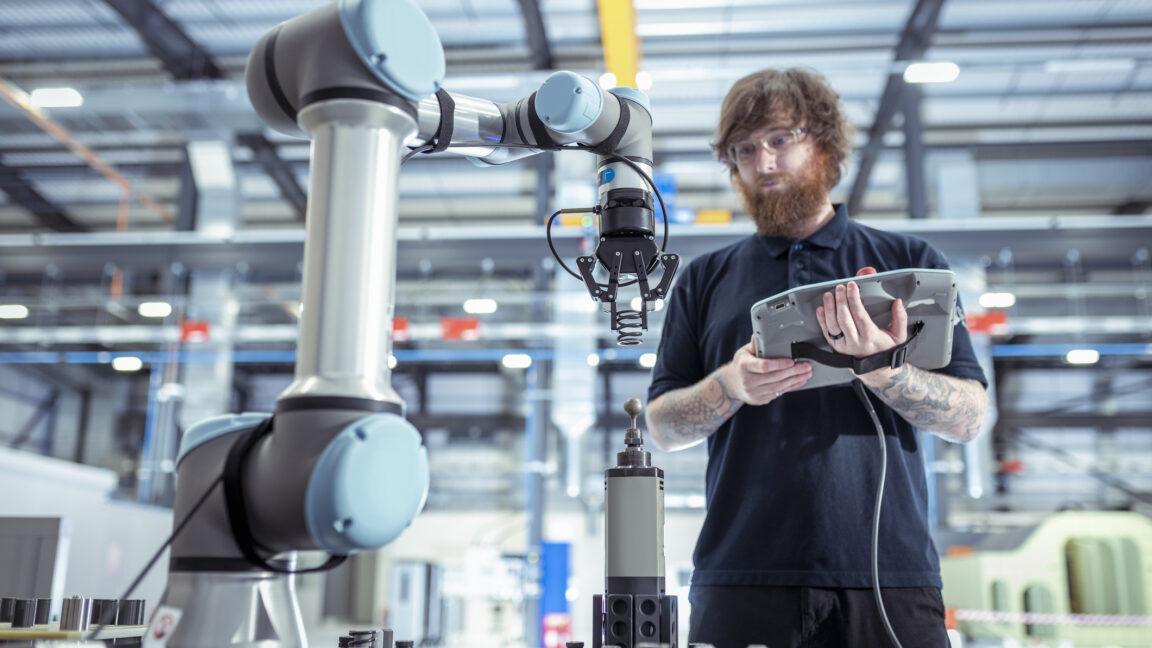
💡Hardware-agnostic robot learning prevents joint jams—key for embodied AI scalability.
⚡ 30-Second TL;DR
What Changed
Prevents joint jamming in robotic movements
Why It Matters
This software could enable scalable multi-robot systems in warehouses and manufacturing, reducing hardware-specific training needs. AI practitioners benefit from faster deployment of embodied AI fleets.
What To Do Next
Experiment with cross-hardware imitation learning in your robot sim like MuJoCo.
Key Points
- •Prevents joint jamming in robotic movements
- •Enables learning across robots with varying hardware
- •Facilitates knowledge transfer between heterogeneous robots
🧠 Deep Insight
AI-generated analysis for this event — not the original article.
🔑 Enhanced Key Takeaways
- •The software utilizes a 'Sim-to-Real' reinforcement learning framework that incorporates a differentiable physics engine to predict and mitigate torque-limit violations before they occur.
- •It employs a universal latent space representation, allowing heterogeneous robots—such as quadrupedal walkers and multi-DOF robotic arms—to map their unique kinematic constraints into a shared policy space.
- •The system reduces the need for manual safety-boundary programming by dynamically adjusting joint velocity profiles based on real-time sensor feedback from the robot's internal motor controllers.
🛠️ Technical Deep Dive
- •Architecture: Employs a Transformer-based policy network that processes proprioceptive data (joint angles, velocities, and torque feedback) as a sequence to predict future state stability.
- •Safety Mechanism: Implements a 'Safety Shield' layer that sits between the neural network policy and the motor controllers, enforcing hard constraints on joint torque and acceleration.
- •Cross-Platform Mapping: Uses a cross-modal encoder that translates the specific action space of a source robot (e.g., a 7-DOF arm) into the action space of a target robot (e.g., a 6-DOF arm) by normalizing the kinematic Jacobian matrices.
- •Training: Utilizes domain randomization in simulation to account for varying friction coefficients, payload weights, and motor backlash across different hardware platforms.
🔮 Future ImplicationsAI analysis grounded in cited sources
Weekly AI Recap
Read this week's curated digest of top AI events →
👉Related Updates
AI-curated news aggregator. All content rights belong to original publishers.
Original source: Ars Technica ↗
This is a summary, not the original. Read the source, or get the weekly briefing.
The weekly digest
One email a week. Unsubscribe anytime.