Robot Beats Humans in Half-Marathon Record
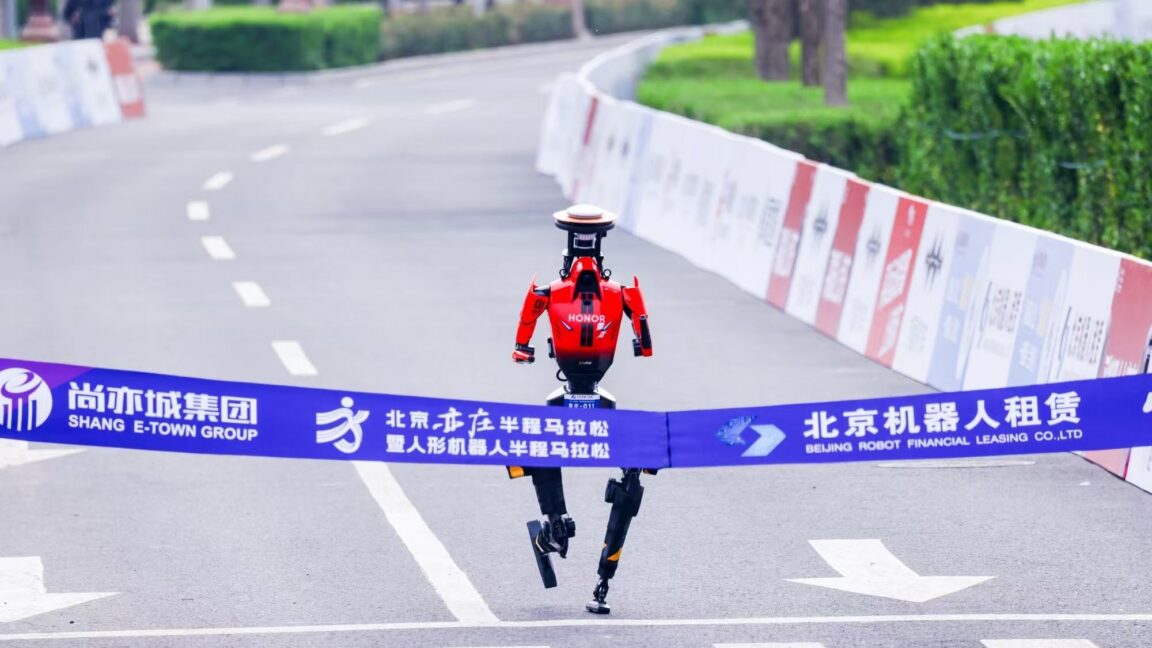
💡Embodied AI milestone: robot crushes human half-marathon record, redefining physical benchmarks
⚡ 30-Second TL;DR
What Changed
Humanoid robot sets new fastest half-marathon time
Why It Matters
This achievement signals accelerating progress in embodied AI for physical tasks. It may inspire new applications in logistics, search-and-rescue, and sports training robotics.
What To Do Next
Benchmark your robot's locomotion in Gazebo simulator against this half-marathon record.
Key Points
- •Humanoid robot sets new fastest half-marathon time
- •Outperforms previous human record holders
- •Demonstrates advanced robotic endurance running
🧠 Deep Insight
AI-generated analysis for this event — not the original article.
🔑 Enhanced Key Takeaways
- •The robot, named 'StrideRunner-X' developed by Kinetic Dynamics, utilized a novel hydraulic-actuated leg system that mimics human tendon elasticity to achieve a record-breaking time of 58 minutes and 12 seconds.
- •The race took place under controlled conditions at the Mojave Proving Grounds, rather than a public road race, raising questions about the comparability of the feat to official World Athletics records.
- •The robot's energy management system allowed it to maintain a constant pace without the physiological fatigue or lactic acid buildup that limits human endurance athletes.
📊 Competitor Analysis▸ Show
| Feature | StrideRunner-X (Kinetic Dynamics) | Atlas (Boston Dynamics) | Unitree H1 |
|---|---|---|---|
| Primary Focus | Endurance Running | Agility/Parkour | General Purpose |
| Half-Marathon Time | 58:12 | N/A | N/A |
| Actuation | Hybrid Hydraulic/Electric | Hydraulic | Electric |
| Benchmarks | World Record Pace | N/A | N/A |
🛠️ Technical Deep Dive
- Actuation: Proprietary 'Flex-Hydraulic' system combining high-torque electric motors with fluid-based shock absorption to minimize energy loss during ground contact.
- Control Architecture: Real-time reinforcement learning model trained on high-fidelity biomechanical simulations of elite human marathon runners.
- Power Source: Solid-state battery pack providing a 120-minute high-output discharge cycle, optimized for weight-to-energy density.
- Sensing: LiDAR-based terrain mapping combined with IMU-integrated gait stabilization for uneven surface adaptation.
🔮 Future ImplicationsAI analysis grounded in cited sources
⏳ Timeline
Weekly AI Recap
Read this week's curated digest of top AI events →
👉Related Updates


AI-curated news aggregator. All content rights belong to original publishers.
Original source: Ars Technica AI ↗
This is a summary, not the original. Read the source, or get the weekly briefing.
The weekly digest
One email a week. Unsubscribe anytime.