Robinhood Launches AI Agent for Automated Stock Trading
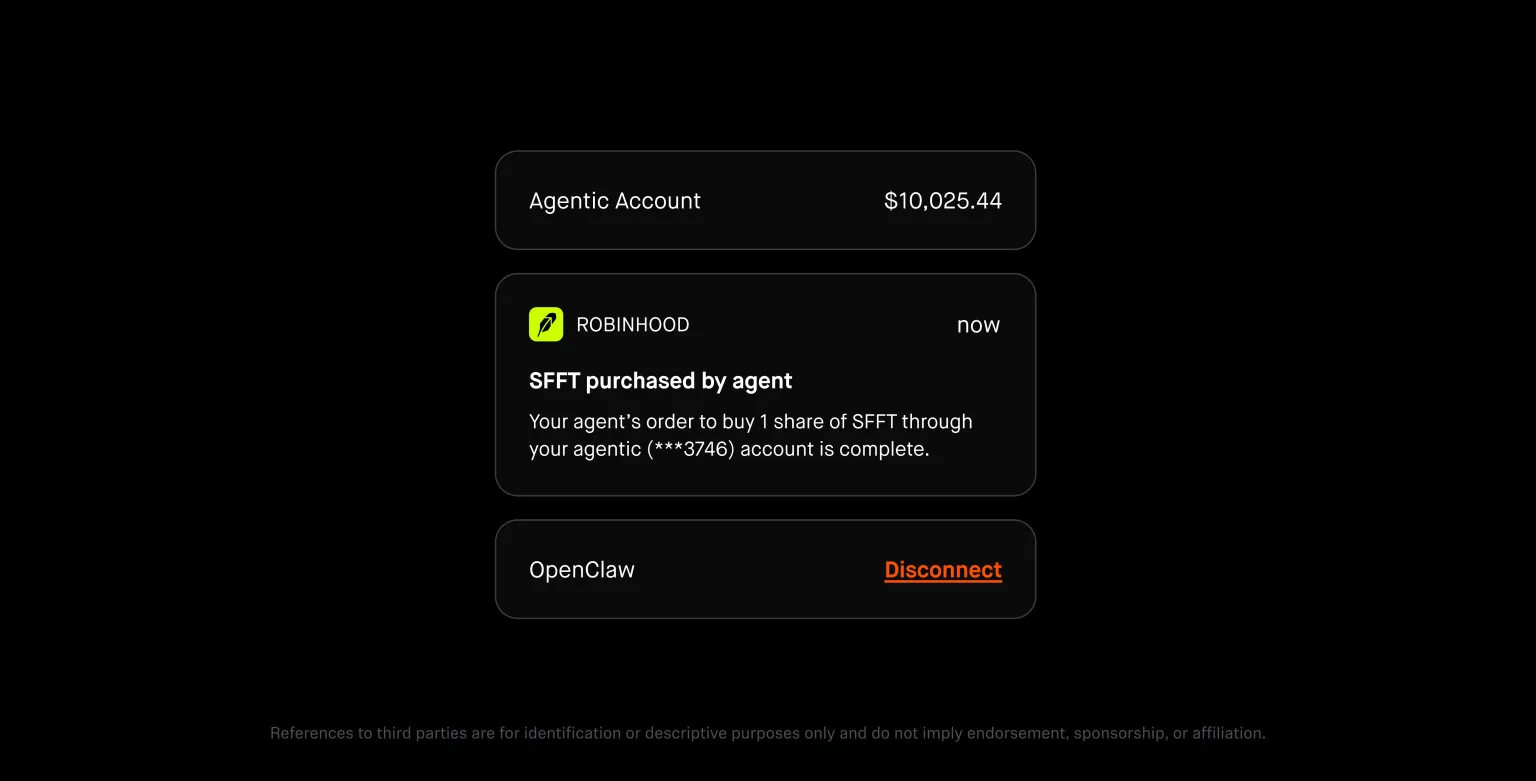
💡First major retail brokerage to integrate autonomous AI agents for direct market execution.
⚡ 30-Second TL;DR
What Changed
AI agents can analyze investment portfolios and generate strategies
Why It Matters
This represents a significant step in autonomous finance, allowing retail investors to deploy agents for systematic trading. It highlights the growing trend of 'agentic' workflows in fintech applications.
What To Do Next
Explore the Robinhood API documentation to understand how to integrate custom agent logic with their new dedicated wallet infrastructure.
Key Points
- •AI agents can analyze investment portfolios and generate strategies
- •Dedicated accounts and virtual cards for agent-based trading
- •Risk management via pre-funded wallet limits
🧠 Deep Insight
Web-grounded analysis with 19 cited sources.
🔑 Enhanced Key Takeaways
- •The AI agents can also make purchases using a dedicated virtual Robinhood Gold Card, which offers 3% cashback on agent-made purchases.
- •Users can connect their own third-party AI agents to the platform via Robinhood's proprietary Model Context Protocol (MCP) servers.
- •The 'Agentic Trading' feature is launching in a beta release and initially supports only equities trading, with plans to expand to options, cryptocurrencies, event contracts, and futures in future updates.
- •Users retain significant control through features like the ability to pause autonomous trading, preview trades, receive push notifications for every transaction, and set manual approval requirements for credit card purchases.
- •Robinhood frames this launch as an extension of its mission to 'democratize finance for all,' now encompassing AI agents.
📊 Competitor Analysis▸ Show
| Feature/Platform | Robinhood AI Agent (Agentic Trading & Credit Card) | Traditional Robo-Advisors (e.g., Betterment, Wealthfront) | AI Trading Bots/Platforms (e.g., Trade Ideas, TrendSpider, BulkQuant) | AI Financial Advisors (e.g., Whistl, Origin) |
|---|---|---|---|---|
| Core Function | Automated stock trading and virtual credit card payments by user-connected AI agents. | Automated portfolio management and rebalancing based on algorithms. | AI-assisted market analysis, signal generation, or automated execution of predefined strategies. | Comprehensive financial planning, personalized guidance, spending/saving behavior analysis. |
| Agent Autonomy | High (AI agents execute trades/payments within set limits), supports third-party agents. | Medium (algorithms manage portfolio, user sets risk profile). | Varies (from signals to full automation, often rule-based or user-defined). | Low (primarily advice, analysis, and recommendations; read-only for money movement). |
| Asset Classes | Equities at launch; plans for options, crypto, futures. | Diversified portfolios (ETFs, mutual funds). | Varies widely (stocks, crypto, forex, options, futures). | Broad financial assets for planning. |
| Payment Integration | Dedicated virtual credit card for AI agents with spending limits and cashback. | Generally none. | None directly for payments. | None directly for payments. |
| Risk Control | Dedicated pre-funded accounts, virtual card limits, manual approval options, instant disconnect. | Risk tolerance questionnaires, diversification, tax-loss harvesting. | Stop-loss, take-profit, position sizing (user-configured or bot-managed). | Financial modeling, scenario analysis, read-only access. |
| Target User | Early adopters of agent technology, users wanting to automate specific strategies and purchases. | Passive investors, those seeking diversified, hands-off investment management. | Active traders, quantitative traders, developers building custom strategies. | Individuals seeking holistic financial planning and behavioral coaching. |
🛠️ Technical Deep Dive
- The AI agent system connects via Robinhood's proprietary Model Context Protocol (MCP) servers, accessible at agent.robinhood.com.
- The platform is built on a microservice-based architecture hosted on Amazon Web Services (AWS), having evolved from a monolithic design.
- It utilizes Kubernetes orchestration and a sharded PostgreSQL data tier to ensure high throughput and reliability.
- Market data ingestion and distribution are handled separately from transactional systems, employing in-memory caches, streaming systems, and fan-out mechanisms for efficient, low-latency updates.
- Security measures include encryption of sensitive data, secure authentication flows, and two-factor authentication (2FA).
- The virtual credit card for AI agents is fully siloed, meaning it does not expose the user's primary Gold Card number or provide any pathway to other Robinhood account information.
- Robinhood explored generative AI solutions in 2023 and uses Amazon Bedrock for building its generative AI models, ensuring customer data remains within its virtual private cloud.
🔮 Future ImplicationsAI analysis grounded in cited sources
⏳ Timeline
📎 Sources (19)
Factual claims are grounded in the sources below. Forward-looking analysis is AI-generated interpretation.
Weekly AI Recap
Read this week's curated digest of top AI events →
👉Related Updates



AI-curated news aggregator. All content rights belong to original publishers.
Original source: cnBeta (Full RSS) ↗