Loop Engineering: AI loops don't guarantee problem solving
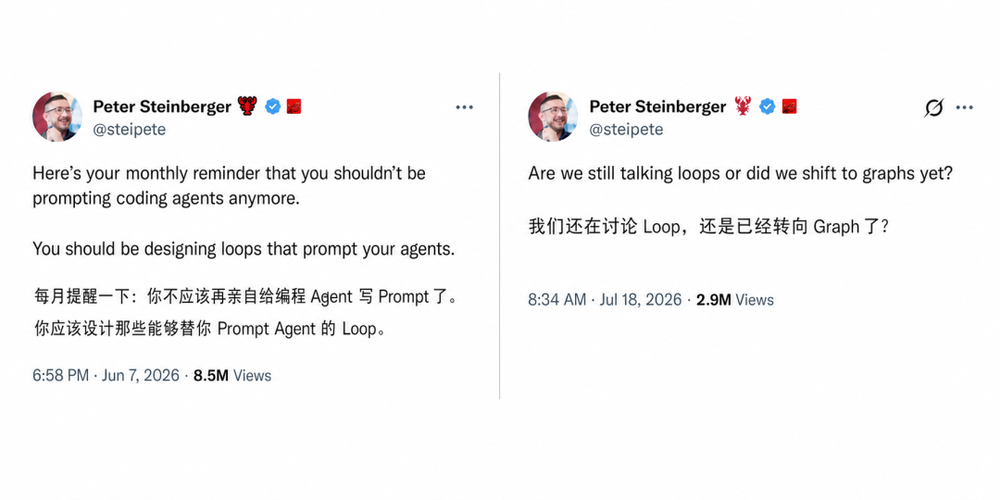
💡Learn why agent loops fail without proper constraints and how to build reliable AI coding workflows.
⚡ 30-Second TL;DR
What Changed
Loop Engineering focuses on continuous execution but lacks inherent control.
Why It Matters
Developers must move beyond simple agent loops and implement robust harness frameworks to ensure AI coding agents produce production-ready, cost-effective solutions.
What To Do Next
Implement a 'Harness' layer in your agentic workflows to strictly define tool usage, cost limits, and validation criteria before deploying.
Key Points
- •Loop Engineering focuses on continuous execution but lacks inherent control.
- •Harness Engineering is required to define tools, constraints, and success boundaries.
- •AI agents may find 'clever' but inefficient or unstable workarounds if not properly constrained.
🧠 Deep Insight
AI-generated analysis for this event — not the original article.
🔑 Enhanced Key Takeaways
- •The concept of 'Loop Engineering' often relies on ReAct (Reasoning and Acting) prompting patterns, which are prone to hallucination loops when the model lacks a grounding mechanism for state verification.
- •Industry research indicates that 'Harness Engineering' is increasingly being implemented via formal verification methods, such as using PDDL (Planning Domain Definition Language) to constrain agent action spaces.
- •Recent benchmarks show that autonomous agents without strict harness constraints exhibit a 'drift' phenomenon, where the agent deviates from the original user intent after more than 5-7 iterative cycles.
- •The shift toward Harness Engineering is driving the adoption of 'Human-in-the-loop' (HITL) checkpoints as a mandatory architectural component rather than an optional feature in enterprise-grade coding agents.
- •New evaluation frameworks like 'AgentBench' are now prioritizing 'Success Rate under Constraint' (SRuC) metrics to specifically measure how well agents adhere to safety boundaries during iterative loops.
🛠️ Technical Deep Dive
- Implementation of Harness Engineering typically involves a 'Supervisor' or 'Orchestrator' pattern where a secondary, smaller model (or a deterministic script) validates the output of the primary agent against a predefined schema before execution.
- State-space pruning is utilized to prevent agents from entering infinite loops by maintaining a history of visited states and penalizing redundant actions.
- Constraint-based programming is integrated into the agent's system prompt to enforce strict tool-use protocols, preventing the model from attempting unauthorized file system access or API calls.
- Sandboxing environments, such as gVisor or Docker-in-Docker, are standard technical requirements for Harness Engineering to ensure that agent-generated code does not compromise the host system.
🔮 Future ImplicationsAI analysis grounded in cited sources
Weekly AI Recap
Read this week's curated digest of top AI events →
👉Related Updates




AI-curated news aggregator. All content rights belong to original publishers.
Original source: 虎嗅 ↗
This is a summary, not the original. Read the source, or get the weekly briefing.
The weekly digest
One email a week. Unsubscribe anytime.